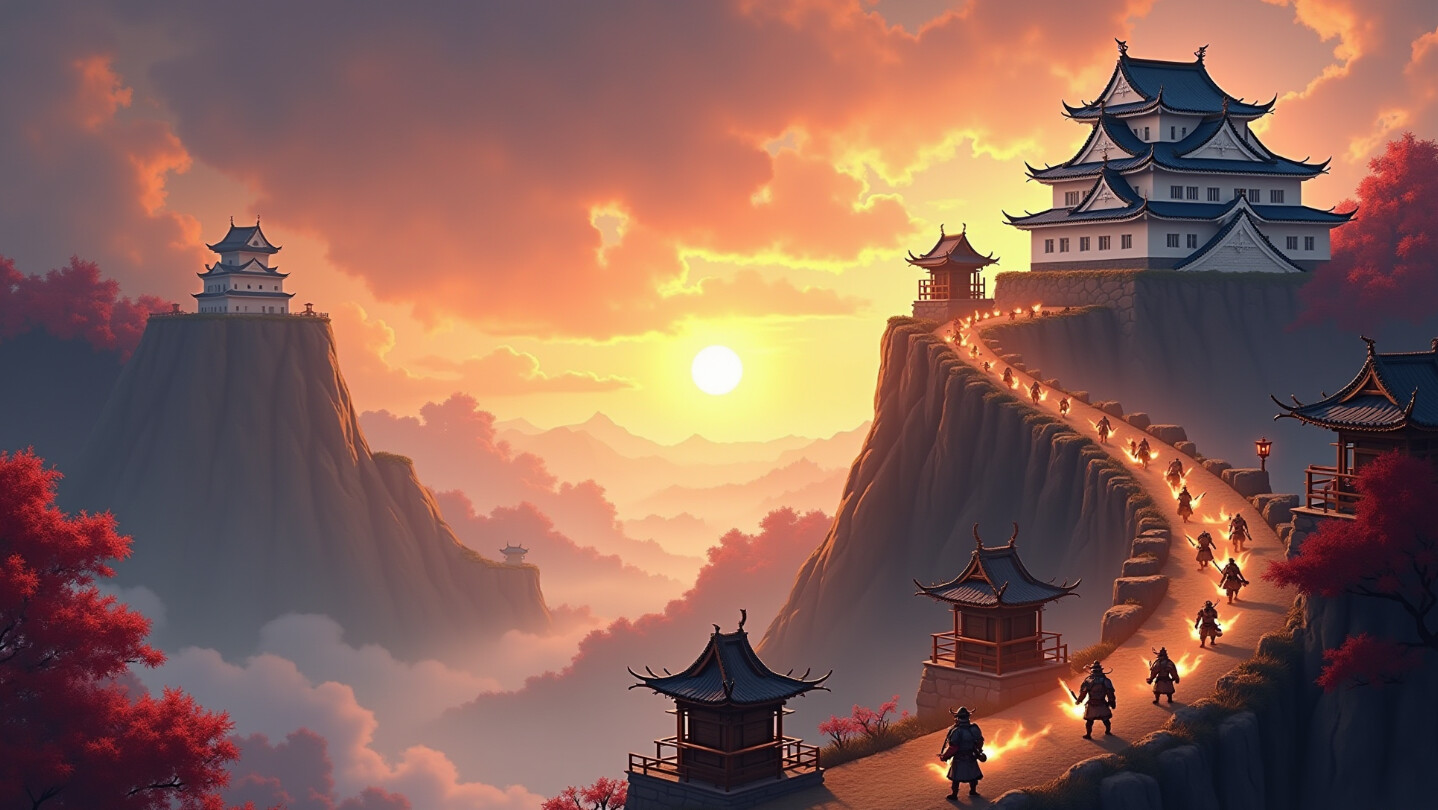

A round castle town: the keep at its centre, four seasonal wards around it, one rampart, four gates. You hold one ward; the rest lie under darkness until you last long enough. Four tower schools, eight fusion towers, free-form mazes, 1-4 player online co-op.

Connectez-vous pour ajouter cet article à votre liste de souhaits, le suivre ou l'ignorer

Français non disponible

Ce produit n'est pas disponible dans votre langue. Veuillez consulter la liste des langues disponibles ci-dessous avant de l'acheter.

Ce jeu n'est pas encore disponible sur Steam

Prochainement

Ce produit vous intéresse ? Ajoutez-le à votre liste de
souhaits et recevez une notification lors de sa sortie.
 

À propos de ce jeu

One round city, four wards

The keep stands on its hill at the exact centre. Four wards fan out around it like slices of a pie, wrapped by one unbroken curve of outer rampart with a gatehouse wherever a road passes through. Each ward keeps its own season — spring grass, summer sand, autumn woods, winter snow — all on the same map at once.

You start holding one ward. The other three lie under a dark shroud: you can make out the rooftops and the run of the streets, but not whether anything is moving in there. Survive twenty waves and a ward opens — the shroud lifts and its road opens with it, up to four roads attacking at once.

The roadsides still carry the last battle: burnt-out townhouses, breached walls, rubble, the charred skeleton of a watchtower. Some have burnt down to ash, some are still smoking, a few are still alight. This castle was not besieged out of nowhere — it has been held for a long time.

Hold the castle. Not one step back.

The enemy pours down the mountain road toward your castle. Four districts, four completely different tower schools: Sengoku arrows, cannons and warriors; the temple ballista, lithobolos and thunder god of Myth; Machine gatlings, mortars and lasers; Yokai bone bows, oni drums and foxfire. Each district builds only its own towers, unless you research an alliance and bring one tower from another school in as support.

Three ways to play

  • Campaign: ten waves, one castle. The place to start.
  • Endless: the map expands every ten waves and a new district with a new enemy route opens every twenty, up to four districts and four routes at once. Survive longer, climb the leaderboard.
  • Free Formation: no fixed road. Wall the enemy in with towers and turn the field into a maze; seal it completely and they will tear down the tower that blocks them most. Seven arenas, and each one changes the rules rather than just the backdrop. Highland Meadow is open ground where you must wall the whole path yourself, so it hands you +50% starting gold. Autumn Rockfield has already cut your chokepoints, so it takes 10% of that back and sends the fastest thing in the game at you in packs. Desert Rift has only two crossings to fund, and the lantern wisps simply fly over it. Snowfield Pillars is made for long mazes and pays +20% gold, except the ushi-oni ignores every slow. Lone Isle leaves you nowhere to fall back and only 10 lives. Sky Isle gives the least buildable ground and the most gold. Alpine Pass sends enemies through three passes at once for +80% gold, and its mud-lords shrug off rapid-fire towers. The first three are open from the start; the rest unlock at 10, 15, 20 and 25 waves survived. Each arena has its own preparation music.

Crowd control: knockback, stun, root, slow, freeze

Damage alone will not hold a line. A ranked cannon knocks splashed enemies back; the catapult dazes what it hits; the torii ward slows and roots at once; a water witch slows deeply; and every school has a control-pulse tower that pins everything in range where it stands every few seconds: the Sengoku Net Tower casts a great net, the Hellenic Gorgon Gaze petrifies with Medusa's stare, the Machina EMP Coil pulses fastest, the Yokai Frost Shrine simply freezes — same skeleton, different rank-up twists. How you combine them is up to you.

Ultimate arts: three weather events

Once a witch masters her element, her ultimate stops being a single blast and becomes seconds of weather. Fire brings a Firestorm, a tornado of flame that drags and burns everything inside. Lightning brings Heaven's Thunder, ten bolts striking one after another, each one stunning. Water brings a Blizzard that freezes the field, then slows deeply and shreds armor. Metal, Wood and Earth keep Iron Cleave, Vine Bind and Fissure.

Fusion, ranks and warlords

  • Fuse two towers into one: Arrow + Foxfire = Fire Arrow, Cannon + Torii = Seal Cannon, Sniper + Witch = Oracle Sniper… eight secret recipes, each with a full fusion ceremony.
  • Every level-up and rank-up has its own presentation: a level-up sweeps a golden ring from base to top, a rank-up opens a sigil on the ground, fires a pillar of light and bursts petals from the top. You paid for it; the screen tells you the tower just got stronger.
  • Fusing two of the same tower raises its rank; when that rank demands a choice — a witch's element, an arrow tower's shot style, a warrior's warlord — the choice stays yours.
  • Warrior towers summon a warlord with a seal when they rank up. Who answers is luck; reroll if it is not the one you wanted.
  • Hero towers walk onto the road, fight in melee and level up on experience.

Research and calamities

Three research trees — Science, Tactics, Defense. Spend crystals to upgrade labs and research points to unlock towers, support slots and passives. Deep in the Tactics tree wait three calamities: tornado, blizzard and earthquake. The earthquake collapses cliffs, and enemies will take the shortcut it opens, so your line has to move with it.

Enemies that do more than walk

Elites carry auras and charge skills; flying units like the Tengu wind up and charge across half the road. A boss marches at the head of its column — a rotating sigil underfoot, rising embers, a banner overhead — so you can pick it out of a crowd of escorts. The rank and file are not one silhouette in different colours: karakasa come in swarms, the nure-onna clings, the ushi-oni ignores every slow, the kamaitachi is the fastest thing on the field, the mud-lord shrugs off rapid fire, and the lantern ghost flies over rifts and splits into two smaller lanterns when it dies. Deeper in there is a second roster: the Yuki-onna walks in the column healing everyone around her, the Kasha runs burning and regenerates, the Nurikabe is a wall that walks, the Gaki come dozens at a time, the Karasu-tengu is a flying soldier in real armour, and the Hannya scatters into three Gaki when killed. Over twenty enemy types, each with its own model and walk animation. Which yokai you face depends on the arena you picked.

A different boss arrives every ten waves, five in rotation, each with its own model and its own answer. The Oni General is the handshake: hit it hard. The Tengu Warlord flies, so only anti-air reaches it, and at half health its wings break and it lands in heavy plate. The Jorogumo is immune to slows, which turns your wards and catapults into dead weight. The Bone General is heavily armoured, shrugs off stuns, and heals every escort around it. The Nine Tails drags down the fire rate of every tower in range — the slower you shoot, the further it walks. From the second boss on, each transforms when its health crosses a threshold, and the third form scatters into a pack of shades that charge the keep. Every wave is announced in advance — read it, then start, and start early for a bonus.

Giants on the road

Not bosses, but one of them fills half the road. The Gashadokuro is a four-metre skeleton: six thousand health, heavy armour, barely touched by stuns or slows, and it costs eight lives if it walks through. The Hellhound is a great dog cracked with lava: thick, fast, healed by its own fire, and it hunts in pairs. They arrive late in their wave, after the rank and file have already tied up your guns. Wherever a giant walks, that stretch of your defence belongs to it alone, and everything marching behind it slips past. That is the real threat.

1–4 player online co-op

Open a war council and give each player a district: their own towers, their own road, shared gold and research. In Free Formation co-op there are no districts — a seat means which tower school you play, and everyone builds anywhere. The council shows each player's Steam avatar and name, and if someone drops mid-match, AI takes over their seat. No typing and no voice — 32 samurai stickers in three rows (tactical, greetings, feelings) say "need help" faster than a sentence, and X or a right-click on the minimap raises one of four signals — Help, Watch, Focus fire, I hold here — as a coloured pillar and flag on the field and the same light on every teammate's minimap.

Alliance Quests and the Goblin Treasure Gang: co-op has one objective the whole team shares. Reach a combined kill count, and every seat must clear its own minimum, so one strong player cannot carry it alone. When it is done, the next wave opens with a Goblin Treasure Gang rushing down every road: thieves sprinting with sacks of loot on their backs, a chief hauling a whole chest. Each one pays five or six times a regular grunt and can drop ascension cores and crystals. They came to steal, not to siege, so letting one escape costs no lives. You just miss that sack.

The Merchant Guild: the co-op treasury is shared, so gold the front line does not need yet can be put to work. Three goods with three temperaments: Echigo rice is steady and pays a dividend, tamahagane steel always rises after a boss, and nanban imports boom and crash. Prices only move when a wave is cleared, so you see the price you buy at but never the next one. Prefer not to gamble? Bank it and collect interest every wave. The guild page never pauses the game: the fight goes on while you look, trade and leave.

And more

  • 26 achievements and Steam leaderboards. Endless, every Free Formation arena and every co-op mode keep their own board, and each entry records the tower school you played — so a Machine run on Alpine Pass is ranked against other Machine runs on Alpine Pass, not against everyone.
  • Auto-upgrade and AI autoplay can be toggled at any time — let them hold a district while your hands are full.
  • Opening and ending cinematics; four districts, four seasons of terrain and music.

Notification de contenu généré par IA

L'équipe de développement décrit l'utilisation de contenu généré par IA dans le jeu comme suit.

Generative AI tools were used during development, and every output was reviewed, edited and integrated by the developer. AI contributed to: parts of the code, the English translation and store copy, some tower and enemy 3D models and textures, UI icons, co-op stickers, title and loading screen illustrations, the opening and ending cinematics, the store key art, the promotional mascot, and the background music and some sound effects. Game design, levels, balance and overall direction were decided by the developer. Nothing is generated by AI while you play.

Configuration requise

    Minimale :
    • Système d'exploitation et processeur 64 bits nécessaires
    • Système d'exploitation : Windows 10 64-bit
    • Processeur : Intel Core i5-4460 or AMD equivalent
    • Mémoire vive : 8 GB de mémoire
    • Graphiques : GTX 960 / RX 570 or equivalent (Vulkan 1.1)
    • Espace disque : 1500 MB d'espace disque disponible
    • Notes supplémentaires : .NET 8 runtime bundled
    Recommandée :
    • Système d'exploitation et processeur 64 bits nécessaires
    • Système d'exploitation : Windows 11 64-bit
    • Processeur : Intel Core i5-10400 or AMD Ryzen 5 3600
    • Mémoire vive : 16 GB de mémoire
    • Graphiques : GTX 1660 / RX 5600 or equivalent
    • Espace disque : 1500 MB d'espace disque disponible
Filtres d'évaluations