


Heaps is a genre-defining sandbox game that builds the universe of you. In Heaps, your real world interests generate endless 3D worlds giving you the creative freedom to explore, discover and evolve. All in an environment designed by two neurospicy artists for interest-based nervous systems.

Sign in to add this item to your wishlist, follow it, or mark it as ignored

Coming Soon To Early Access

The developers of this game intend to release as a work in progress, developing with the feedback of players.

Note: Games in Early Access are not complete and may or may not change further. If you are not excited to play this game in its current state, then you should wait to see if the game progresses further in development. Learn more

What the developers have to say:

Why Early Access?

“Heaps was originally demoed live at the Gray Area Foundation's Cultural Incubator in 2025. That demo was, and still is, fully functional, with no major defects; but is seriously lacking in feature completion. Moreover, we got some great feedback at the show; but that feedback will require a complete re-write of large portions of the codebase. Everyone who saw Heaps at the demo expressed a lot of enthusiasm about getting to play with it now. Early Access allows us to balance the curiosity of these players with the need for a longer development timeline, and will allow us to shape its direction with player feedback.”

Approximately how long will this game be in Early Access?

“Ideally, 1-2 years. It will depend on how much interest there is in the game. Right now is a fraught time for anything with AI features. It might turn out no one wants to buy our game simply because it contains any AI at all. We hope that doesn't happen. We hope you'll check it out, see how we're using the technology, and that will change your mind.

We have authored an AI transparency labeling standard, called ARTS--the AI Rating Transparency System. This is an open-source system, published under a CC0 license, with which we plan to label all of our products so users understand exactly what they are buying. You can check it out at our website. Heaps will have an ARTS label, so you can look up the exact AI specifications of our game. We've also proposed ARTS as a standard to the California and New York Assemblies and Senates, the National Assembly of the Republic of Korea and the European Parliament. Hopefully you'll read Heaps' ARTS label and it will align with your values. If not, that's cool too. We designed ARTS to reinforce and support consumer choice.

To be perfectly honest, if we don't generate enough interest, it may be in Early Access longer than that. Alernatively, if more interest is generated than anticipated, and we get a lot of player feedback, that might also extend the timeline so that we can implement everything that players express interest in to a high degree of quality, so something more similar to say, Satisfactory, which was in Early Access for almost 6 years.
”

How is the full version planned to differ from the Early Access version?

“As currently designed, Heaps generates overhead maps. They are 3D, but flat, and navigated like a 2D interface in a god view from the camera. The overwhelming feedback from the Gray Area show was, "We want a character and we want to explore in 3D!" So that's the first major change. This means that entire level of each heap--these are essentially levels you create from your own files--will have to be re-written from scratch as a fully 3D procedurally generated level, rather than a flat one with tiles, as it currently is. And of course, we need to design and implement some sort of character, and all of the interface features that go along with that.

The second big change has to do with persistence and storage. For the demo, we just cheated this by reading and writing JSON files to disk. We plan to implement an entirely local SQLite3 database with full encryption and signing. This will enable us to safely store text in your database that we can mine procedurally to generate fun features in the game.

Speaking of encryption and signing, we also plan to sign our application and encrypt the local socket connection that the SLM uses to communicate from its C-back-compiled python server to the Unity binary. This is an important quality-of-life improvement we believe we need to make to improve the security of our product; otherwise, malware could potentially target that socket connection as an attack surface. It's unlikely, but we don't like to leave such things to chance.

After we refactor the map level of the game, we also need to implement the lower levels of navigation that allow you to enter individual objects within the heap, overlay and modify connections on the map, and much, much more. Heaps is intended to be a fully interactive knowledge map of the documents you feed it.

We also need to make a few changes to the python server running the SLM, because much better models have released since we first demoed the game, with faster performance and larger context windows. Currently, the state-of-the-art for this application seems to be Qwen 3.8, but that might change in the future.

The longest term feature we plan to add is knowledge gap analysis, wherein, having ingesting files into the game to build your heap, you can analyze it and the game will suggest further sources of knowledge to pursue on the same topic. That's a pretty blue-sky feature at the moment, so it's not much more than a note scribbled on a Post-It right now.

Here's a list of some other features we currently plan to add:

- "Concept creatures" that forage through the environment of your heaps.
- Crafting system to build tools you can use to analyze your heaps.
- Generative mission system with various mission types you can play.”

What is the current state of the Early Access version?

“The current state is that the map level of each heap is as far as you can navigate; navigation within a map is 2D from an overhead god view perspective; maps cannot be modified by the player, or explored in FPV perspective, and there is no gap analysis. Heaps saves are via JSON files. However, we do fully support a huge range of file types for ingestion:

Plain-text: txt | md

Other text formats: rtf | pdf | docx | doc | odt | tex (doc requires installation of Libre Office)

Spreadsheets: xls | xlsx| csv | ods

Presentations: ppt | odp

Images (OCR): jpg | png | gif (* requires installation of Tesseract OCR)

Miscellaneous: warc | epub | html

Code files: c | cc | cpp | h | cs | java | kt | kts | py | js | as | cls | fs | fsx |erl | hrl | wl | hs | lhs | sc | scala | lsp | lisp | clj | cljc | adb | ads | pas | pp | pl | f | for | f90 | f95 | f03 | php | rb | go | rs | dart | m | r | jl | mm | swift | cg | cginc | glsl | vert | frag | hlsl | shader | metal (* most encodings supported; legacy encodings like EBCDIC may not work)

Future types currently planned: srt | eml | mobi”

Will the game be priced differently during and after Early Access?

“We plan to gradually increase the price of the game as we roll out new features and improvements.”

How are you planning on involving the Community in your development process?

“We plan to stream weekly devlog sessions, and we are actively looking for volunteers to test specific private builds via Steam Playtest. We are also entirely open to your suggestions via our Community Page and socials about what features you want to see in Heaps. ”
Read more
This game is not yet available on Steam

Coming soon

Interested?
Add to your wishlist and get notified when it becomes available.
 

Report bugs and leave feedback for this game on the discussion boards

See all discussions

About This Game

Heaps lets you ingest files of your choosing from your computer: Anything from PDFs or text files to images; even spreadsheets and code files! A Small Language Model, running locally on your GPU, scrapes your files for concepts, clustering them into 3D neighborhoods that you can explore.

Build a Mycelial Network of Knowledge

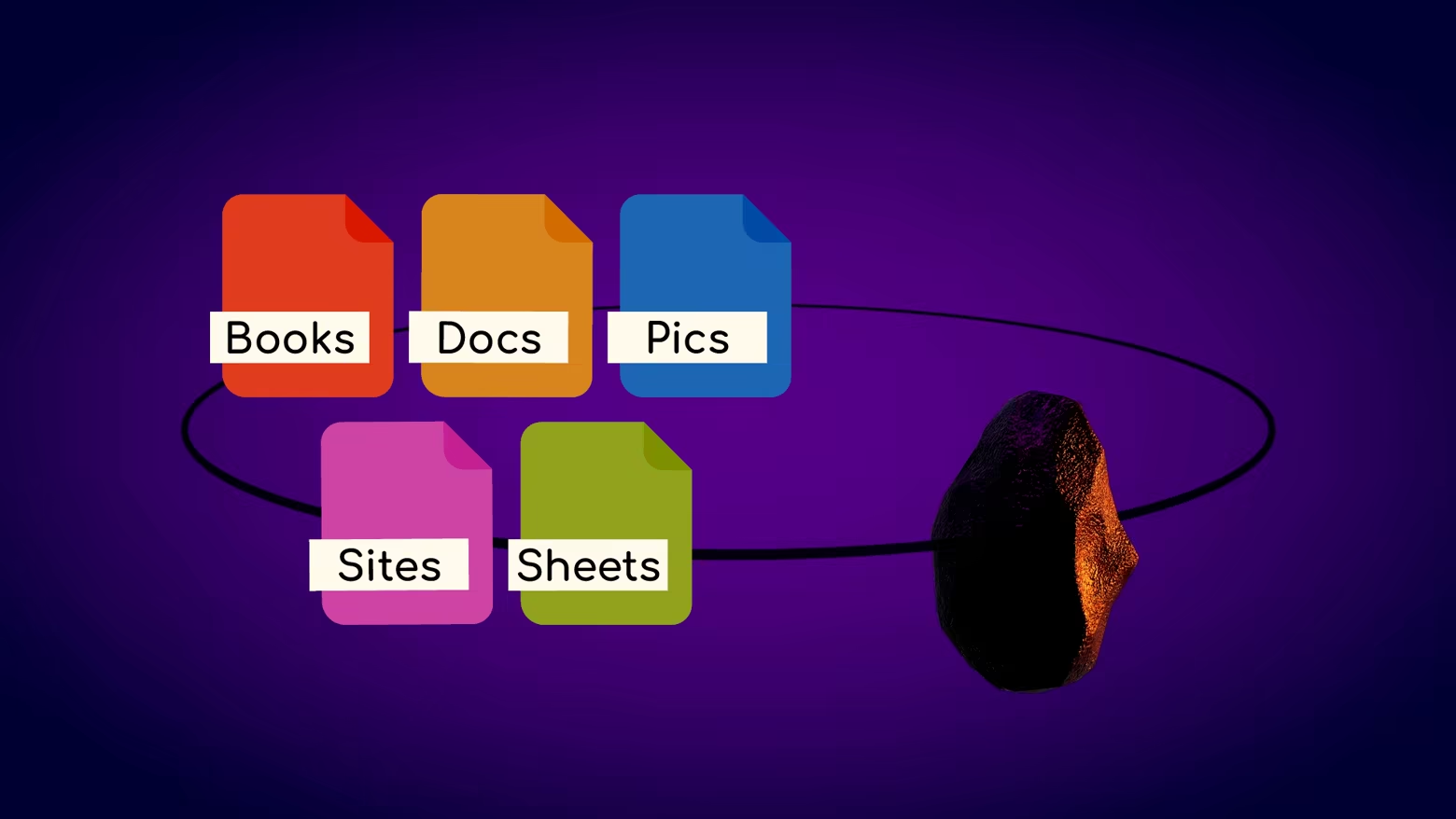
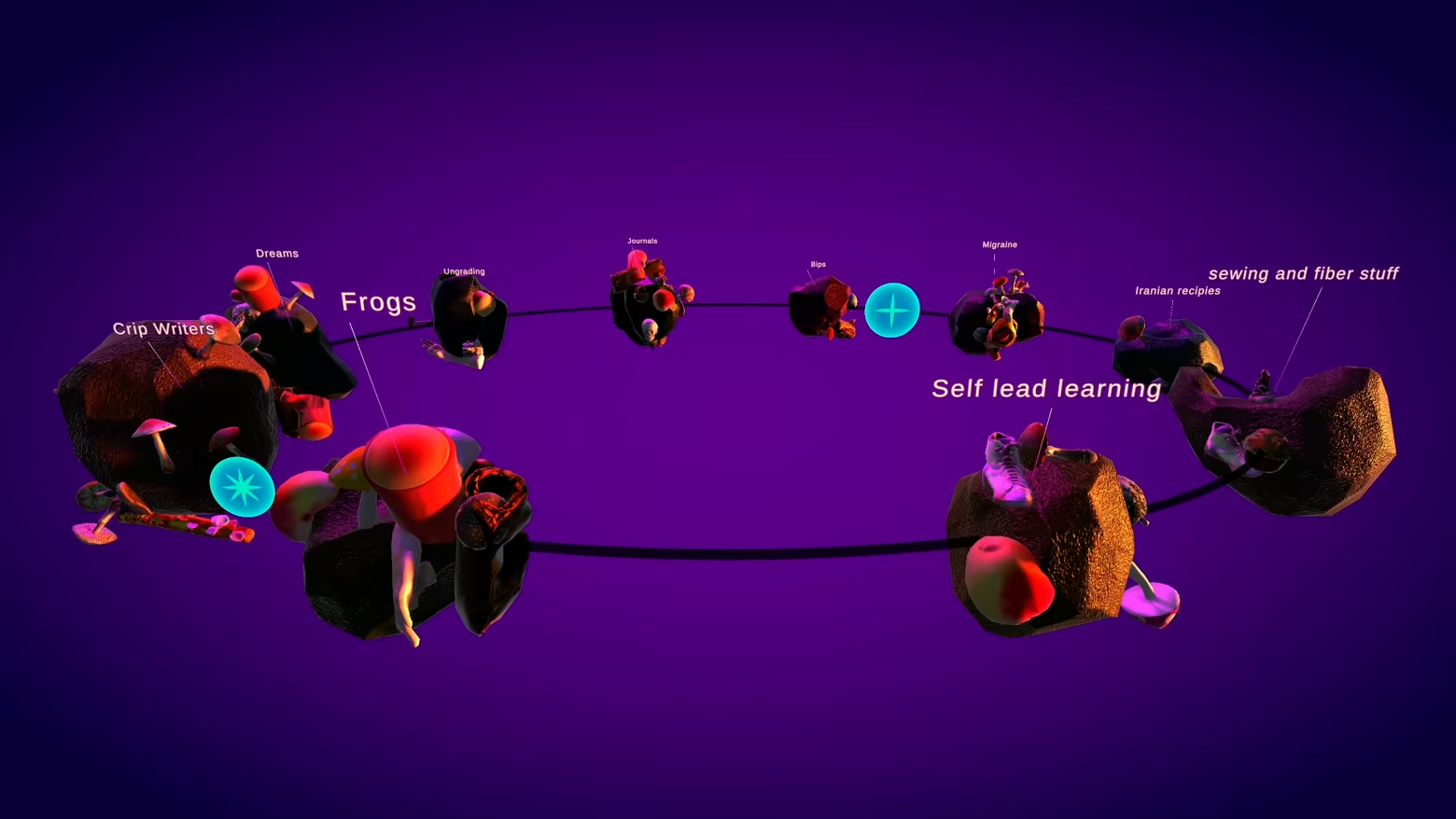
You start by creating a heap and feeding it some files (nom). We call this top level the universe ring:

Feeding your heap some files. The background is actual gameplay footage; the foreground graphics are just an abstract representation of some files.

Note: Heaps relies on several open-source freeware dependencies and python to pull this off, namely Ollama (no relation to Meta), LibreOffice (for your docs and Powerpoints) and Tesseract-OCR (to scrape text from images).

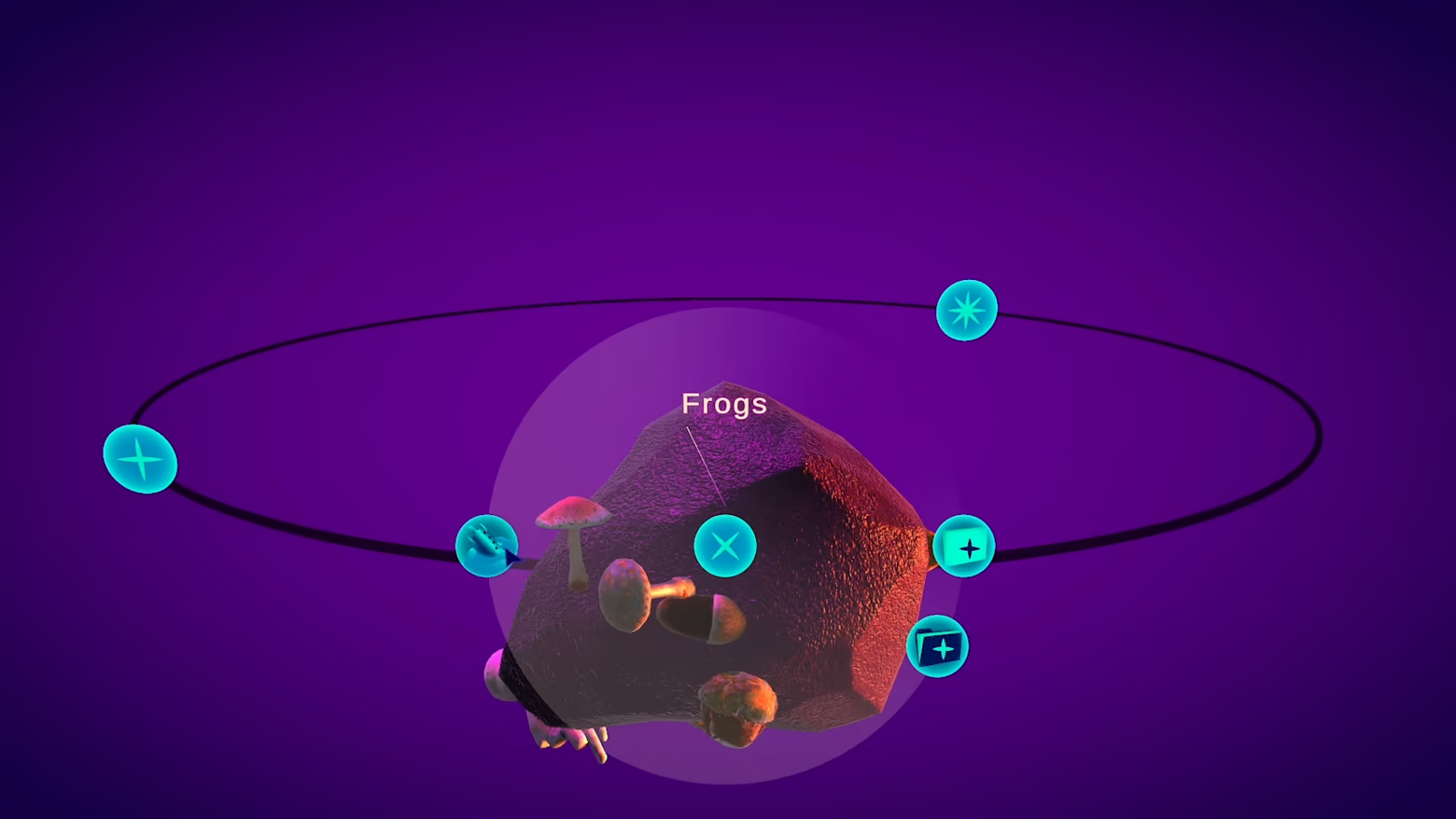
From this, Heaps will generate your heap. Let's say you really nerd out about frogs and created a heap from your copious collection of frog files. Once it has ingested all of those files, scraped and clustered the concepts, it will generate and persist your frog-based heap. Once it's finished, you can enter your heap and explore it:

Entering your heap. Frooaags!

Exploring your Heaps - Now and in the Future

The first time you enter a heap, its world is procedurally generated and automatically saved to disk:

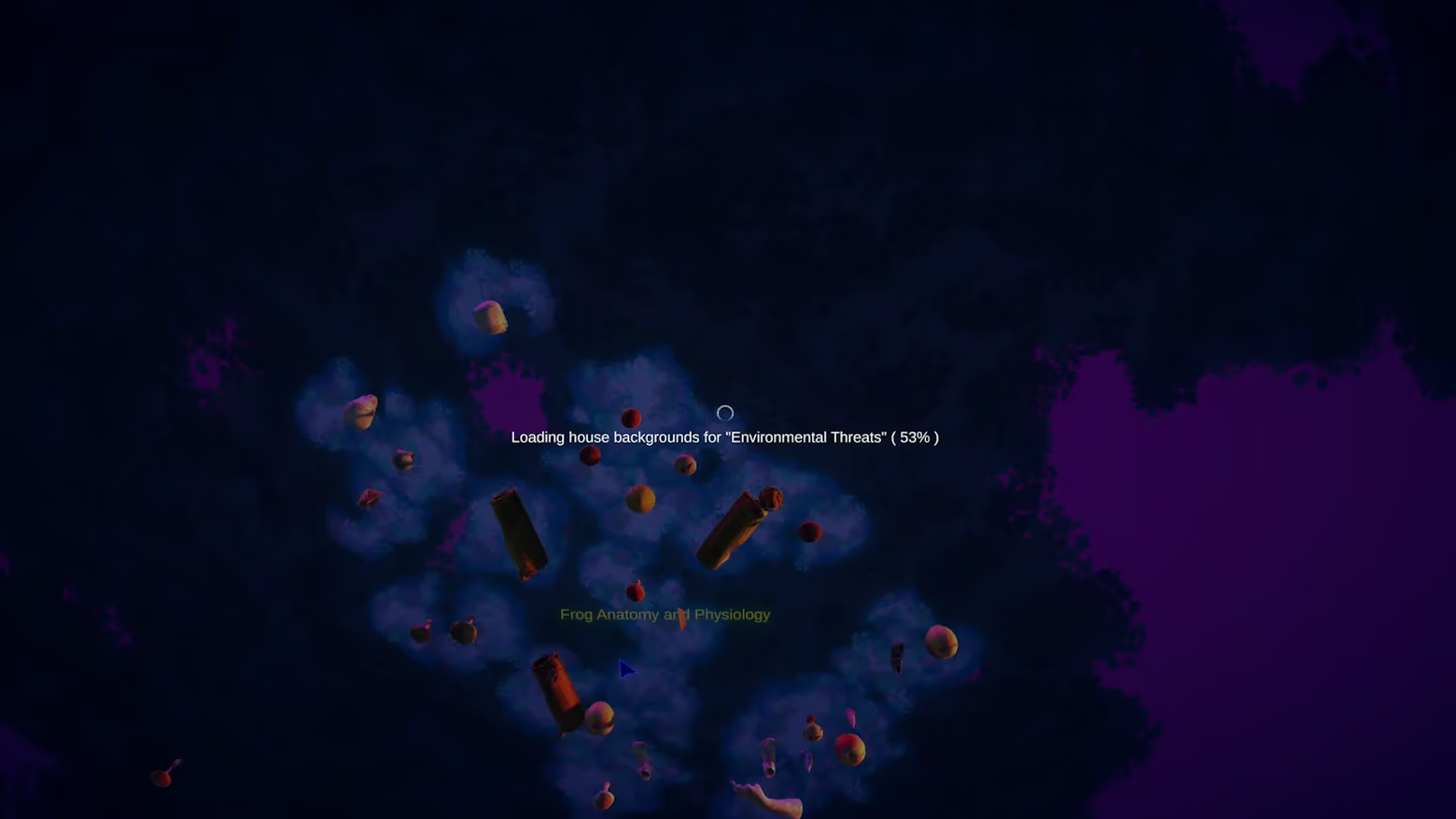
Generating FrogWorld.

Now you can explore your heap! In the future, your heaps will be fully interactive worlds you can explore in first-person perspective. Eventually there will be concept critters foraging through your heaps, missions, crafting and even the ability to modify your heaps!

You can have as many heaps as you want... within reason. We may have to add multiple rings or do something else with the interface if players really go nuts (which, let's face it, you probably will):

Your universe of personal knowledge heaps.

This is Heaps: what will you discover?

Droidknot Believes in Transparency

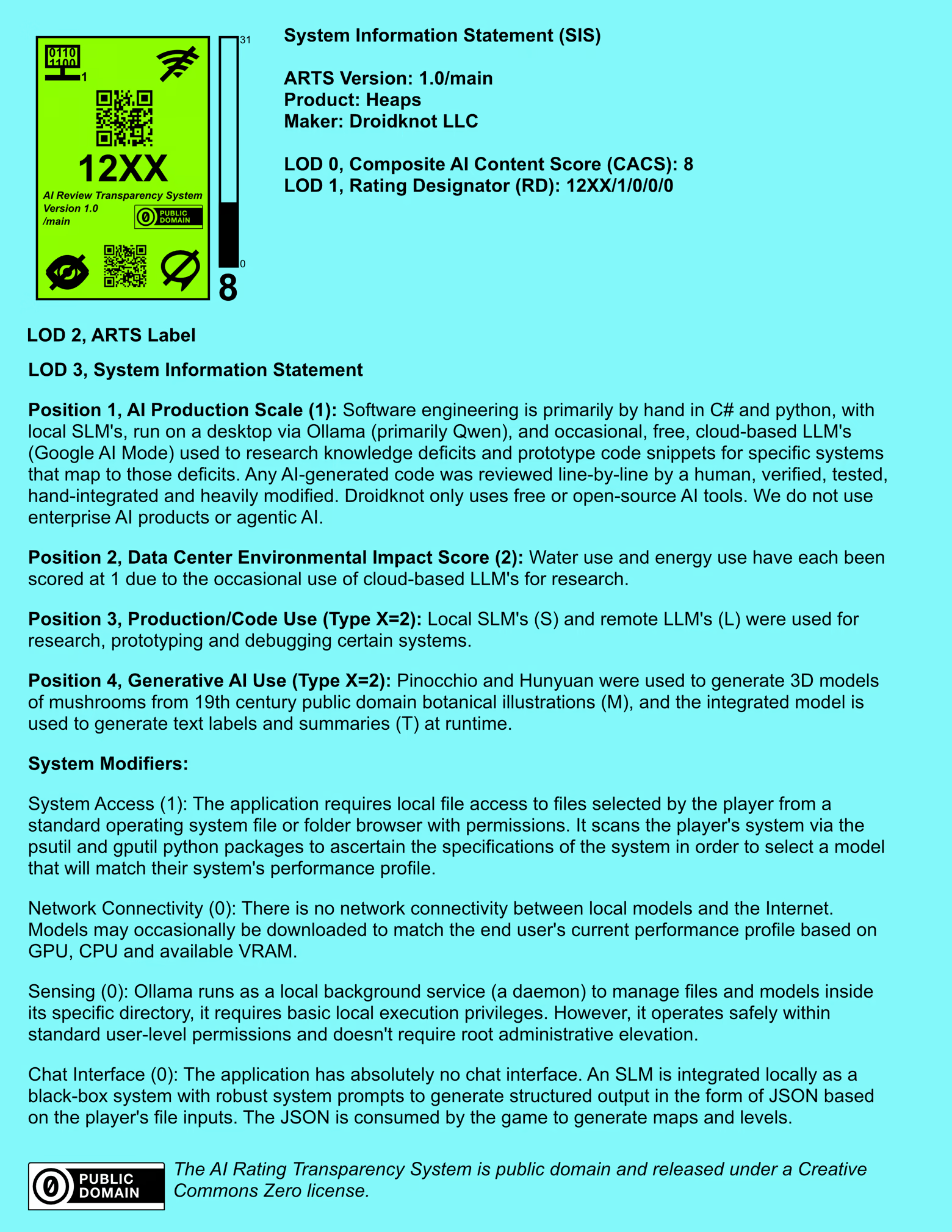
Heaps' SLM-powered content is labeled under the open-source ARTS standard, which we published under a CC0 license. You can link to Heaps' System Information Sheet hosted on our website via the smaller QR code on the bottom of the ARTS label. Scan the larger QR code at the top of the label to learn about the standard. We have included a copy of the System Information Statement below as well.

AI Generated Content Disclosure

The developers describe how their game uses AI Generated Content like this:

Software engineering is primarily by hand in C# and python, with local SLM's, run via Ollama, and occasional cloud-based LLM's used to research knowledge deficits and prototype code snippets for specific systems that map to those deficits. Any AI-generated code was reviewed line-by-line, hand-integrated and heavily modified.

The application requires local file access to files selected by the player from a standard operating system folder browser with permissions. It scans the user's system via the psutil and gputil standard python packages to ascertain the specifications of the user's system to select a model that will match their system's performance profile.

Pinocchio and Hunyuan were used to generate 3D models of mushrooms from 19th century public domain botanical illustrations, and the integrated SLM model is used to generate text labels and summaries at runtime.

The application has absolutely no chat interface. An SLM is integrated locally as a black-box system with robust system prompts to generate structured output in the form of JSON based on the player's file inputs. The JSON is consumed by the game to generate maps and levels.

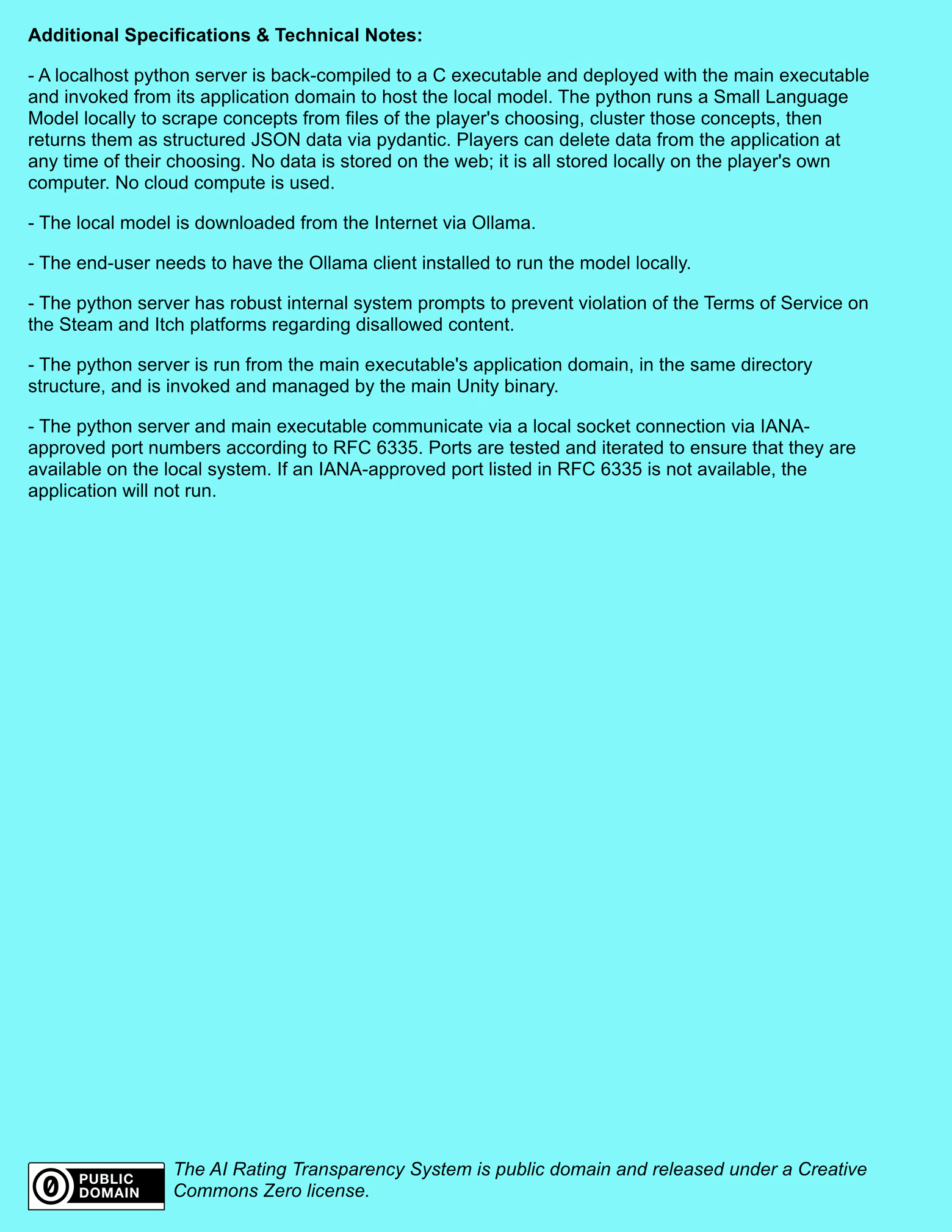
Additional Specifications & Technical Notes:

- A localhost python server is back-compiled to a C executable and deployed with the main executable and invoked from its application domain to host the local model.

- The local model is downloaded from the Internet via Ollama.

- The end-user needs to have the Ollama client installed to run the model locally.

- The python server has robust internal system prompts to prevent violation of the Terms of Service on the Steam and Itch platforms regarding disallowed content.

- The python server is run from the main executable's application domain, in the same directory structure.

- The python server and main executable communicate via a local socket connection via IANA-approved port numbers according to RFC 6335. Ports are tested and iterated to ensure that they are available on the local system. If an IANA-approved port listed in RFC 6335 is not available, the application will not run.

Heaps adheres to the ARTS standard for AI labeling. A full accounting of our use of AI in this game can be found at:

droidknot.com/ARTS/Heaps_SIS_082726.pdf

System Requirements

    Minimum:
    • Requires a 64-bit processor and operating system
    • OS: Windows 10
    • Processor: Intel Core i7 6770HQ @ 2.60GHz
    • Memory: 8 GB RAM
    • Graphics: 2x Nvidia GTX 980 Ti or 1x Nvidia RTX 2080 Ti
    • Storage: 40 GB available space
    Recommended:
    • Requires a 64-bit processor and operating system
    • OS: Windows 11
    • Processor: Intel Core i9-10980XE @ 3.00GHz
    • Memory: 64 GB RAM
    • Graphics: Nvidia RTX 4090
    • DirectX: Version 12
    • Network: Broadband Internet connection
    • Storage: 200 GB available space
Review Filters