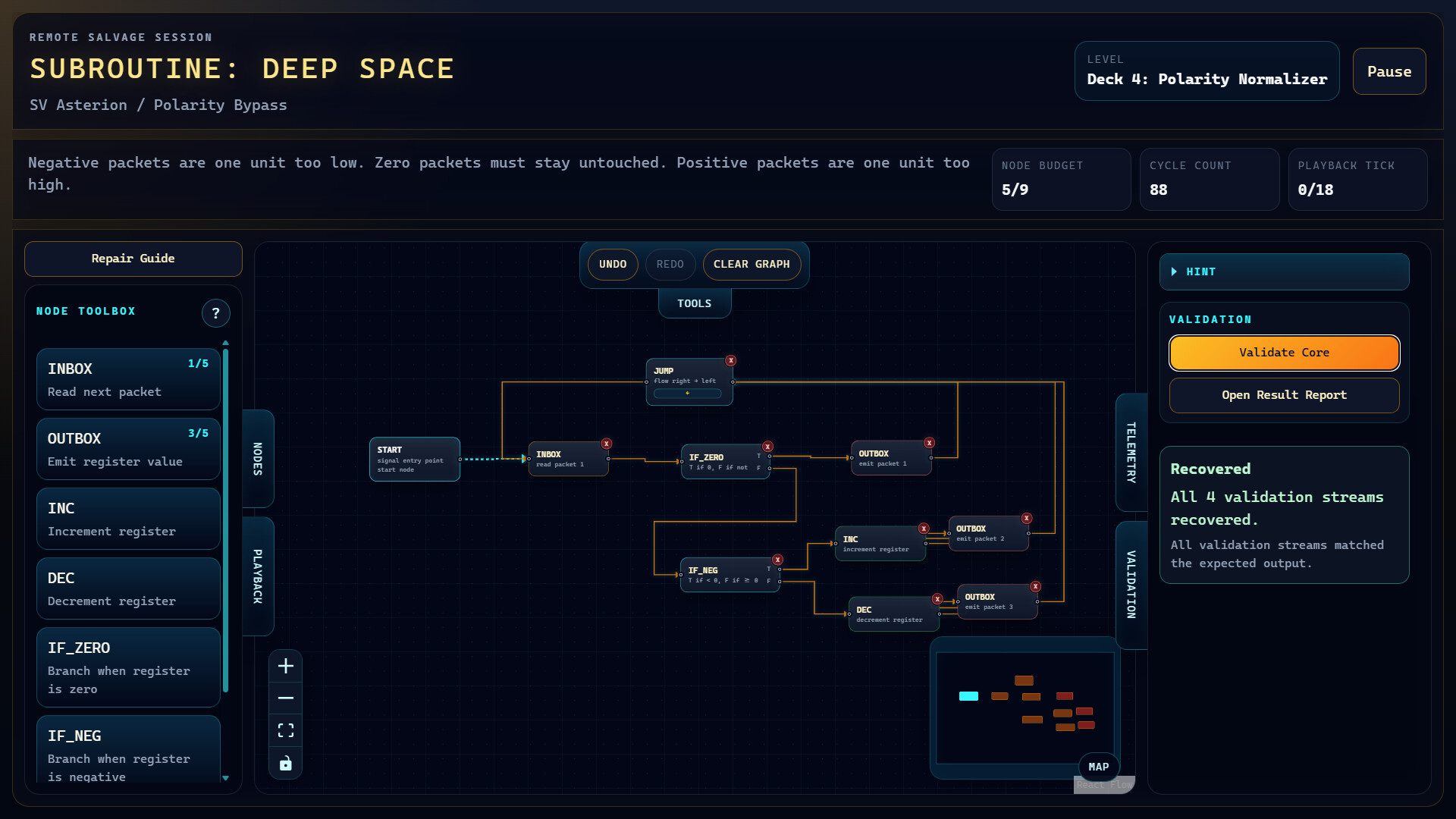

A sci-fi programming puzzle game. Repair corrupted ship cores by wiring executable node graphs — memory, logic, and I/O — then step through playback like a debugger until every validation stream passes.

Daftar masuk untuk menambah item ini ke senarai hajat anda, ikuti atau tandakannya sebagai diabaikan

Akan Datang ke Akses Awal

Pembangun permainan ini berhasrat untuk melancarkannya sebagai projek yang sedang berlangsung, dengan perkembangan dipengaruhi oleh maklum balas pemain.

Nota: Permainan dalam Akses Awal belum lengkap dan mungkin akan mengalami perubahan. Jika anda tidak berminat untuk bermain permainan ini dalam versi semasa, anda seharusnya menunggu untuk melihat jika permainan ini akan terus dibangunkan. Ketahui lebih lanjut

Kata-kata daripada pembangun:

Kenapa Akses Awal?

“The core game is playable now: a 10-deck visual-programming campaign with a graph editor, playback debugger, validation, and ratings. We are launching in Early Access because the rest of the expedition is still being designed, and we want players to stress-test the loop before we lock a much larger campaign.

Our goals during Early Access are specific. We want feedback on puzzle difficulty and pacing, whether briefings and repair guides are clear enough, which instruction nodes feel missing or confusing, how fair S-rank node and cycle budgets are, and which bugs or accessibility issues block people from finishing a deck. Waiting until 30 decks are finished would mean shipping a full campaign that only we have played.”

Berapa lama permainan ini dijangka akan berada dalam Akses Awal?

“Roughly 3 years, by September 30, 2029. We plan to leave Early Access once the expanded campaign, remaining story logs, and Steam Cloud are in a state we consider 1.0. If that estimate changes, we will update this Q&A and the store page.”

Apakah perbezaan yang dirancang antara versi penuh dan versi Akses Awal?

“Early Access is Windows 10/11, English, a 10-deck single-player campaign, and local saves on this PC. There are no extra game modes. The loop is campaign, replay, and optimization.

The full version is planned to expand that same game, not replace it:

Grow the campaign from 10 decks toward about 30 decks
Continue the Maximo story logs as later decks unlock
Add Steam Cloud so progress can follow your Steam account
Use more of the Node Index in later puzzles (some catalog entries are listed now but not used in the Early Access decks)
Tune difficulty, budgets, and UX from player reports
Those are plans. Buy the Early Access build for the 10 decks and tools that ship today. Anyone who owns Early Access keeps the game through 1.0; you will not have to buy it again.”

Bagaimanakah keadaan semasa versi Akses Awal?

“Customers can play a complete 10-deck single-player campaign aboard SV Asterion. A typical first playthrough is a few hours, longer if you chase S-rank graphs.

What is in the build today:

Visual node-graph editor (place, wire, undo/redo, node and cycle budgets)
Playback debugger that steps through ticks like a debugger
Validation against visible examples and hidden test streams
B / A / S ratings based on node count and cycle count
Briefings, repair guides, How To Play, and an in-game Node Index
Sequential unlocks, level select for recovered decks, and story logs from the Maximo expedition
Full keyboard play with rebindable keys
Settings for display, audio, and accessibility
Local saves on this PC
Platforms: Windows 10/11. Language: English. Steam Cloud is not in this build. Mac and Linux are not in this build. Some Node Index instructions are reference for later updates and are not used in the current 10 decks.”

Adakah harga permainan ini berbeza semasa dan selepas Akses Awal?

“No. We do not plan to change the price when the game leaves Early Access. The Early Access price is the planned 1.0 price.

Anyone who buys during Early Access keeps the game through 1.0 at no extra cost.”

Bagaimana anda merancang untuk melibatkan Komuniti dalam proses pembangunan anda?

“The main channel is this game’s Steam Community Hub: Discussions for bugs, unclear puzzles, missing tools, and difficulty, plus a News/update post whenever we ship a build.

We will read Discussions throughout development and reply there. As decks are added we expect to post store News with those builds rather than going quiet between updates. Wishlist comments and playtest notes are useful too, but Discussions is the place we will actually answer.

We will use reports on later-deck difficulty, briefing and repair-guide wording, S-rank budgets, keyboard and accessibility issues, and anything that makes validation or playback hard to trust. Feedback that shows up often will shape later decks and 1.0 systems.

We cannot take every suggestion. The salvage loop and node-graph rules stay; we will use Early Access to make that loop clearer, fairer, and bigger.”
Baca lagi
Bahasa Bahasa Melayu tidak disokong

Produk ini tidak menyokong bahasa tempatan anda. Sila semak senarai bahasa yang disokong di bawah sebelum membuat pembelian

Permainan ini belum tersedia di Steam lagi

Akan datang

Berminat?
Tambah ke senarai hajat anda dan terima pemberitahuan apabila permainan sudah tersedia.
 

Laporkan pepijat dan tinggalkan maklum balas untuk permainan ini di papan perbincangan

Lihat semua perbincangan

Tentang Permainan Ini

In 3022, Andrew Mercer answered the first SOS from beyond Earth — undeniable proof of other life, asking for help. His wife, Evelyn, told him it was too convenient. A species that had never reached out before does not suddenly need saving. He went anyway.

The exploration ship Maximo never came home.

Their last transmission was another distress call. Then silence. Now a salvage operator is patched into the wreck: dead cores, fractured telemetry, and personal logs from a crew that started noticing the signal changing as they closed in. The pilot’s jokes stopped reaching her eyes. The comms officer saw a frequency no one else would admit was there. Forty-eight hours from history, it already felt like they were going the wrong way.

Recover what they left behind. Find out who called — and why anyone answered.

A visual programming puzzle game

Subroutine: Deep Space is a single-player sci-fi programming puzzle. You repair those dead cores by building executable node graphs. Every deck starts at a protected START node. From the toolbox you place and wire INBOX and OUTBOX for the packet stream, memory slots to hold values, arithmetic and branches for control flow, string ops for headers and tokens, logic gates for boolean work, and clock nodes when a deck cares about timing.

Then you run it. Open the validation panel and press Validate Core. Visible examples show the intended transform; hidden streams still have to pass. If the graph crashes, drops a packet, or exceeds the cycle cap, the core stays dark.

When a solution almost works, use playback like a debugger: step forward and back through ticks, watch the register and memory, and see which node fired. Each deck has a briefing, a repair guide, and a node budget. START, INBOX, and OUTBOX are free; everything else counts. Inefficient graphs fail even if the idea is right.

The goal of every deck is the same: emit the correct output stream. The challenge is how little hardware you spend doing it. Passing unlocks the next deck and can recover another personal log. Ratings (B, A, and S) score your best node count and cycle count against par, so you can return to a solved core and tighten the graph. New instruction types unlock as you move through the wreck, so later decks are not just harder puzzles — they are new kinds of programs.

Early Access

Early Access follows the first ten recovered decks of that expedition aboard the salvage site SV Asterion. A typical first playthrough is a few hours, longer if you chase S-rank solutions. More of the story is planned. Progress is saved locally on this PC. There are no extra game modes in this build — campaign, replay, and optimization are the whole loop.

Decks currently in the build:

  • Deck 1: Reverse Transmission — store packets and emit them last-in, first-out

  • Deck 2: Signal Boost — loop the stream and increment every reading

  • Deck 3: Calibration Offset — save the first packet, add it to the rest

  • Deck 4: Polarity Normalizer — branch on sign and zero

  • Deck 5: Parity Ping — reduce each value until you can report odd or even

  • Deck 6: Repeater Relay — echo every packet twice

  • Deck 7: Window Slice — cut a fixed routing window out of string headers

  • Deck 8: Parity Latch — compare boolean pairs

  • Deck 9: Clock Divider — align wait cycles with the execution clock

  • Deck 10: Authenticated Length — gate name lengths behind an OPEN token

    What you get with this purchase

  • A 10-puzzle single-player campaign with sequential unlocks and level select for recovered decks

  • A visual graph editor with undo/redo, node limits, and full keyboard play (rebindable in Settings)

  • Playback debugger and validation against visible plus hidden test streams

  • S / A / B ratings for compact, fast solutions

  • Briefings, repair guides, and an in-game Node Index for every instruction

  • Recovered story logs from the Maximo expedition

  • Sci-fi salvage interface with procedural ship-ambient audio

  • Local saves on this PC (Steam Cloud is planned, not in this build)

Windows 10/11. English.

The exploration ship Maximo never came home.

Their last transmission was another distress call. Then silence. Now a salvage operator is patched into the wreck: dead cores, fractured telemetry, and personal logs from a crew that started noticing the signal changing as they closed in. The pilot’s jokes stopped reaching her eyes. The comms officer saw a frequency no one else would admit was there. Forty-eight hours from history, it already felt like they were going the wrong way.

Recover what they left behind. Find out who called — and why anyone answered.

Early Access follows the first ten recovered decks of that expedition. More of the story is planned. Progress is saved locally on this PC.

Pendedahan Kandungan Dihasilkan AI

Pembangun menerangkan cara permainan mereka menggunakan Kandungan Dihasilkan AI seperti berikut:

Some of the icons and help text were generated.

Keperluan Sistem

    Minimum:
    • OS: Windows 10
    • Pemproses: Dual-core 2.0 GHz
    • Memori: 4 GB RAM
    • Grafik: DirectX 11 compatible
    • DirectX: Versi 11
    • Storan: 200 MB ruang tersedia
    • Nota Tambahan: Microsoft Edge WebView2 Runtime (already on most Windows 10/11 PCs). Display at least 1280×800.
    Dicadangkan:
    • OS: Windows 11 64-bit
    • Pemproses: Quad-core 2.5 GHz
    • Memori: 8 GB RAM
    • Grafik: DirectX 11 compatible
    • DirectX: Versi 11
    • Storan: 200 MB ruang tersedia
    • Nota Tambahan: WebView2 Runtime. 1920×1080 for the default layout.
Penapis Ulasan