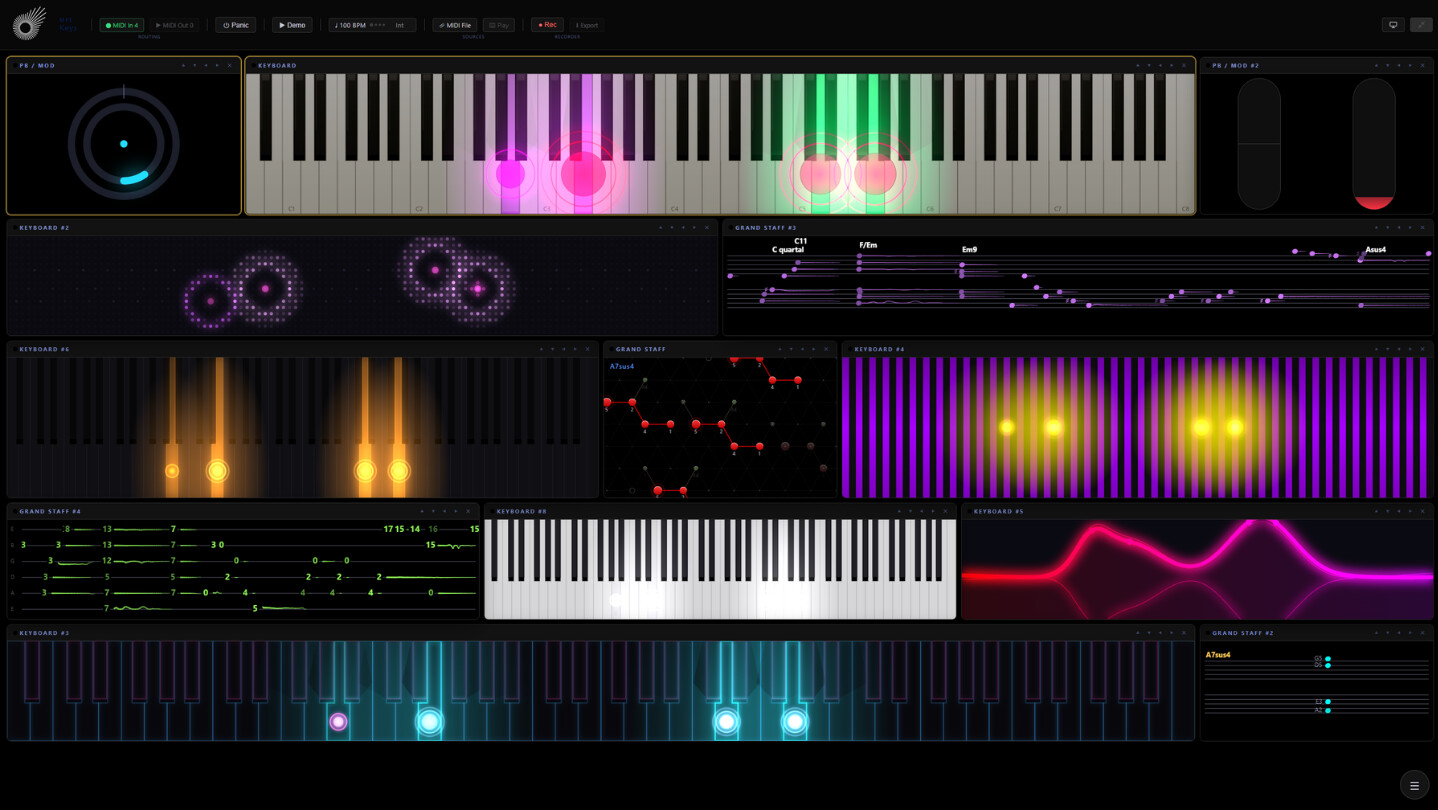

A real-time MIDI keyboard and piano visualizer. Every note you play appears in the colour of its own MPE channel, with pressure, pitch bend in cents and timbre drawn on the key itself. Nine designs, and live notation on a Grand Staff. No controller? Your computer keyboard plays it.

Sign in to add this item to your wishlist, follow it, or mark it as ignored

This game is not yet available on Steam

Coming soon

Interested?
Add to your wishlist and get notified when it becomes available.
 

About This Software

MPE Keys is a real-time MIDI keyboard and piano visualizer. It puts the instrument you already own on screen, key by key: every note in the colour of its own MPE channel, its pressure, its pitch bend and its timbre drawn on the key itself.

It is the Keyboard, the PB / Mod display and the Grand Staff of MPE Insight, running on their own, in a window shaped for three modules instead of nine. A smaller app, not a smaller keyboard: nothing about the keyboard is cut down for this build.

For the camera, the classroom and the desk. Any class-compliant MIDI device, no drivers, no plugins and no browser. An MPE controller sends its five dimensions straight away; an ordinary keyboard lights the keys it plays.

A piano that shows what your hands are doing

On an ordinary keyboard display a key is on or off. Under MPE a key has a life: it is held by one voice, it leans, it presses, it brightens. All four are drawn at once, on the key itself, from any MIDI keyboard you already own.

It plays, too

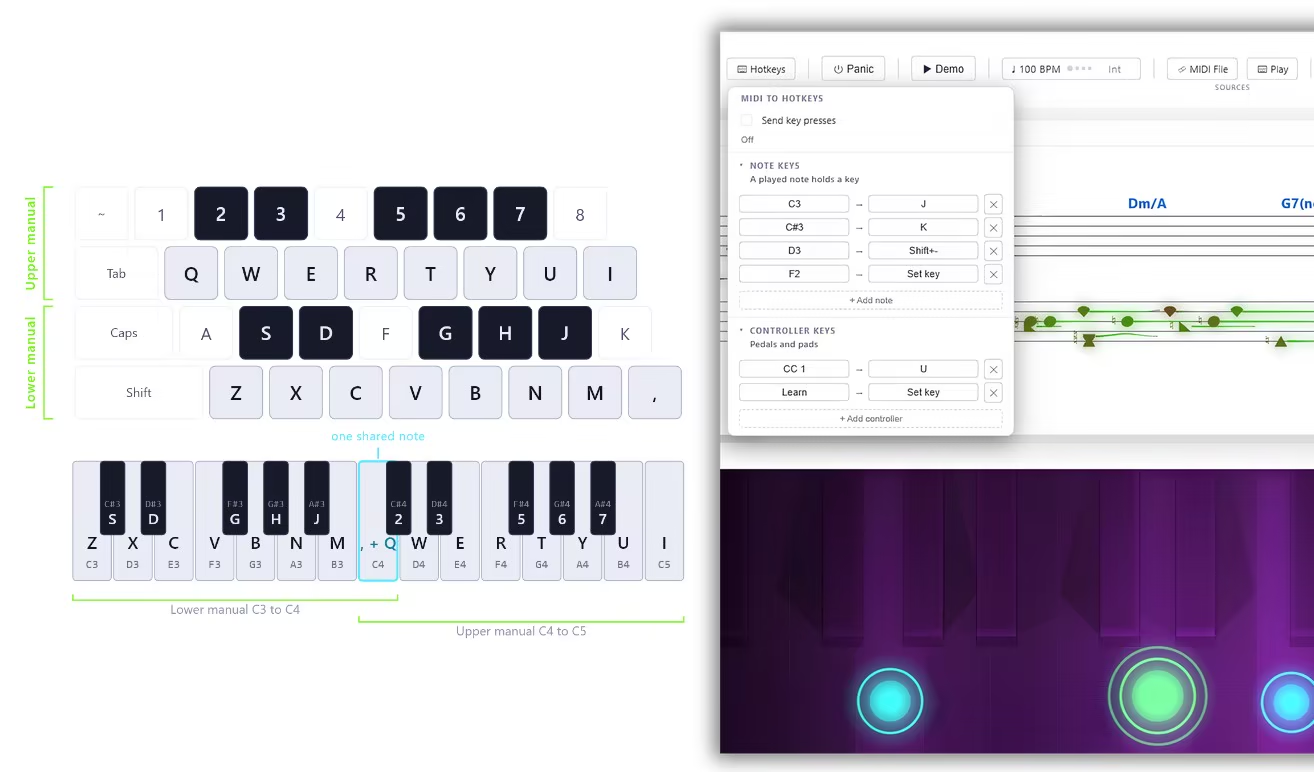
A display that can only watch is useless on a train, so both playable ways in come along and both send real MPE out of the app. Typing Keys lays two manuals under your hands on the computer keyboard, eight white keys each with the sharps on the row above and the space bar as the sustain pedal, in key positions rather than letters so QWERTY, QWERTZ and AZERTY fall under the same fingers. Mouse Mode gives every pointer its own MPE member channel, so multi touch chords work: drag sideways for pitch bend, up for pressure, down for timbre. One switch puts it on channel 1 instead, for a synth that does not speak MPE.

Nine designs, the same notes read nine ways

  • Nine designs, each with its own colours. Classic is a real instrument, Glass is polished with depth, Neon is outlines only, Minimal is a bar at the foot of the key, Dark lets only the notes carry light, Fingerboard gives every semitone the same width with no key shapes at all, Motion is a wave rather than a key, Pixel Grid is an LED raster, and Microtonal splits every key in two for quarter tones or reads each key's just intonation offset in cents. Every design draws the same data

  • Pixel Grid alone gives you three layouts: a dotted piano silhouette, an equal-width chromatic field, and the button-accordion grid where every interval spans the same distance in every key. Twelve keyboard presets, ten for the Grand Staff and eight for the wheels come along as starting points, and every colour in every one of them can be changed

Four things happen on one key, and light across them all

  • Pressure, right now. Channel pressure moves the key's colour between a low and a high tone, or fills the key from the bottom up like a meter

  • Pitch bend as a ring in cents. A ring around the key shows how far the note has actually travelled, reading the bend range your instrument reports over RPN 0 instead of assuming a standard one

  • One voice, one colour. MPE gives every note its own channel, so every lit key carries the colour of the voice holding it and a chord reads as separate voices rather than one block. A hand split gives the left hand a colour pair of its own

  • Timbre on its own ring. CC74 rides a brightness ring with its own colour pair, size and intensity, so slide and pressure never have to share one signal

  • And light across the whole bed. On the designs whose keys have real height, Key Light turns the performance dot into a lamp: the black keys cast their own shadows, and a dim over the bed sets how much of it you see

The Grand Staff

Beside the keys sits live notation: what you play is engraved as it happens, on treble and bass clef with the accidentals of the key signature you pick. Chord detection labels what you hold lead-sheet style, slash inversions included, an optional pitch bend hook arcs out of each notehead, and a soft halo sits behind them. Bar lines can run through the live playing as well, in Time and in Tab. Five views read the same playing: Now shows only what is held, Time scrolls it past like a timeline, Flow turns every note into a ribbon whose length is its duration and whose curve is the bend, Weave drops the staves for an interval field where every major chord is the same triangle in every key, and Tab writes it as guitar tablature on six strings, with tuning and capo adjustable and an unplayable fret shown in red rather than hidden. And it prints: a recorded take is engraved and paginated in the view you were using, saved as one PNG.

The two wheels

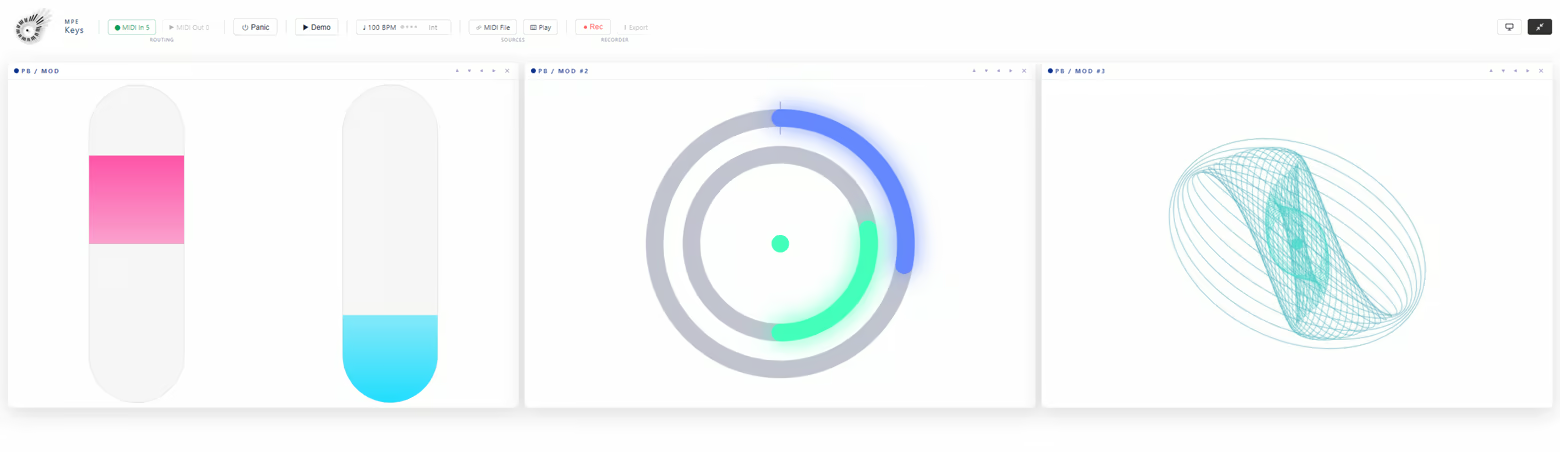
Beside the piano sit master pitch bend and modulation from channel 1, as two sliders or as one dial. This is the one reading on screen that never converts, so full deflection is full deflection whatever range the instrument reports.

MIDI in and out

  • A dedicated MIDI output port, so what you play with the mouse or the computer keyboard reaches your synth on the way through, alongside MIDI Thru for the incoming stream, per channel filtering and a panic button

  • Built-in MIDI file player: load a .mid, or drop one anywhere on the window, and it runs through exactly the same path as live input, with full transport

  • Recording of a whole session, notes and expression alike, with a timer beside the button. Stop it and the take leaves as a Standard MIDI File for any DAW, as raw CSV to read the numbers, or as a printable notation sheet: the whole recording engraved and paginated, chord symbols and bar lines included, or six string lines when Tab is the view you are in, saved as one PNG

  • Sustain pedal of either kind: a switch or a continuous half-pedal, detected on its own and invertible for pedals wired the other way round

  • Demo Mode with full MPE simulation, for setting a look up before anyone is watching, with nothing plugged in at all

The workspace

  • 88, 61, 49 or 25 keys. Switch the whole app between them. A smaller range means bigger keys, which is what a small screen and a small controller both want

  • Stage View: one shortcut clears the toolbar, the frames and the titles, fills the screen with your layout and fades the cursor away. Everything keeps playing while you are out there, and one key brings the workspace back exactly as it was

  • Transparent background: drop the panel chrome so only the keys, the wheels and the staff render, with nothing painted behind them, for overlay use in your video mix

  • Global snapshots for the whole window, saved, reordered and recalled as one file

  • MIDI Learn: put a hardware knob or a pedal on a control and keep your hands on the instrument

Setup

  • Guided tour on first launch, with Demo Mode playing underneath. Skip it at any point, or replay it later from the About menu

  • Multiple MIDI devices active at once, auto-detected on connect, with automatic instrument detection and true pitch-bend scaling

  • Modular: every module sits in its own tile, and you arrange them yourself. Drag a tile where you want it, make it as big as you like, or switch one off when you do not need it. Runs on Windows

What is not in it

MPE Keys is the smaller of the two apps on purpose. AURA, CASCADE, FORGE, DRIFT, the Expression Overview and the Stream Log are not in this build, and not switched off either: the files they live in are not in it at all. If you want those, you want MPE Insight.

System Requirements

    Minimum:
    • Requires a 64-bit processor and operating system
    • OS: Windows 10 / 11
    • Processor: Integrated graphics are sufficient
    • Memory: 4 GB RAM
    • Graphics: NVIDIA GTX 1060 / AMD RX 580 (or higher)
    • Storage: 700 MB available space
    • Sound Card: -
    • VR Support: -
    • Additional Notes: -
    Recommended:
    • Requires a 64-bit processor and operating system
    • OS: Windows 10 / 11
    • Processor: Intel Core i5 (or higher), AMD Ryzen 5 (or higher)
    • Memory: 8 GB RAM
    • Graphics: NVIDIA GTX 1060 / AMD RX 580 (or higher)
    • Storage: 750 MB available space
    • Sound Card: -
    • VR Support: -
    • Additional Notes: -
Review Filters