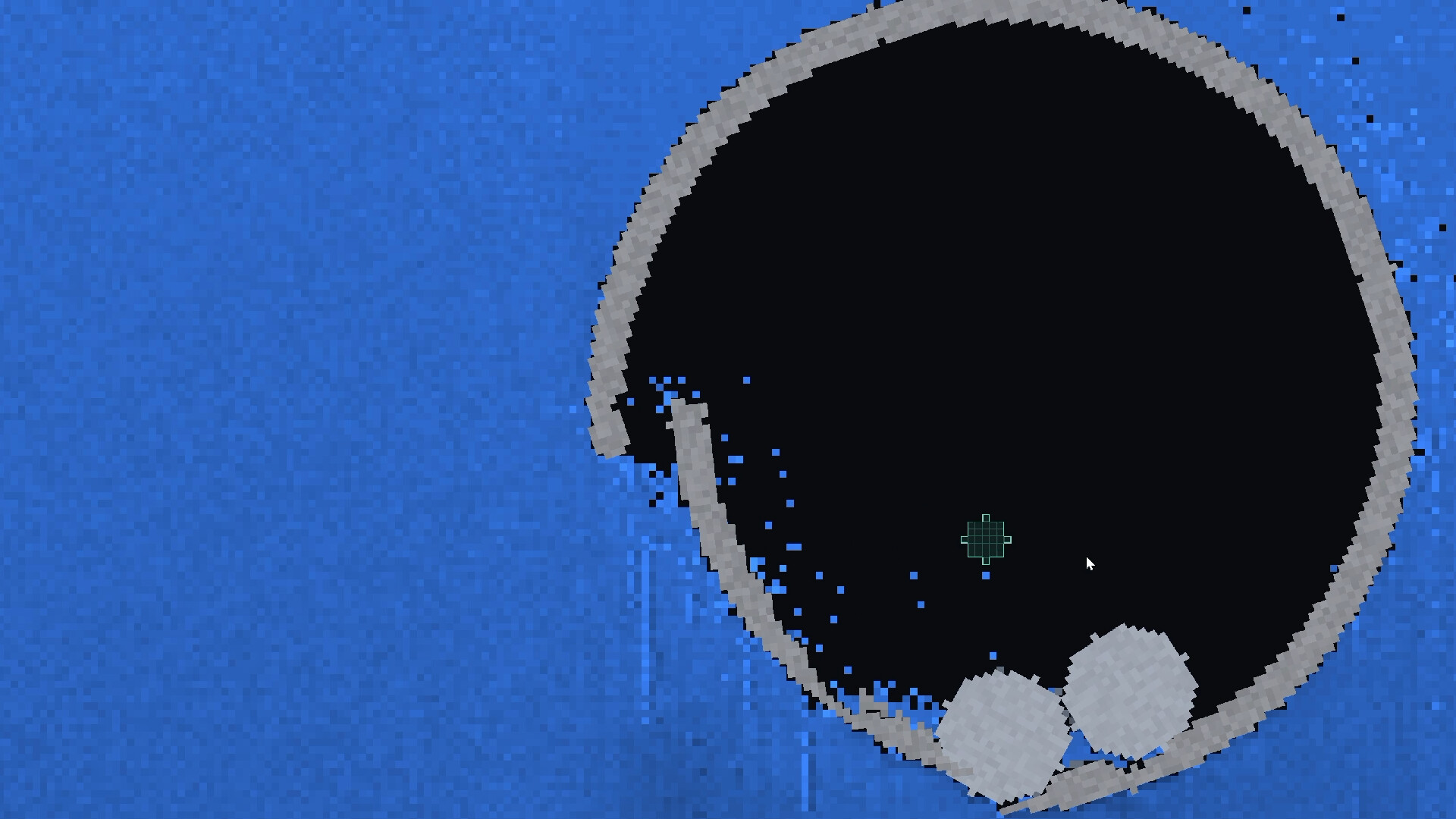


Build machines, trigger chain reactions, and throw planets at each other. SPS combines flowing particles with rigidbody physics at scales from centimeters to thousands of kilometers. Run that experiment you've always wanted without burning down your house.

Sign in to add this item to your wishlist, follow it, or mark it as ignored

This game is not yet available on Steam

Planned Release Date: To be announced

Interested?
Add to your wishlist and get notified when it becomes available.
 

About This Game

We heard you like pixels.

And you like it when they mix, collide, and explode. You especially like it when you can build complex things with those pixels and throw them at each other.

Welcome to Spike’s Particle Sandbox.

SPS brings flowing particles, moving objects, and material interactions together in one physics sandbox. Build catapults, design tanks, experiment with nuclear fission, or find an entirely new use for an unreasonable amount of water. Some people say I have an unhealthy obsession with dams. Do with that as you will.

Every pixel represents a material. Those materials can collide, mix, transfer heat, and react with their surroundings. Chain reactions together to create complex mechanisms, power your experiments, or introduce a small problem that rapidly becomes everyone’s problem.

What you build is only half the experiment. The other half is finding out what happens to it.

Build a dam, fill the reservoir, and see how much it can hold. Trap pressure inside a container and give it somewhere to escape. Send a projectile into your carefully constructed machine and discover which parts were actually necessary. Just make sure you aim the barrel away from your face.

SPS’s subgrid system lets solid pixels form objects that move and rotate independently of the underlying simulation grid. Combine those objects with mechanisms such as ropes and axles to build vehicles, moving machinery, and elaborate contraptions, at a fraction of the cost of building them in the real world, and significantly less damage to personal and government property.

Scale is part of the experiment, too.

Choose the size each cell represents when creating your world, from centimeters to kilometers.

Design small machinery where individual moving parts matter or create worlds thousands of kilometers across and throw them at each other. Changing scale changes the physical situation you’re exploring. A few stones colliding and two planets meeting at speed should produce very different experiences. At least my physics textbook says so.

SPS aims to make physics reflect your chosen scale while keeping the results fun to build, watch, and destroy. You shouldn’t need to juggle a collection of physics multipliers just to make a scene feel right.

Things should behave how you expect. Usually.

We also heard you like modding.

If the available materials don’t cover your idea, make your own. SPS defines materials, reactions, and behaviors in C#, giving modders a shared language for expanding the sandbox. Add a material, invent a reaction, or explore how a new behavior changes everything around it.

Build something ingenious. Test its limits. Rebuild whatever survives.

Or just throw planets at each other. We understand.

System Requirements

    Minimum:
    • OS: Windows 11
    Recommended:
    • OS: Windows 11
Review Filters