
Interactive 3D mathematics from the makers of Makarov Physics Suite: fractals, chaos, the complex plane, 4D polytopes, linear algebra, Fourier, Monte Carlo, graphs, primes. Nobody drew these pictures: each one is recomputed as you drag the parameters, and the numbers are measured on screen.

Sign in to add this item to your wishlist, follow it, or mark it as ignored

This game is not yet available on Steam

Planned Release Date: Dec 30, 2026

This game plans to unlock in approximately 3 months

Interested?
Add to your wishlist and get notified when it becomes available.
 

About This Game

Nobody drew these pictures. Every one of them is computed.

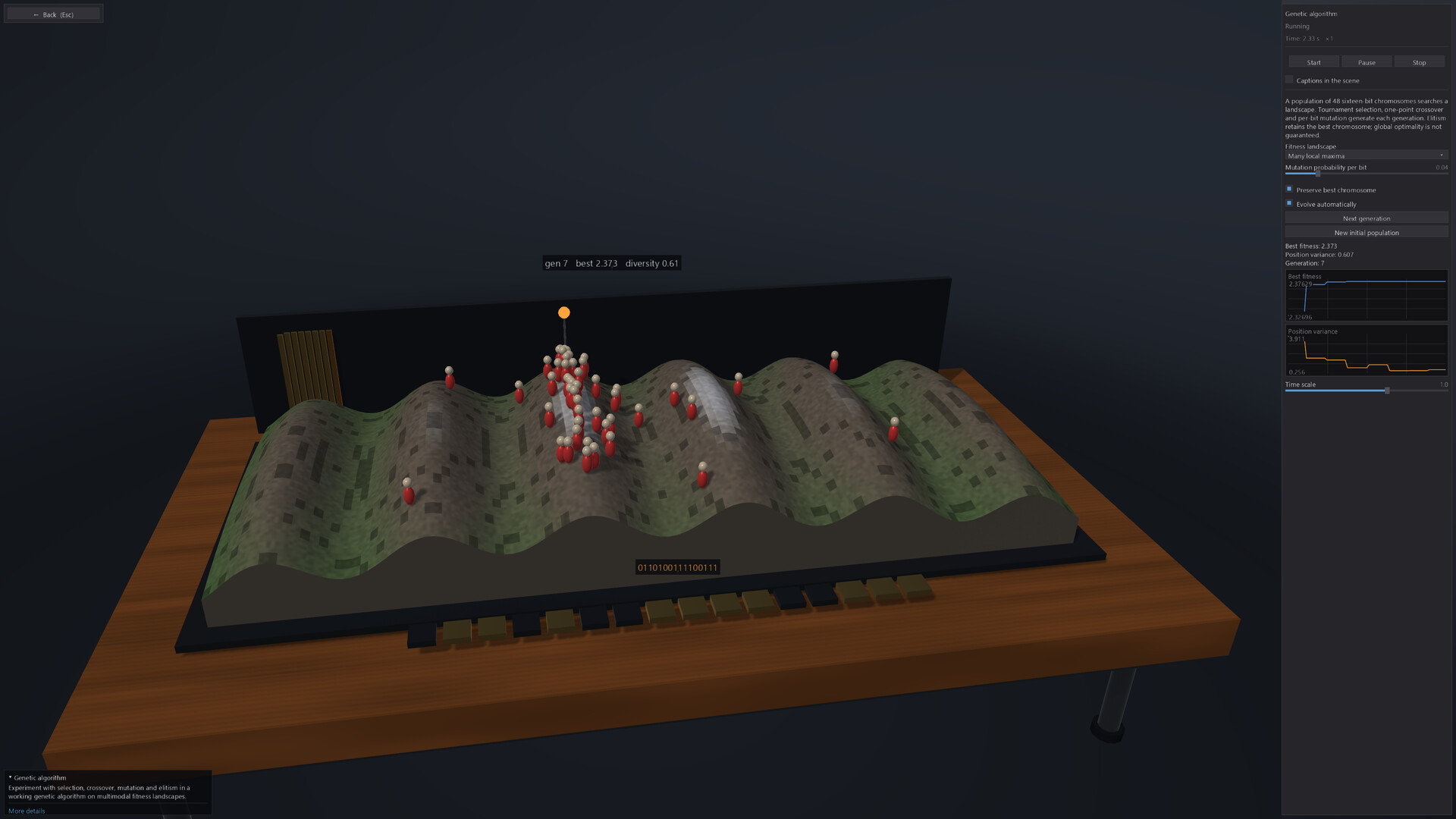
Interactive 3D mathematics: fractals and deep zooms, chaos and dynamical systems, the complex plane, geometry in three and four dimensions, linear algebra, Fourier analysis, probability and Monte Carlo, graphs and optimisation, primes and the Collatz conjecture, cellular automata and neural networks. Each module is a live model, not an illustration: drag a corner, a matrix or a parameter and the picture is recomputed on the spot, because it was never an image.

What you get

- A 3D scene, controls and live charts for every module

- A one-line caption that says in plain words what is happening right now, and where the idea lives outside the textbook: JPEG compression, phone towers, delivery routes, earthquakes

- Presets that show every mode of a module, and objects you drag directly in the scene

- Measured numbers under the picture: the dimension of a fractal, the percolation threshold, the rate of convergence, the error against the exact answer

- Every number is checked against an independent reference implementation before release

- Eight interface languages

- Runs offline. No account, no telemetry.

A few of the modules

- Chaos game. A die and a jump toward a random corner build the Sierpinski triangle, the fern, the dragon, the Menger sponge - the same from any start. Drag the corners, change the jump, count the boxes and measure the dimension.

- Singular value decomposition. Any matrix is a rotation, a stretch and another rotation: the unit sphere turns, stretches into the ellipsoid of the singular values and turns into place, one factor at a time.

- Percolation. Open sites join into clusters, and at one sharp threshold a cluster suddenly spans the whole grid; the crossing curve is measured live as the probability sweeps through it.

- Travelling salesman. A tour that shortens while you watch - greedy, 2-opt uncrossing edge by edge, annealing climbing over the wall - against the exact optimum.

- Prime spirals. The numbers laid on a square spiral, the primes lit: diagonals appear that should not be there, Euler's n² + n + 41 runs down one of them, and π(N) is plotted against N/ln N as the spiral grows.

- Deep zoom. Into the Mandelbrot set until double precision gives out - then buy 22 more mantissa bits and watch the wall move.

From the same workbench

Makarov Math Suite is built on the engine of Makarov Physics Suite: the same carousel, the same panel, the same live charts. A few modules live in both, where the two subjects meet - the Ising model, the Galton board, flocking - and the rest is the mathematics that physics never gets around to.

Under the hood

C# on .NET with OpenGL 3.3 core rendering. Each module is a separate plugin. Fractal surfaces and deep zooms are drawn in shaders; slime mould, reaction-diffusion and the Ising model use CUDA where a GPU offers it, and everything runs on the CPU without one.

System Requirements

    Minimum:
    • Requires a 64-bit processor and operating system
    • OS: Windows 10 64-bit
    • Processor: Dual-core 2.4 GHz
    • Memory: 4096 MB RAM
    • Graphics: GPU with OpenGL 3.3 support
    Recommended:
    • Requires a 64-bit processor and operating system
    • OS: Windows 10 64-bit
    • Processor: Quad-core 3.0 GHz
    • Memory: 8192 MB RAM
    • Graphics: GPU with OpenGL 3.3 support
Review Filters