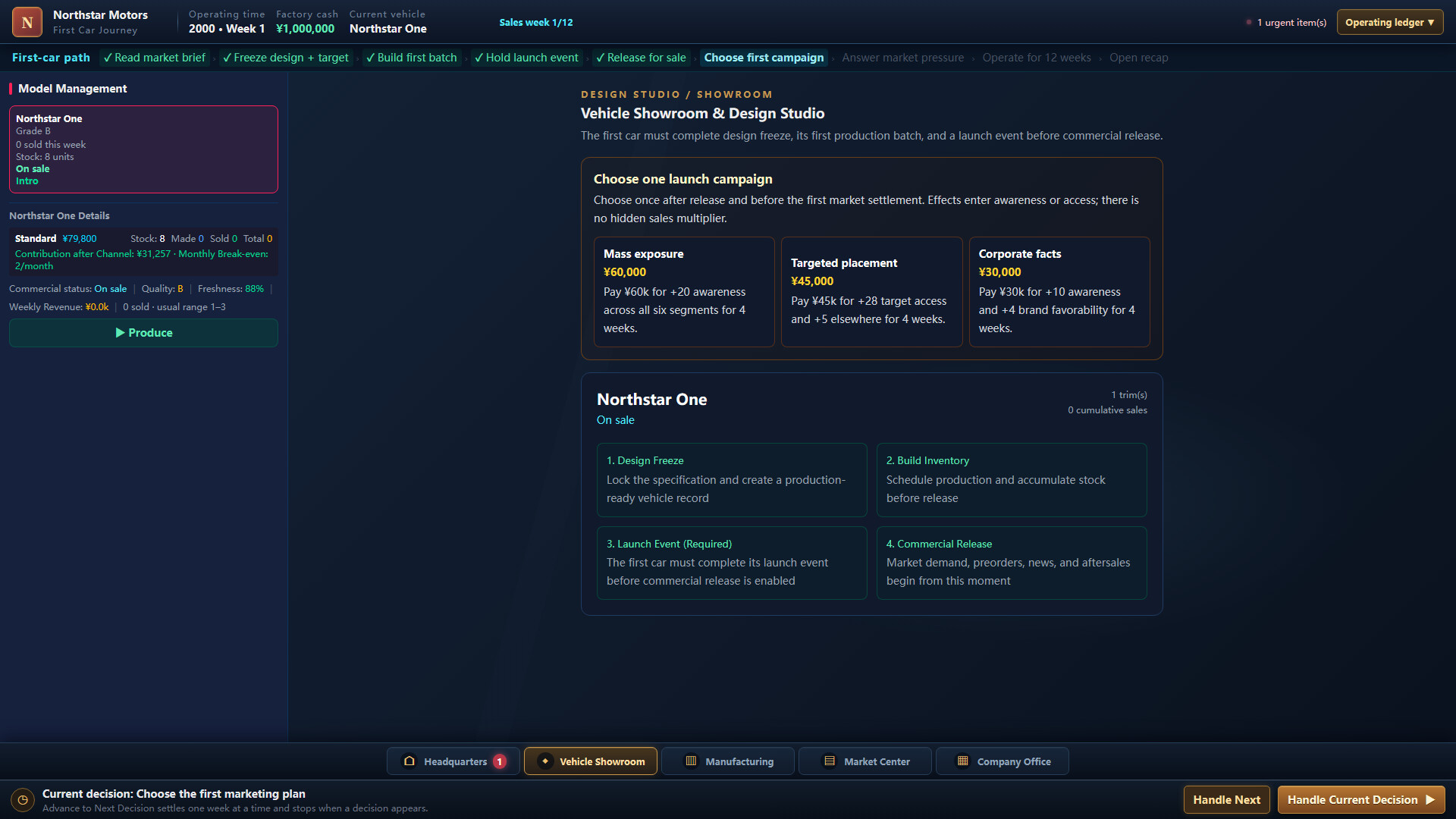


You've inherited a rusty assembly line. From sourcing a single bolt to developing your own V8, from a "shady workshop" mocked on forums to a household brand name—every design decision is a stone thrown into water. The ripples across the entire media landscape are the real exam.

Sign in to add this item to your wishlist, follow it, or mark it as ignored

This game is not yet available on Steam

Coming soon

Interested?
Add to your wishlist and get notified when it becomes available.
 

About This Game

You're not building a car. You're dropping a stone into a pond—and watching the entire surface erupt.


The year is 2000, in the fictional nation of C-country. You've acquired a failing car manufacturer with three million in capital, one assembly line, a few dozen workers, and zero brand recognition. Over the next thirty years, you'll decide every component under the hood—engine, chassis, seats—set the price, choose the channels, then hold your breath as review scores drop, influencers post takes, forums explode, sales numbers roll in, and rival CEOs take jabs at you in interviews.

Eight Core Modules, Over 300 Real Components


Chassis, powertrain, body, cockpit, safety, energy, electronics, and vehicle calibration—eight assembly modules with 300+ authentic parts spanning 2000's torsion-beam drum brakes to 2030's solid-state batteries and silicon-carbide controllers. Three distinct powertrain routes—combustion, hybrid, electric—each with independent component ecosystems. A V8 won't fit in a compact chassis; air suspension needs electric power steering to function. Compatibility rules prevent nonsensical mashups. Every part swap refreshes nine core performance metrics and five target-demographic match scores in real time. One platform can spawn a volume base trim, a profit-driving luxury trim, and a brand-building flagship.

NPC Consumers With Personalities, Not Spreadsheets


They aren't "+100 sales." Each has age, occupation, family status, salary—and eight hidden preference dimensions you can't see. Some care only about specs, others only about price; some are swayed by a single influencer video, others buy for status. Bargain hunters compare you line-by-line against rivals. Brand loyalists evangelize on forums. Angry owners either file complaints or ruin your reputation in owner groups. You can't see their weights directly—you infer them from behavior and posts. That's the black box.

Seven Layers of Ripples—Media Is the Lifeblood


After launch, feedback isn't a number popup—it's a weeks-long wave: enthusiast magazines publish review scores, portals rush breaking news, KOLs post video takes (for better or worse), forums erupt in arguments, owners post real-world impressions, rivals slash prices in response, national papers write year-end features. Nine media channels unlock progressively across five eras—from 2000's print newspapers and web forums to 2020's short video and livestreams—each with its own voice and personality. Print says "sources report," forums say "this workshop's at it again," short video says "guys, this car slaps." Your company title evolves too: from "that small factory" to "Motors Co., Ltd." to finally being called "the Group."

Five Eras, Three Powertrain Routes, Thirty Years


From the startup era's assembly survival, through brand awakening, domestic-vs-joint-venture warfare, the new-energy transition, to the full-intelligence era—change is gradual, not hard cuts. New media emerges, old media fades, new consumer segments appear, regulations mandate ABS then ESP, new components unlock via R&D. Stick with combustion and perfect it, go all-in on electric and bet the future, or run hybrid in parallel—each path has different challenges and endings.

More Than Building Cars—Running a Company


    [ ]R&D System: Seven parallel tech trees with generational iteration. Tech freshness decays yearly; fall behind and rivals surpass you. More funding accelerates research—but over-investment risks accidents.[ ]Supplier Network: Relationship levels Lv0–Lv3 affect pricing and stability. Both you and competitors can buy out exclusive components to execute supply-chain blockades.[ ]Production: Expand lines, hire and train workers, upgrade equipment—pure numeric constraints, no drag-and-drop minigames, but capacity, yield rate, and worker skill all affect delivery.[ ]Dealerships & Marketing: From dealer agents to 4S stores to direct experience centers; from print ads to short-video campaigns. Channels and marketing determine who sees your cars.[ ]Banking & Credit: Borrow to expand. Credit ratings from AAA to D determine interest rates and limits.[ ]After-Sales & Recalls: Corners cut on quality come back—with interest—in recall campaigns.

Six Starting Factories, Six Stories


From a one-star derelict plant to a five-star industry relic, six acquirable factories each offer different starting lines, worker quality, brand legacies, and difficulty. Hard starts have tight budgets but exclusive tech heritage; easier starts are stable but face fiercer competition. Every playthrough tells a different business story.

Six Endings, Graded S to F


Reach 2030 and be scored across six dimensions: market performance, brand building, R&D output, production scale, company tier, and financial health. You might become a "National Brand Legend" (S), achieve "Steady Operation" (C), or suffer an "Inglorious Exit" (F). Failure gets its own screen. Success gets no fireworks—because the next quarter is already here.

AI Generated Content Disclosure

The developers describe how their game uses AI Generated Content like this:

his game uses generative AI during development to assist in the creation of certain visual assets, including but not limited to store promotional images, concept illustrations, and decorative graphics. All AI-generated images have been reviewed, selected, and post-processed by the developer to ensure consistency with the game's overall art direction. The core gameplay, programming code, written content, numerical systems, music, and sound effects were independently designed and authored by the developer without the use of generative AI. AI tools were used solely to improve the production efficiency of visual assets and are not involved in any real-time in-game content generation.

System Requirements

    Minimum:
    • OS: Windows 10 64-bit
    • Processor: 4-core / 8-thread x86-64 processor
    • Memory: 8 GB RAM
    • Graphics: Integrated graphics with DirectX 11 support
    • DirectX: Version 11
    • Storage: 1 GB available space
    • Sound Card: Windows-compatible audio device
    • Additional Notes: Keyboard and mouse required. SSD recommended.
Review Filters