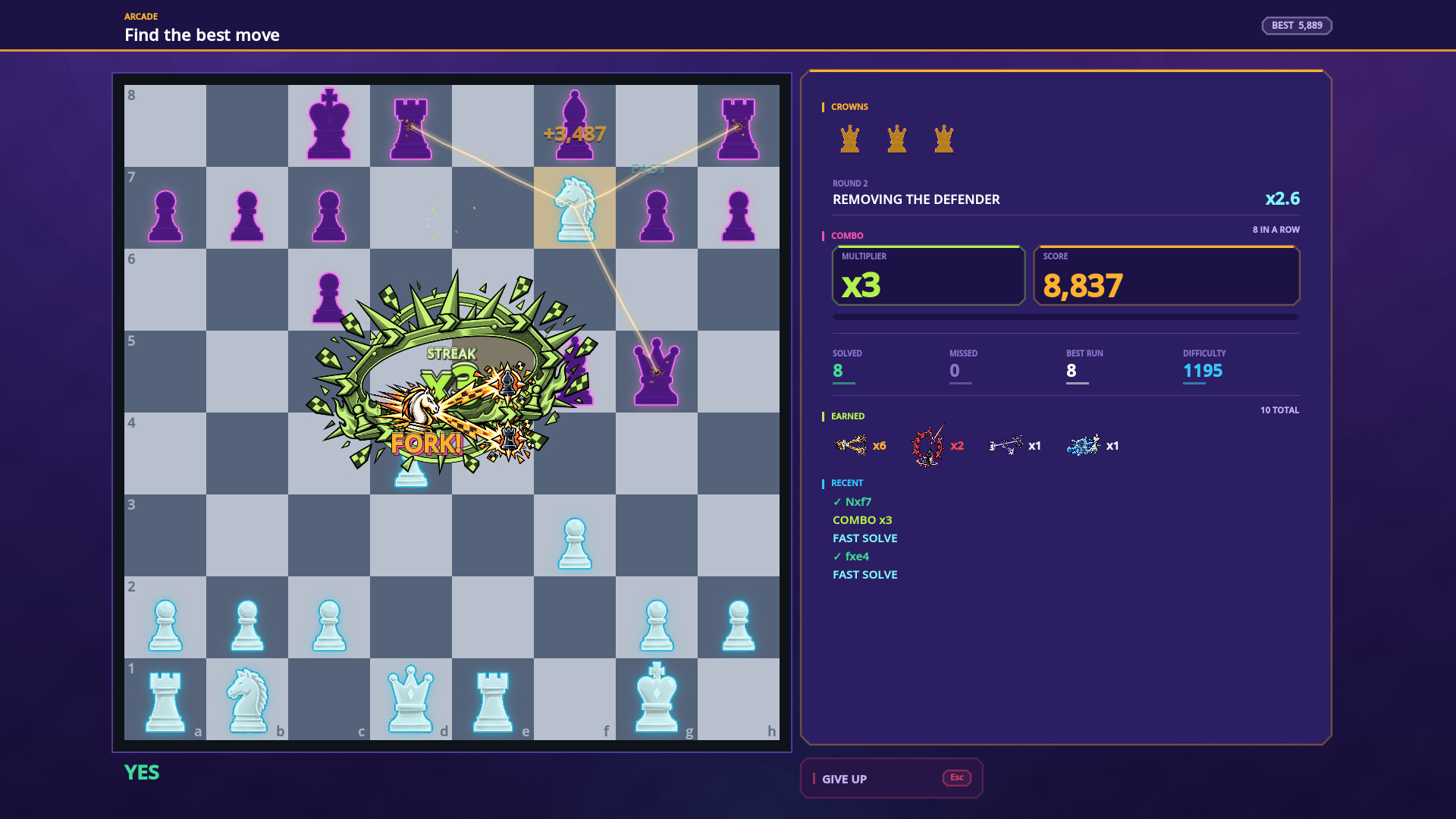

Learn chess by playing it. Master the rules, openings, endgames and tactics, then put your skills to the test in Arcade mode, against eight computer opponents, or against friends. Real chess, unchanged — just more approachable, playful and alive.

Sign in to add this item to your wishlist, follow it, or mark it as ignored

Coming Soon To Early Access

The developers of this game intend to release as a work in progress, developing with the feedback of players.

Note: Games in Early Access are not complete and may or may not change further. If you are not excited to play this game in its current state, then you should wait to see if the game progresses further in development. Learn more

What the developers have to say:

Why Early Access?

“Chess:Arcade already has its core game modes in place, but there are several directions in which it can grow.

Early Access gives us the opportunity to find out how players actually use the game: whether they spend more time working through structured courses in Journey, chasing positions in Arcade, or simply playing chess.

Player feedback will help shape which parts of the game receive the most attention, how the Journey courses are structured and expanded, and how progression, pacing and difficulty are tuned before the full release.”

Approximately how long will this game be in Early Access?

“We currently expect Early Access to last approximately 6–12 months.
The exact timing will depend on player feedback and how much the game changes during Early Access.”

How is the full version planned to differ from the Early Access version?

“The full version is planned to be a more refined and expanded version of the same game rather than a fundamentally different one.

During Early Access we plan to expand and improve Journey courses, refine Arcade progression and difficulty, improve onboarding and presentation, and address features and quality-of-life improvements that players find most valuable.

The exact focus will partly depend on feedback during Early Access.”

What is the current state of the Early Access version?

“Chess:Arcade is fully playable and includes the Journey and Arcade modes.

Journey contains structured chess courses presented as explorable maps, covering areas such as openings and endgames. Arcade provides a faster tactical mode built around thousands of chess positions.

The core chess gameplay, progression and save system are functional. Early Access will focus mainly on expanding, balancing and refining these systems rather than establishing the basic game concept.”

Will the game be priced differently during and after Early Access?

“We currently plan to keep Chess:Arcade affordable throughout Early Access. The price may increase slightly for the full release depending on how much the game grows during Early Access.”

How are you planning on involving the Community in your development process?

“Player feedback is one of the main reasons for releasing Chess:Arcade in Early Access.

Feedback will be collected through the Steam Community and an optional Discord server. In particular, we want to learn which parts of the game players enjoy most and where additional development would make the biggest difference.

This includes questions such as whether Journey should receive more courses and educational content, which kinds of Arcade challenges players enjoy, how difficulty and progression feel, and which quality-of-life improvements are most useful.

Feedback will be used to help prioritize development throughout Early Access.”
Read more
This game is not yet available on Steam

Coming soon

Interested?
Add to your wishlist and get notified when it becomes available.
 

Report bugs and leave feedback for this game on the discussion boards

See all discussions

About This Game

An arcade cabinet where you learn chess — and then play it. Real chess, unchanged: against the computer, against friends, or alone.

LEARN CHESS BY PLAYING IT

The first time you start the game, it asks how well you already know chess and drops you in right where you belong. Complete beginners get eighteen lessons where no rule is simply explained — every rule is played.

THE JOURNEY

A map of 105 stops instead of a list of lessons. Two continents are open: eight opening regions, where each line is first shown, then tested, and finally put into practice; and the endgames, ranging from basic rook endings all the way to the Lucena position.

Beyond the final milestone waits THE ADVENTURE — a run through a branching route, played out instead of simply solved.

ARCADE

12,067 tactical positions. Each one has a move that decides it, and a time limit calculated from the position itself.

You have three crowns, and between rounds you choose from three tactical themes. The more accurately you play, the louder the arcade cabinet gets.

AGAINST THE COMPUTER AND FRIENDS

Eight opponents rated from 600 to 2000, whose weaknesses are built in rather than simply dialed down. Each level has its own budget of inaccuracies, mistakes, and blunders.

Play standard chess or Chess960 — against the machine, or against a friend you invite through the Steam Overlay.

AND MORE

Post-game analysis and PGN export for every match. Eighteen music tracks generated by the game itself. Pieces and boards to unlock, board effects that can be reduced or disabled in three levels, and full support for English and German.

AI Generated Content Disclosure

The developers describe how their game uses AI Generated Content like this:

CHESS: ARCADE uses generative AI for its 2D artwork and for its music.

The illustrated assets — move callouts, effect overlays, chess piece sets, UI plates, the title graphic and the game icon — were generated with GPT Image 2 from prompts we wrote and iterated on ourselves. Every generated image then goes through our own import pipeline (trim, alpha normalisation, correction onto the game's fixed palette, downscale), is reviewed in the running game by hand, and is reworked or discarded when it misses. All of it ships as fixed image files inside the build.

The soundtrack was composed with generative AI: the melodies, harmony and arrangements were written with AI assistance, then reviewed, edited and mixed by hand. The game ships no audio files and uses no AI audio model — the score exists as note data that the game's own synthesiser renders procedurally at first launch. Twelve of the tracks are arrangements of public-domain classical themes; the rest are original.

Nothing is generated while you play, and the game never connects to an AI service. The opponent is a classical alpha-beta chess engine with a hand-written evaluation and opening book, and the puzzles come from the public Lichess puzzle database, verified against that engine. No player input, game data or personal data is ever sent to an AI model.

System Requirements

Windows
SteamOS + Linux
    Minimum:
    • Requires a 64-bit processor and operating system
    • OS: Windows 10 64-Bit 1607+
    • Processor: x64, Dual-Core 2,0 GHz
    • Memory: 2 GB RAM
    • Graphics: Intel HD Graphics 4000, GeForce GT 600, Radeon HD 5000
    • Storage: 500 MB available space
    • Additional Notes: Maus und Tastatur erforderlich — kein Gamepad-Support. Kleinstes Fenster 960×600.
    Recommended:
    • Requires a 64-bit processor and operating system
    Minimum:
    • OS: 64-Bit mit glibc 2.28+ Ubuntu 20.04, Debian 10, Fedora 30, SteamOS 3
    • Processor: x64, Dual-Core 2,0 GHz
    • Memory: 2 GB RAM
    • Graphics: GPU mit OpenGL 3.3 (Mesa 20+); Vulkan 1.0 wird bevorzugt und automatisch genutzt
    • Storage: 500 MB available space
    • Sound Card: ALSA oder PulseAudio/PipeWire; das Spiel startet auch ohne Audiogerät
    Recommended:
    Review Filters