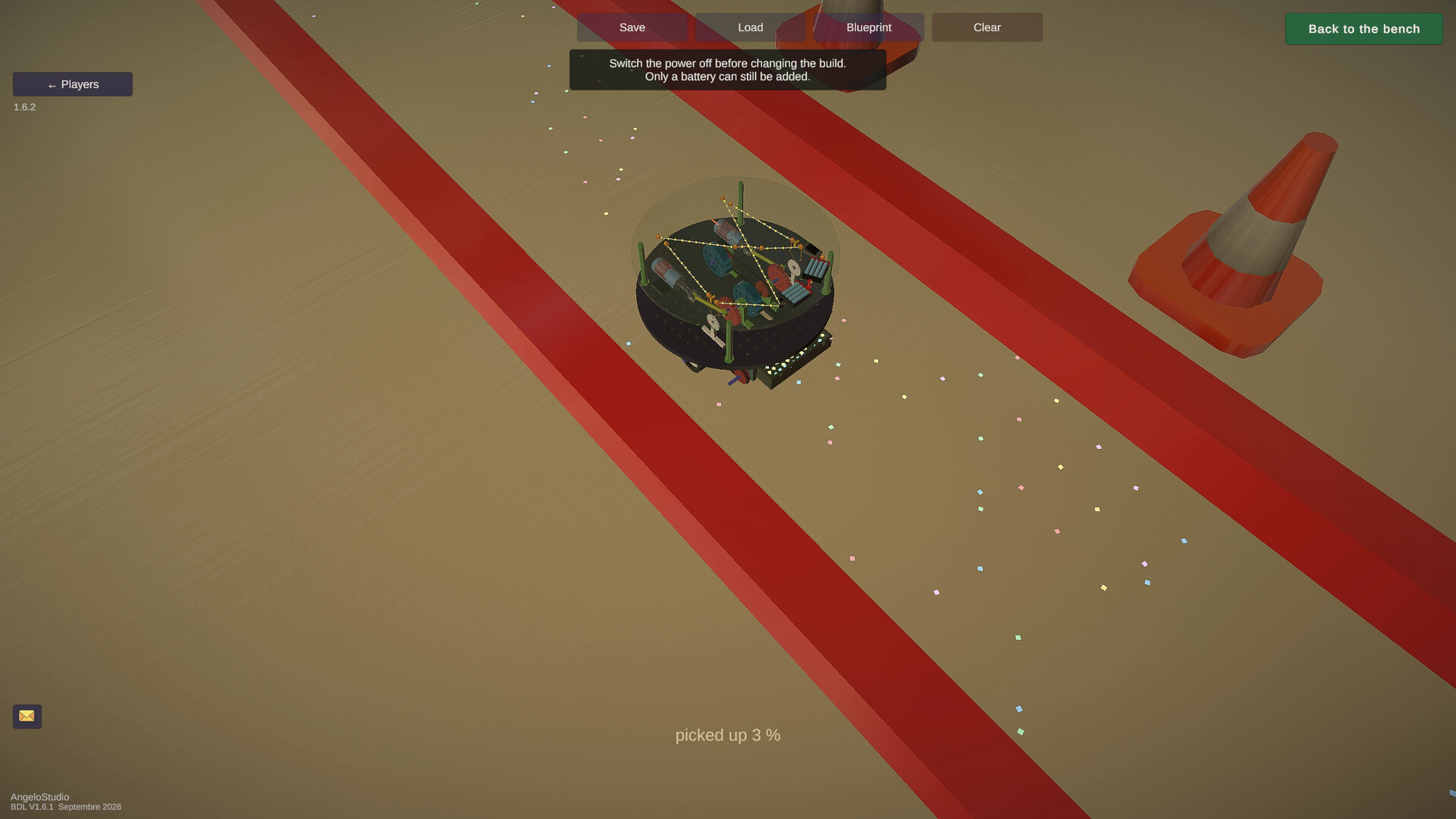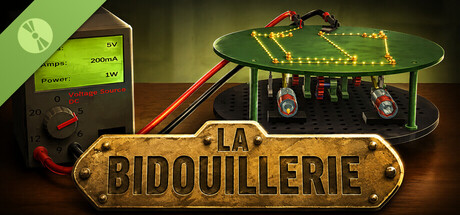

Build a machine from a real electromechanical kit. Snap parts onto a perforated chassis, wire them on the board above, switch the power on — and see whether it moves, sparks or burns. Twelve missions, a 1970s pinball table, a sandbox.

Sign in to add this item to your wishlist, follow it, or mark it as ignored

Free Demo

Play La Bidouillerie Demo

Check out the full game


About This Demo

A workbench, a power supply, and a kit of parts

There is no hero in this one. The hero is the workbench — and the power supply sitting next to it.

La Bidouillerie is a construction game about real electromechanics. You place parts on a perforated chassis, wire them on the electrical board above, switch the power on — and watch whether the thing moves, sparks, or burns a component. The circuit is solved by a real simulator, and so is the mechanics. Nothing is scripted to work: it works when it is right, and not before.

What's in the demo

  • Twelve missions around a small vacuum robot. Build the drivetrain, turn it with your own finger, then give it a breaker that switches the current on its own — and further on, a brush, a second solenoid, two ignition lines. Something burns out along the way. That part is on purpose, and working out what to do about it is your job.
  • A pinball table — a 1970s electromechanical machine without a single chip. Trace your walls, wire your flippers, arm the transformer, shoot the ball. Five missions, and the table stays playable at every step. Two score reels and three wires, and you count to 99. Nobody will tell you how.
  • A sandbox, once the missions are done, where nobody tells you what to build any more.
  • An encyclopedia of about ninety entries — parts, ideas, tools and faults, with their history: what a solenoid is, why a coil that is cut sends its voltage back somewhere, what "electromechanical" meant before there were chips.

What you actually do

  • Place. Parts snap onto a 10 mm grid — solenoid, breaker, gears, wheels, pulleys, rods. What fits, fits; what doesn't, doesn't.
  • Wire. Wires, switches, resistors, capacitors, a transformer. The board sits above the mechanics, and the circuit is solved for real, not faked.
  • Power up. Then it works, or it sparks, or it burns a part. A breaker that arcs wears out. A motor that stalls draws current until something gives.

Good to know

  • The demo is free and complete in itself. The full game will be paid: it is made by one person, and it has to earn its keep.
  • Eight languages: English, French, Spanish, Brazilian Portuguese, Russian, Simplified Chinese, German and Japanese. Everything beyond French and English was translated by an AI, with the vocabulary of the workshop, and no native speaker has read it yet: if a sentence sounds wrong, say so — in the game's message board or on the forum — and it will be fixed.
  • Windows PC.
  • Already visible in the parts drawer, under a padlock: the relay, the contactor and its contact blocks, the score motor, the bumper, the drop target, the insert. They come with the full game.

AI Generated Content Disclosure

The developers describe how their game uses AI Generated Content like this:

Some marketing assets on the store page (capsules, logo) were produced with a generative AI tool, based on screenshots and 3D renders from the game itself.

Part of the in-game text (encyclopaedia entries and mission briefings) was drafted with the assistance of a large language model, then reviewed and edited by the developer.

The 3D parts, textures and the simulation itself are authored. Nothing is generated while the game is running.

System Requirements

    Minimum:
    • Requires a 64-bit processor and operating system
    • OS: Windows 10 64-bit
    • Processor: Intel Core i5 (2nd generation) or AMD equivalent
    • Memory: 8 MB RAM
    • Graphics: NVIDIA GeForce GT 520 / Intel HD Graphics 4000
    • DirectX: Version 11
    • Storage: 500 MB available space
    Recommended:
    • Requires a 64-bit processor and operating system
Review Filters