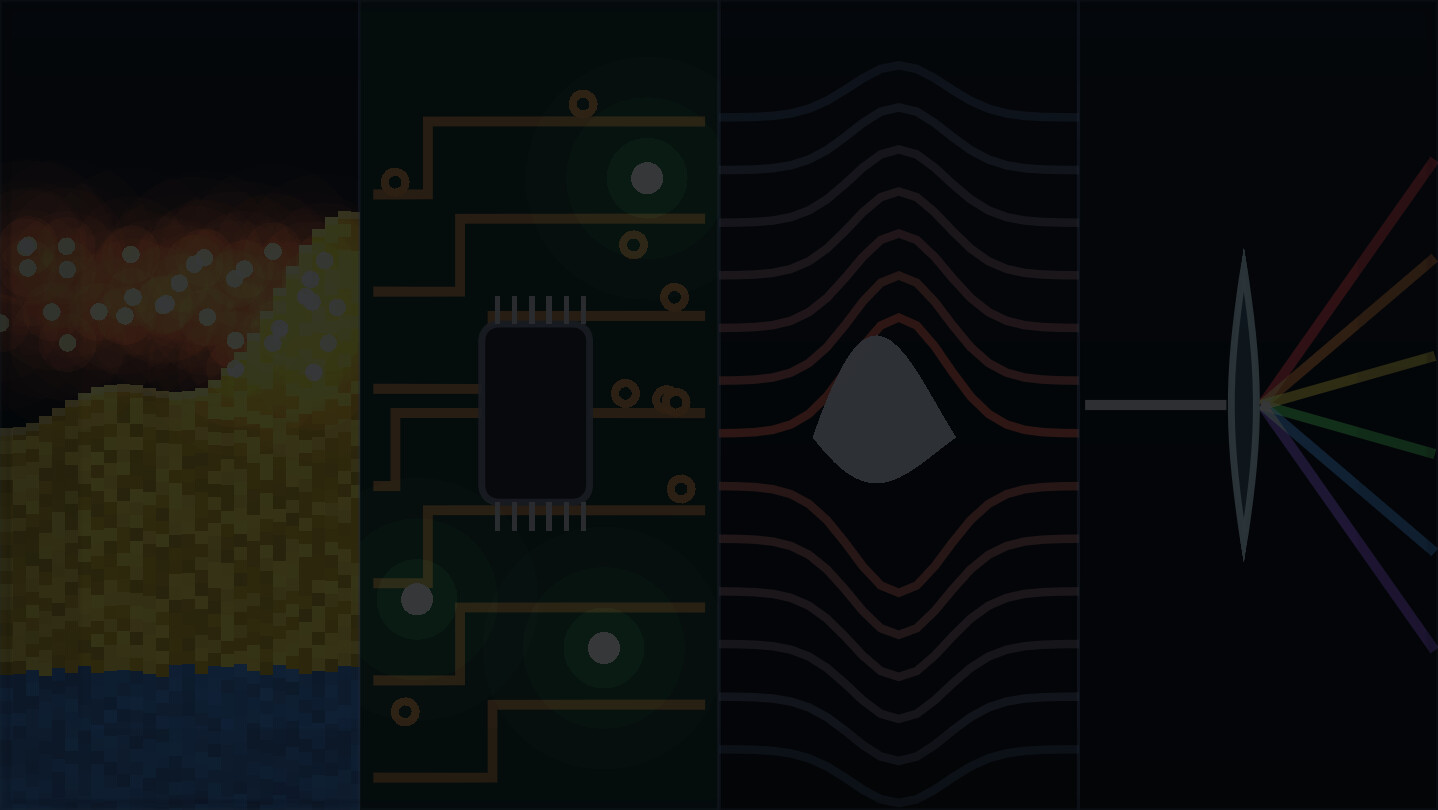



A physics sandbox built on real chemistry. Drop 674 materials into a falling-sand world and watch them react, burn, freeze and explode. Then wire circuits, test wings in a wind tunnel, or split light through lenses — alone or with friends online.

Sign in to add this item to your wishlist, follow it, or mark it as ignored

Coming Soon To Early Access

The developers of this game intend to release as a work in progress, developing with the feedback of players.

Note: Games in Early Access are not complete and may or may not change further. If you are not excited to play this game in its current state, then you should wait to see if the game progresses further in development. Learn more

What the developers have to say:

Why Early Access?

“Powdertron is already a large sandbox, but it is one I am still building. Releasing now lets the people playing it decide where it grows: which materials get added, how multiplayer sessions should work, and which of the four simulators deserves the most attention. Feedback from people actually using it is worth more than anything I can guess on my own.”

Approximately how long will this game be in Early Access?

“I plan for around a year in Early Access, though that depends on how the game develops and what players ask for. I would rather leave Early Access when it is ready than hold to a date.”

How is the full version planned to differ from the Early Access version?

“I plan to keep expanding the material library and the reaction set, deepen the electronics simulator with more components and larger boards, and continue improving multiplayer. I also plan to add more story challenges, translations into further languages, and Steam features such as achievements and cloud saves. The scope may change as I learn what players actually want from it.”

What is the current state of the Early Access version?

“The game is fully playable. It includes four simulators — chemistry, electronics, wind tunnel and optics — with 674 materials, 1,409 reaction rules, a guided tutorial, story challenges, saving and loading, mod support, and online multiplayer over Steam. Multiplayer is the newest part and has had limited testing across different machines and networks, so it is the area most likely to have rough edges.”

Will the game be priced differently during and after Early Access?

“I plan to raise the price gradually as more content and features are added. Anyone who buys during Early Access will not need to pay again.”

How are you planning on involving the Community in your development process?

“I read and reply on the Steam community forums, and I treat bug reports and suggestions as a queue to work from. Players can share the reactions and circuits they find, and mod support means the community can add materials of its own. I plan to post regular updates covering what has changed and what I am working on next.”
Read more
This game is not yet available on Steam

Planned Release Date: September 2026

Interested?
Add to your wishlist and get notified when it becomes available.
 
See all discussions

Report bugs and leave feedback for this game on the discussion boards

About This Game

Four simulators. One sandbox.

Powdertron is a physics playground where the chemistry is real. Its 674 materials — pure elements, compounds, alloys, minerals and industrial stock — each carry a genuine density, melting point, boiling point and formula, and 1,409 reaction rules decide what happens when they meet. Iron rusts. Sodium explodes in water. Limestone calcines. Nothing here is a lookup table of pretty colors.

Chemistry

Paint sand, water, acid, thermite or plasma onto a canvas of up to 120,000 cells and let it run. Heat it, freeze it, set it alight, pull the air out to a vacuum or switch gravity off entirely. Phase changes, combustion, dissolution, radioactive decay, heat conduction and structural collapse all play out cell by cell in a multithreaded C++ engine — fast enough that a full canvas still runs smoothly.

Electronics

A real circuit simulator, not a wiring puzzle. Batteries, resistors, capacitors, inductors, logic gates, seven-segment displays and an oscilloscope, connected by actual nets rather than cell adjacency. Build something that works, package it into a named chip, and drop that chip into your next design.

Wind Tunnel

Draw a shape, put it in the airflow, and see what happens. A lattice-Boltzmann solver renders live streamlines, pressure across the surface of the body, and the point where the flow separates.

Optics Bench

Lenses, mirrors and prisms with wavelength-accurate refraction. Split white light into its spectrum, chase a focal point, or build something that shouldn't work and find out why it doesn't.

Learn it by breaking it

Every material carries its real formula and properties, and reactions you trigger are logged as discoveries as you find them. A guided tutorial and a set of story challenges give you somewhere to start if a blank canvas is too much choice.

Build together

Host a session over Steam and share a canvas with friends. Everyone paints into the same world, sees each other's cursors, and watches the same simulation run. Name your worlds, give each its own physics settings, and lock the session with a password if you'd rather keep it private.

Make it yours

Add your own materials through the mods folder, save and load worlds, capture screenshots, and export measurement data straight to CSV for when the sandbox turns into an experiment.

AI Generated Content Disclosure

The developers describe how their game uses AI Generated Content like this:

Some of Powdertron's development and marketing materials were produced with AI assistance. The store page text was drafted with an AI writing tool and edited by hand, and the capsule images and trailer were rendered by procedural code written with AI assistance, using the game's own artwork and captured gameplay footage.

The game itself contains no generative AI. Nothing is generated at runtime, no AI service is contacted while you play, and all in-game content — the materials, reaction rules, simulations and interface — is authored and deterministic.

System Requirements

    Minimum:
    • Requires a 64-bit processor and operating system
    • OS: Windows 10 64-bit
    • Processor: Dual-core 2.0 GHz with SSE2
    • Memory: 4 GB RAM
    • Graphics: OpenGL 3.3 compatible, 1 GB VRAM (Intel UHD 630 or better)
    • Network: Broadband Internet connection
    • Storage: 250 MB available space
    • Sound Card: Any Windows-compatible device
    Recommended:
    • Requires a 64-bit processor and operating system
    • OS: Windows 11 64-bit
    • Processor: Quad-core 3.0 GHz or better
    • Memory: 8 GB RAM
    • Graphics: Dedicated GPU with Vulkan or OpenGL 4.5, 2 GB VRAM
    • Network: Broadband Internet connection
    • Storage: 500 MB available space
    • Sound Card: Any Windows-compatible device
Review Filters