
Build a robot from real parts — solenoids, gears, connecting rods — wire it up, and figure out why it won't turn yet. Nothing here is faked: the current is really computed, and every breakdown has a cause you can find.

Sign in to add this item to your wishlist, follow it, or mark it as ignored

This game is not yet available on Steam

Coming soon

Interested?
Add to your wishlist and get notified when it becomes available.
 

About This Game

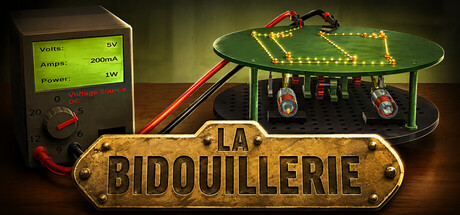
A perforated chassis, a box of parts, and a robot that has to roll. You bolt the mechanics underneath, you wire the electrics on top, you switch it on — and then you find out what you got wrong.

Build with real parts

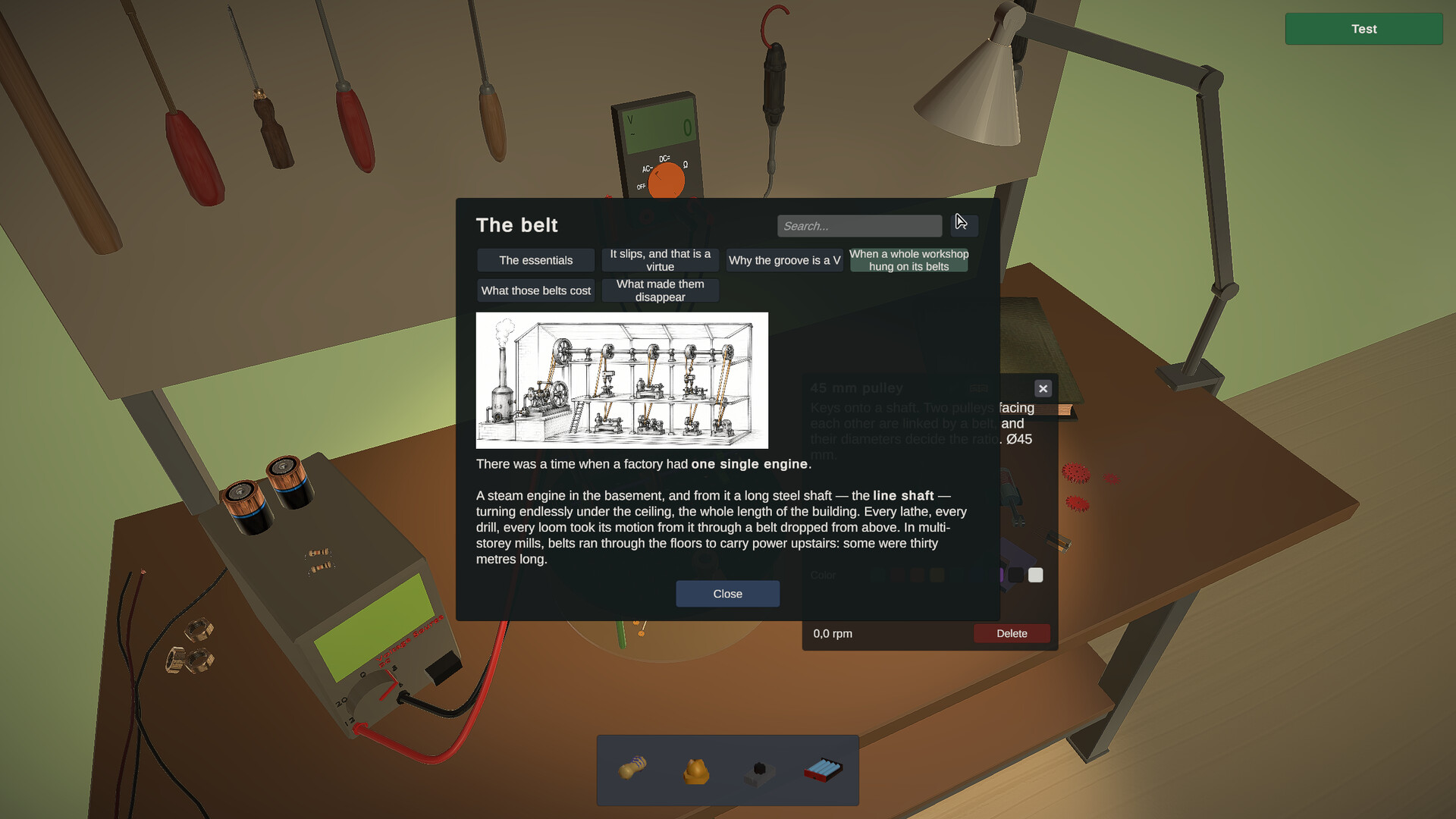
Solenoids, gears from 8 to 32 teeth, connecting rods, crank pins, bearings, shafts, drive wheels, flywheels, a contact breaker, capacitors, a resistor, a switch. Every part has a data sheet, real dimensions and a place where it fits. Nothing snaps magically into position: if your two shafts sit a few millimetres too far apart, the gears will not mesh, and the game will tell you by how much.

Nothing is faked

Ten thousand times a second, the game solves a real system of equations to find the voltage at every point of your build and the current in every wire. That is why your machine behaves like a machine. It stalls at dead centre until you fit a flywheel. Your breaker contacts erode spark by spark until they stop conducting — and a capacitor in the right place will save them. The connecting rod tears off if you stretch the linkage too far.

Every failure has a cause, and you can find it

Press F1 and the Encyclopaedia opens: every part, every idea, every fault, cross-referenced. Not a manual — a workshop notebook that explains why the spark eats your contacts, and what a magnetic field has to do with any of it.

In this demo

Twelve build missions, from a solenoid you slide in and out by hand to a robot that drives itself down a track on its own battery. Then a free sandbox with the parts box open — and a pinball table to build and play.

In the full game

The demo teaches you the parts. The full game makes you earn them.

We start with an electromechanical pinball — relays, solenoids, contacts — because that is how the story goes. The electronics that came right after (transistors, the first integrated circuits, parts you can still read with your eyes) only make sense once you have seen the mechanics they replaced. And today’s electronics only make sense once you have seen those.

You start with a broom and an empty workshop. Cleaning pays, parts cost money, and the catalogue is the tech tree: the more advanced the part, the more it costs — real prices, real reasons. Build a vacuum robot that reaches under the furniture, then one flat enough for the low cupboard, then one that actually sucks, for the carpet. Each room asks for a different machine, and the room decides, not a lock.

Parts wear out. Contacts erode, LEDs blow, a stretched linkage tears its rod off — and you buy again, or design better.

Doors you can see from across the room open with keys you find by cleaning where nothing else reaches. Behind them: the pinball table, the upper floor, and new seasons of parts — DC motors with real brushes, transformers, and the mechanisms that need them.

And the Encyclopaedia keeps growing with every part you unlock.

Eight languages

English, French, Spanish, Brazilian Portuguese, Russian, Simplified Chinese, German and Japanese — every text of the game and every page of the Encyclopaedia. Everything beyond French and English was translated by an AI, with the vocabulary of the workshop, and no native speaker has read it yet: if a sentence sounds wrong, say so in the game's message board or on the forum, and it will be fixed.

AI Generated Content Disclosure

The developers describe how their game uses AI Generated Content like this:

Some marketing assets on the store page (capsules, logo) were produced with a generative AI tool, based on screenshots and 3D renders from the game itself.

Part of the in-game text (encyclopaedia entries and mission briefings) was drafted with the assistance of a large language model, then reviewed and edited by the developer.

The 3D parts, textures and the simulation itself are authored. Nothing is generated while the game is running.

System Requirements

    Minimum:
    • Requires a 64-bit processor and operating system
    • OS: Windows 10 64-bit
    • Processor: Intel Core i5 (2nd generation) or AMD equivalent
    • Memory: 8 GB RAM
    • Graphics: NVIDIA GeForce GT 520 / Intel HD Graphics 4000
    • DirectX: Version 11
    • Storage: 500 MB available space
    Recommended:
    • Requires a 64-bit processor and operating system
Review Filters