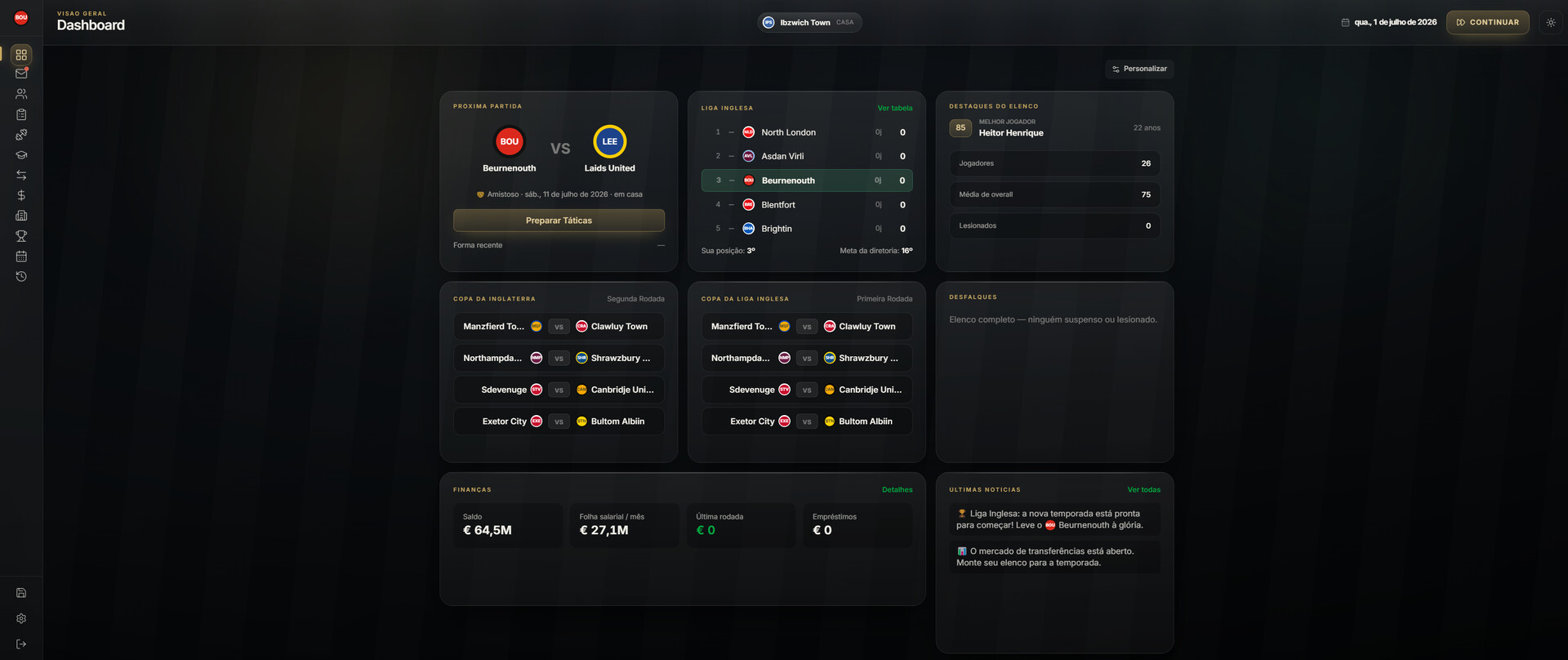


Take charge of a football club and answer for everything: sign players in a market where clubs haggle for days, balance the wage bill against the board's demands, and steer matches live from the touchline. 27 leagues, 690 clubs, one season at a time.

Sign in to add this item to your wishlist, follow it, or mark it as ignored

Coming Soon To Early Access

The developers of this game intend to release as a work in progress, developing with the feedback of players.

Note: Games in Early Access are not complete and may or may not change further. If you are not excited to play this game in its current state, then you should wait to see if the game progresses further in development. Learn more

What the developers have to say:

Why Early Access?

“Footy Manager is already a complete game: 27 leagues, over 690 clubs and 15,000 players, with full seasons, a transfer market, club finances, tactics and live matches. But a management game lives on its details, and details only surface through play.

I have spent the past months testing with a small group, and nearly every meaningful fix came from a player's report — an unbalanced market value, an odd decision by a rival manager, a confusing screen. Early Access is how I widen that group and keep refining the game alongside the people actually playing it.”

Approximately how long will this game be in Early Access?

“I plan to keep the game in Early Access for roughly to twelve months. The timeframe depends on player feedback — I would rather leave Early Access when the game feels well balanced than on a fixed date.”

How is the full version planned to differ from the Early Access version?

“I plan to use Early Access to deepen what is already there, rather than to pile on features.

The directions I intend to work on:

• Simulation balance — market values, how rival clubs negotiate, player development and match results
• More depth in management — youth academy, scouting and board relations
• National teams, with call-ups and international tournaments
• Interface improvements guided by real use
• Fixes and adjustments based on community feedback

None of this is a firm commitment: these are the directions I intend to follow, and the order may change according to what players ask for.”

What is the current state of the Early Access version?

“The game is complete and playable from start to finish. You can run a career across multiple seasons in any of the 27 leagues, competing in national championships, cups and continental competitions.

Already in the game: a transfer market with negotiation and instalment payments, detailed finances, tactics with dozens of formations, live matches with substitutions and half-time adjustments, a youth academy, club infrastructure, a database editor, and support for Portuguese (Brazil and Portugal), English and Spanish.

What I expect to improve is balance — the numbers that make a season feel fair — and that is exactly where player feedback matters most.”

Will the game be priced differently during and after Early Access?

“I plan to raise the price gradually as the game gains content and depth. Anyone who buys during Early Access will receive all updates at no additional cost.”

How are you planning on involving the Community in your development process?

“I am a solo developer and I will follow the Steam forums personally. The game includes a built-in feedback channel, which is already the main source of the adjustments I make.

I intend to release updates regularly and explain what changed and why in each one. The game also ships with a database editor that lets players adjust names, squads and images — and what the community builds with it helps guide what I prioritise.”
Read more
This game is not yet available on Steam

Planned Release Date: Sep 30, 2026

This game plans to unlock in approximately 3 weeks

Interested?
Add to your wishlist and get notified when it becomes available.
 
See all discussions

Report bugs and leave feedback for this game on the discussion boards

About This Game

A whole club in your hands

You take over a team and you answer for it. Not just for Sunday's line-up: for the wage that fits

the budget, for the kid coming up from the academy, for the bid that lands for your best player the

night before the derby.

The board hired you with an expectation a place in the table, a run in the cup, the books in the

black. Meet it and you keep the job. Miss it and there are consequences, and they arrive before the

season ends.

Pick your side of the club

Three roles, three different games inside the same world.

Manager  - everything goes through you: line-up, training, transfers, finances and building work.

Head Coach - you handle what happens on the pitch. The board buys and sells, but they ask you

first when a bid comes in for one of your starters: he's essential, he'd do, I don't need him.

Your word carries weight it doesn't rule. With the club in the red they sell anyway, and the email

explains why.

Director of Football - you don't pick the team and you don't train it. You hire the person who

does, and you answer for the whole club.

DIRECTOR MODE - the club beyond the touchline

The coach is a person, not a menu

He has a name, an age, a personality, attributes and a contract. In the objectives meeting the two

of you agree the season league, cup, academy, finances and what you agree is locked until the

year turns.

After that it's a relationship: push him, praise him, call a squad meeting. Every conversation

carries risk, and his reaction depends on who he is. When the fans call for his head, you decide

whether to back him.

He asks for signings too. When the squad is thin somewhere, he arrives with names that make sense

for a club your size. Delivering improves the relationship; ignoring him until the window shuts

wears it down.

The stadium is yours, section by section

The stadium stopped being a single number. It is a map of up to 20 positions terrace, seating,

boxes, and the pitchside boxes right on the touchline and each section has its own price.

An expensive box empties the box and never spills into the terrace. You can bleed the people who

pay most and still keep the crowd in the ground, which is exactly what a real director does.

Six stadium shapes, and your club is born with one: complete, missing a side, ends only, missing an

end, single tier (which can double), and the bowl, where the ends curve round and swallow the

corners. The shape decides the club's ceiling and where you can build.

Expanding is a year-long decision. Work takes 20 to 52 weeks depending on size, and the section

stays shut throughout. You see the cost, the timeline, the revenue per match and how many matches

it takes to pay for itself before you sign anything.

Advertising starts at zero

When you take the job the club has no deals at all: no pitchside boards, no shirt sponsor, no store

partner. Eleven spaces, and every one of them is negotiated.

Offers arrive through the season, and what they pay depends on the division, the club's standing

and the average crowd. A small club gets a small offer. Going up brings better ones. A long deal

buys certainty; a short one lets you renegotiate once the club grows.

Membership is a choice, not a number

Up to four plans, and you set everything: the monthly fee, the perks, and how much a member pays

for a ticket.

Free entry fills the membership and empties the gate. Stingy perks do the opposite: a full gate,

few members, shaky income. There is no right answer there's yours.

Social media has an owner, and you hire them

The club has accounts, but nobody runs them. They bleed followers until you hire a social media

manager one to five stars, on a wage that comes out of the club's payroll.

Their profile changes everything. The same goal becomes "Club goal. Smith, 38 minutes" from the

corporate type and a three-exclamation-mark shout from the supporter. The corporate one never slips

and never thrills. The provocateur gets the biggest reach and creates the crisis alongside it. The

content creator makes the video the fans share and gets the tone wrong on a bad day.

They work on their own: goals, full time, matchday eve, the table, a player's birthday on his real

date, a new signing, work starting at the ground. Three networks with different audiences images,

quick text and short video and what lands on one falls flat on another.

And they come to you when the call is a management one: the coach under pressure, complaints about

ticket prices, a rival taking shots on derby eve. You see what each path costs before you choose 

or you leave it to them, and their profile decides.

Reach becomes money: members who arrive through social media, store sales, and weight in

sponsorship offers. That's what justifies the wage.

And when the rival goes out

The game knows who your real rivals are. Eighty-three derbies with names of their own the one

across the city, the one across the region, the one that stops the country. When one of them is

knocked out of a cup, the wind-up is available, and it has a price: go out yourself in the next

round and it comes straight back at you.

Sunday, 4pm. Kick-off.

The match runs and you follow it minute by minute. Speed it up when you're comfortable, pause it

when it tightens.

Losing on 60? Change the mentality, take off a holding midfielder, throw on another striker. Except

the bench gives you five changes across three stoppages the real rule and burning them early

leaves you with nothing when someone pulls up.

The other coach is doing the same. Behind, he'll commit; ahead, he'll shut up shop. The game

doesn't wait for you to decide on your own.

A settled team is a better team

Naming the same eleven builds understanding, and that is worth points on the pitch. Rotating too

much tears it down. But the calendar doesn't forgive: cup on Thursday, league on Sunday, and a

tired starter gives you less than a fresh substitute.

Every player has morale, form and a specific role. A centre-back shoved out to full-back plays

worse the engine knows, even when the team sheet looks right on paper.

Fifty-seven formations, and the pitch view shows what each one does.

The market is a negotiation, not a button

You make the bid. The other club takes days to answer, and can come back asking for more. Meanwhile

another team joins the race for the same player and whoever offers the better project, not just

the bigger fee, gets him.

Once the clubs agree, you still have to convince the player. Wage, signing-on fee, contract length.

He can turn you down and hold out for a move that matches his ambition.

When the cash won't stretch, there are ways round it:

- Pay in instalments - take the signing now and pay over time, with interest. Miss a payment

date and the debt grows, and the board hears about it.

- Pay the release clause - the club can't refuse. But it costs, and the player still has to

want to come.

- Loan - split the wage, negotiate an option to buy, and bar him from playing against you.

- Give up a sell-on percentage - cheaper today, and you sign away part of tomorrow's profit.

The books close at the end of the month

Sponsorship, TV money, gate receipts and the store on one side. Wages, upkeep and the instalments

you took on the other. On the first of every month the balance lands and it is the ruler for

everything you can do in the market.

A small club doesn't buy a star. But it can make one.

The academy takes years, and it's yours

The kids develop slowly. Promote too early and you hand a raw player to the first team; hold on too

long and you waste his best years. And at 21, anyone not promoted walks away for nothing.

You get a promotion quota each season. Choose well.

27 countries. A world that plays without you.

Brazil, England, Spain, Italy, Germany, France, Portugal, Argentina and more 693 clubs and

almost 16,000 players contesting their own leagues, domestic cups and continental competitions.

Clubs sign from each other, go up, go down and change coaches while you look after yours. Want a

lighter world? Choose which leagues the game simulates.

Your way

A full database editor ships with the game: names, squads, attributes, stadiums and images.

Whatever you build can become a file and be shared with other players in comunity.

Full interface in English, Spanish and Portuguese (Brazil and Portugal).

System Requirements

    Minimum:
    • Requires a 64-bit processor and operating system
    • OS: Windows 10 64-bit (versão 1809 ou superior)
    • Processor: Intel Core i3-4000 / AMD FX-6300 ou superior
    • Memory: 4 GB RAM
    • Graphics: Placa integrada com suporte a DirectX 11 (Intel HD 4000 ou superior)
    • DirectX: Version 11
    • Storage: 1 GB available space
    • Additional Notes: Requer resolução mínima de 1280x720.
    Recommended:
    • Requires a 64-bit processor and operating system
    • OS: Windows 11 64-bit
    • Processor: Intel Core i5-8400 / AMD Ryzen 5 2600 ou superior
    • Memory: 8 GB RAM
    • Graphics: Placa dedicada com 2 GB
    • Storage: 1 GB available space
    • Additional Notes: Requer resolução mínima de 1280x720.
Review Filters