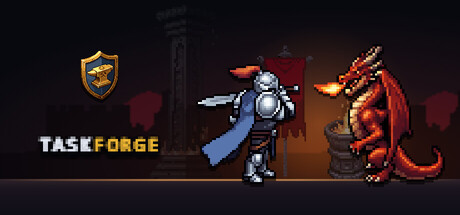

Taskforge is an idle RPG that lives in a floating strip on your desktop. Pixel heroes fight on their own while you work — you gear them, pick the party, and choose where to farm. 5 acts, 50 stages, three difficulties, and loot with six rarities and rolled affixes.

Sign in to add this item to your wishlist, follow it, or mark it as ignored

This game is not yet available on Steam

Coming soon

Interested?
Add to your wishlist and get notified when it becomes available.
 

About This Game

A whole RPG in a strip on your desktop

Taskforge doesn't run fullscreen. It lives in a borderless strip floating above whatever you're already doing — and inside it your heroes fight, die, level up and bring back loot while you work.

It takes your desktop, not your attention

Drag the strip anywhere: the position is saved per monitor. Pick one of three sizes and decide whether it stays on top. Closed the game? Your heroes keep earning gold and XP while you're away, and a summary tells you exactly what came in when you get back.

Combat is automatic. The decisions are yours

Nobody clicks attack, target or ability. You command three things, and that's where the game lives:
  • Gear — which item goes on which hero
  • Party — who's in and in what order, because whoever stands in front is who takes the hits
  • Where to farm — which stage and which difficulty to repeat

Four heroes, three slots

All available from the start — there's no recruiting, there's choosing. The Guardian is the only hero who can reach the game's 80% damage reduction. The Ranger turns attack speed into damage from range. The Arcanist hits several targets at once and brings down the whole wave. The Cleric keeps the whole party regenerating as long as they're alive on the field. Only three fight at a time, and whoever stands in the first slot takes every hit — so who goes in, and in what order, is a real decision.

Every hero wears their own set

Six of the nine slots are class-locked — weapon, off-hand, chest, helm, gloves and boots — and the main stat of each piece comes from the class itself: the Guardian's helm and gloves are armor, the Ranger's buy critical chance and attack speed, the Arcanist's buy critical damage and raw damage, the Cleric's buy XP gain and item find. Only the three accessories move freely between heroes. A drop meant for someone else is never wasted: break it down and craft the piece you actually want.

Loot that changes the sheet, not a power number

Nine slots, 54 base items, six rarities and affixes with rolled values — what the item card says is exactly what lands on the hero's stats. On weapons and armor, two bases of the same type aren't the same thing: the focused piece concentrates the main stat and gives up an affix; the broad one keeps your options open. In the Workshop you forge pieces, reroll affixes and break down what you don't need.

Five acts, fifty stages, three difficulties

Twelve enemy species with distinct silhouettes, an elite closing every stage and a boss at the end of every act. Every stage resolves in under five minutes: the party clears it or dies trying. Difficulty isn't waiting longer — it's the enemy hitting harder, and you coming back better prepared.

Pixel art made for the strip

Every hero and every enemy reads by silhouette alone, in a sprite small enough to fit a 132-pixel band and clear enough that you know what's happening out of the corner of your eye.

AI Generated Content Disclosure

The developers describe how their game uses AI Generated Content like this:

The pixel art in Taskforge — character and enemy sprites, animation frames, item and UI icons, scenery pieces and the game's emblem — was produced with the help of an AI image generation tool during development. Every generated asset was reviewed, selected, edited and assembled by hand, and ships as a fixed image file. Nothing is generated while you play: the game contains only static assets and never calls an AI service at runtime. Code, game design, balance data and all written text were made by the developer.

System Requirements

    Minimum:
    • OS: Windows 10 64-bit
    • Processor: 64-bit dual-core, 2 GHz
    • Memory: 4 GB RAM
    • Graphics: Integrated graphics with DirectX 11 support
    • DirectX: Version 11
    • Storage: 500 MB available space
    • Additional Notes: Runs in a borderless window on your desktop, not fullscreen. Minimum screen resolution 1280x720.
    Recommended:
    • OS: Windows 11 64-bit
    • Processor: 64-bit quad-core
    • Memory: 8 GB RAM
    • Graphics: Integrated or dedicated graphics
    • DirectX: Version 11
    • Storage: 500 MB available space
    • Additional Notes: 1920x1080 screen resolution.
Review Filters