
Keep the last forge burning. Buy iron, hammer blades, sell to the travellers who walk in — and every spark you throw makes the dark see you further. Arm your neighbours, direct turn-based battles, and cut ten expeditions into the Long Night. Nothing advances while you are away.

Sign in to add this item to your wishlist, follow it, or mark it as ignored

This game is not yet available on Steam

Coming soon

Interested?
Add to your wishlist and get notified when it becomes available.
 

About This Game

The Long Night fell once, and it is coming back.
While one forge still burns, it cannot close over the world.
You are not a king. You are not a hero.
You are the smith who keeps the ember lit.

One rule, and it changes everything


Nothing happens while you are away.

Not the forge queue. Not the village. Not the countdown to the next warband. Close the game and the world holds its breath; open it again and it exhales exactly where you left it — same iron on the anvil, same seconds left on the wave clock.

This is a deliberate design decision, not a missing feature. There is no harvest waiting for you when you come back, so there is no reason to come back out of guilt. The session is the game. If you are looking for a number that grows in your pocket while you sleep, this is the wrong forge.

Prosperity and danger are the same coin


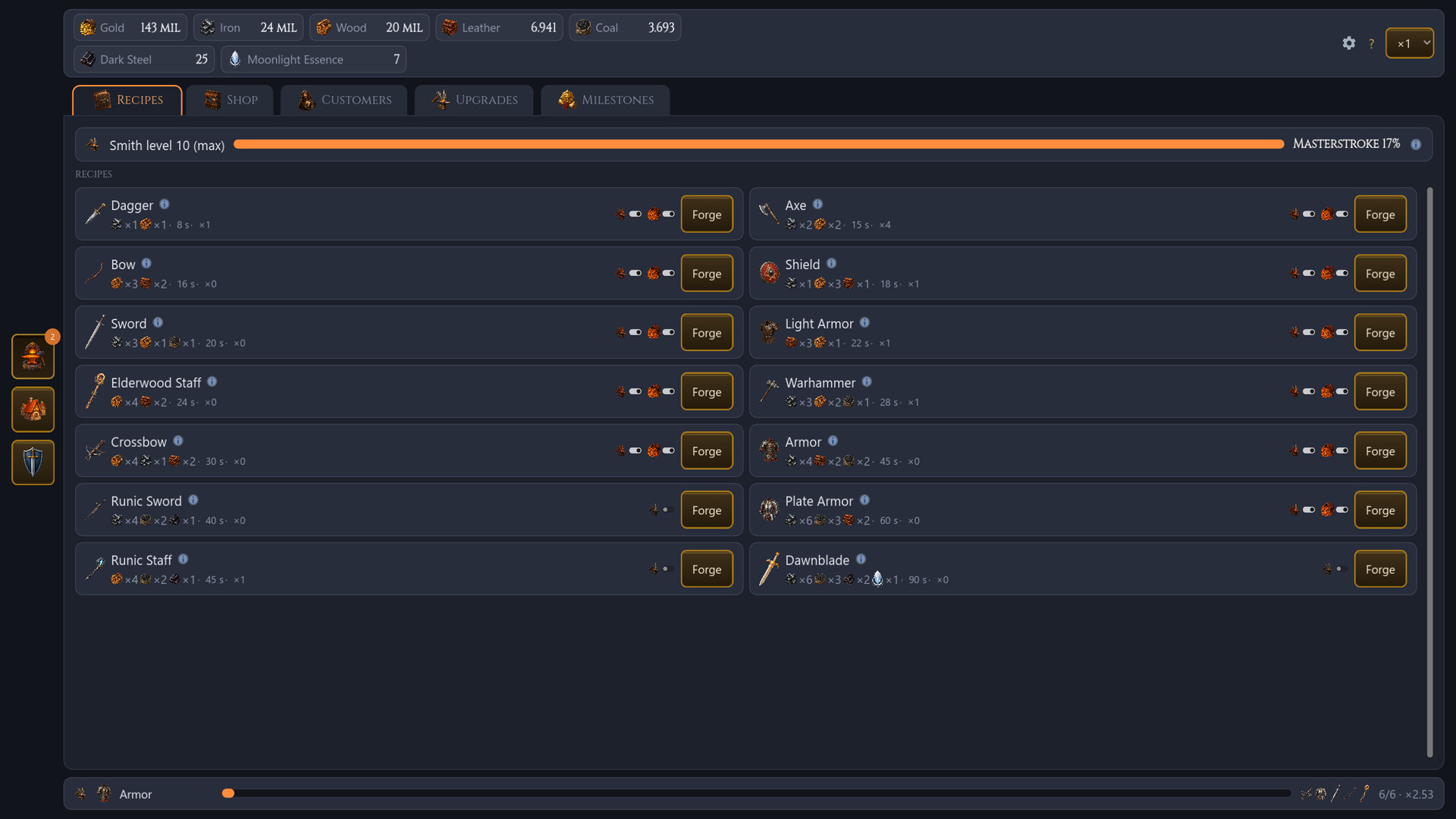
Buy iron, wood, leather and coal. Hammer them into daggers, swords, armour, bows and shields. Sell them to the adventurers who walk into your shop, and put the gold back into a faster forge, a longer queue, a village that feeds itself.

Then they come for the light. Every weapon you hammer out is a spark thrown at the dark — and the brighter your forge burns, the more of them see it. That is not flavour text bolted onto an economy. It is the economy.

What grows around the anvil


A village. Houses fill with people who arrive on their own schedule. Give them a trade — woodcutter, tanner, collier, farmer, instructor — and they feed the forge with raw material instead of just eating your grain. Eleven jobs, eleven buildings, and morale that sours if you let them go hungry.

A wall. The warbands are not random encounters. Every bandit is someone who found a splinter of dark steel and could not put it down, and the metal whispers the same order to all of them: go to the forge in the valley and put it out. You recruit from your own population, equip them with what you made yourself, arrange them in formation, and fight a turn-based battle you can actually direct.

A road out. Ten expeditions, each with a named boss and a weakness that means something: the axe splits the man who was once a woodcutter, the hammer dents the plate another one stole. Six destinations are the human kingdom of bandits. The last four are what was standing behind it.

A myth you assemble yourself. Nobody narrates it at you. It is scattered across item descriptions, boss epitaphs and material lore, and the Codex fills in as you earn the fragments. Play the whole game without reading a line and it works fine. Read them, and the ordinary metal you have been farming since your first wave starts to look very different.

Three tempers


  • Normal — Fallen units retire wounded and come back whole. The calm temper.
  • Hard — Tougher enemies, an extra minion per fight, and the fallen need treatment before they can fight again.
  • Permadeath — The fallen are gone, and their equipment comes back to your anvil bent. Reaching the final boss at all is roughly a coin flip. It is meant to be brutal.

The forge in numbers


  • 14 recipes on the anvil, from a bare dagger to the Dawn Sword
  • 11 village jobs and 11 buildings
  • 31 milestones, each with a reward
  • 10 expedition destinations, every one with a named boss
  • Fully localised in English and Spanish
  • Zero emoji — every icon is bespoke art

Autosaves every 30 seconds and on exit, with atomic writes and a backup that survives a corrupt save.

AI Generated Content Disclosure

The developers describe how their game uses AI Generated Content like this:

Some of the artwork in The Dawn Forge — the item, building, unit and boss illustrations — and the spoken narration lines were created using AI image and voice tools, working from the developer's own art direction and scripts, and then composed and edited by hand. Nothing is generated while you play: the game runs entirely offline and never contacts an AI service.

System Requirements

    Minimum:
    • Requires a 64-bit processor and operating system
    • OS: Windows 10 64-bit
    • Processor: Dual-core 2.0 GHz (x86_64)
    • Memory: 4 GB RAM
    • Graphics: Vulkan 1.0 capable GPU
    • Storage: 1 GB available space
    • Sound Card: DirectX compatible
    Recommended:
    • Requires a 64-bit processor and operating system
    • OS: Windows 11 64-bit
    • Processor: Quad-core 2.5 GHz
    • Memory: 8 GB RAM
    • Graphics: Dedicated GPU with Vulkan 1.2 and 2 GB VRAM
    • Storage: 1 GB available space
    • Sound Card: DirectX compatible
    • Additional Notes: Designed for 1920x1080
Review Filters