


Guide one family across centuries of collapse, evacuation, settlement and interstellar expansion. Preserve memories, establish laws, command crews, inherit ships and face the Afterless as every choice becomes part of history.

Sign in to add this item to your wishlist, follow it, or mark it as ignored

This game is not yet available on Steam

Planned Release Date: To be announced

Interested?
Add to your wishlist and get notified when it becomes available.
 

About This Game

Nothing ends. It only casts a longer shadow.

Earth is dying.

Water is rationed. Fuel has become scarce. Electricity fails without warning. Armed soldiers guard power stations, reservoirs and transport hubs while governments insist that recovery is still possible. Behind closed doors they are deciding who will be evacuated and who will be left behind.

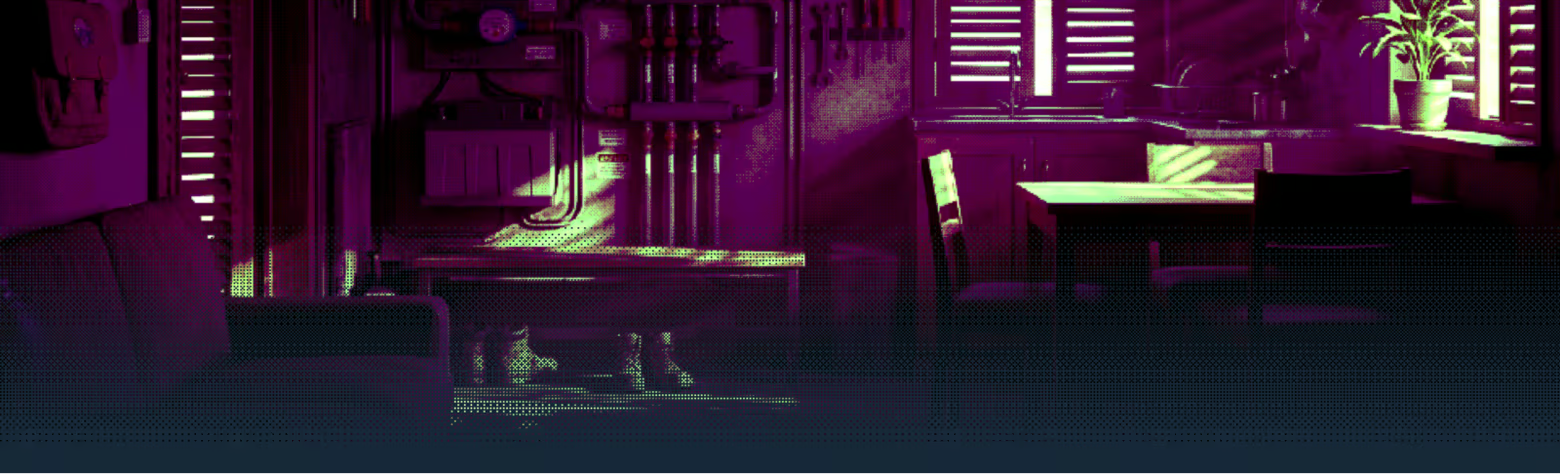
You begin in 2098 as an ordinary parent trying to keep a family together during the final years of Earth.

You won’t remain that person for long.

Long Shadow is a text-first, choice-driven science-fiction RPG where you guide a single family across more than four centuries of human history. Every generation inherits the consequences of the last. Children become parents. Parents become memories. Eventually they become history.

When a character dies, the story continues through their descendants.

Your family inherits property, relationships, reputation, legal rights, unfinished disputes, old promises and forgotten mistakes. A record created during Earth’s evacuation may decide a court case two hundred years later. A law written after a desperate winter may shape an empire. Someone your family abandoned generations ago may still have descendants who remember.

There are no hero levels to grind.

There is only the family you leave behind.

A branching family saga

Long Shadow is a branching narrative RPG set in a persistent world that remembers every generation.

Guide your family through Earth’s collapse, humanity’s evacuation, life aboard Lunar Base, centuries inside a failing generation ship, the founding of New Earth and the expansion of civilisation across the stars.

Every playthrough creates a different family history.

Raise children. Build relationships. Establish settlements. Write laws. Command starships. Explore distant systems. Decide what survives each generation and what is left behind.

Governments preserve records.

Families preserve memories.

History judges both.

Earth is ending

The first decisions feel ordinary because the disaster has become routine.

Your child still goes to school. Bills still arrive. Food still needs cooking. Outside, queues grow longer every week. Water restrictions tighten. Rolling blackouts interrupt daily life. Fewer vehicles pass the house because fuel has become too valuable to waste. Military checkpoints appear around reservoirs, substations and transport routes. Everyone knows someone who has disappeared into an evacuation programme. Nobody knows how those decisions are made.

You decide what your family sees.

Do you explain what is happening, or protect your child from it for one more day?

Do you store food or help the neighbour who has already run out?

Do you keep the lights on tonight, knowing tomorrow’s electricity may cost even more?

These moments shape the household long before anyone leaves Earth.

When the evacuation begins, your family carries more than luggage.

It carries habits, trust, fear and memories that will follow every generation that comes after.

Pass through the Defence of Earth Complex

The evacuation begins long before anyone reaches a spacecraft.

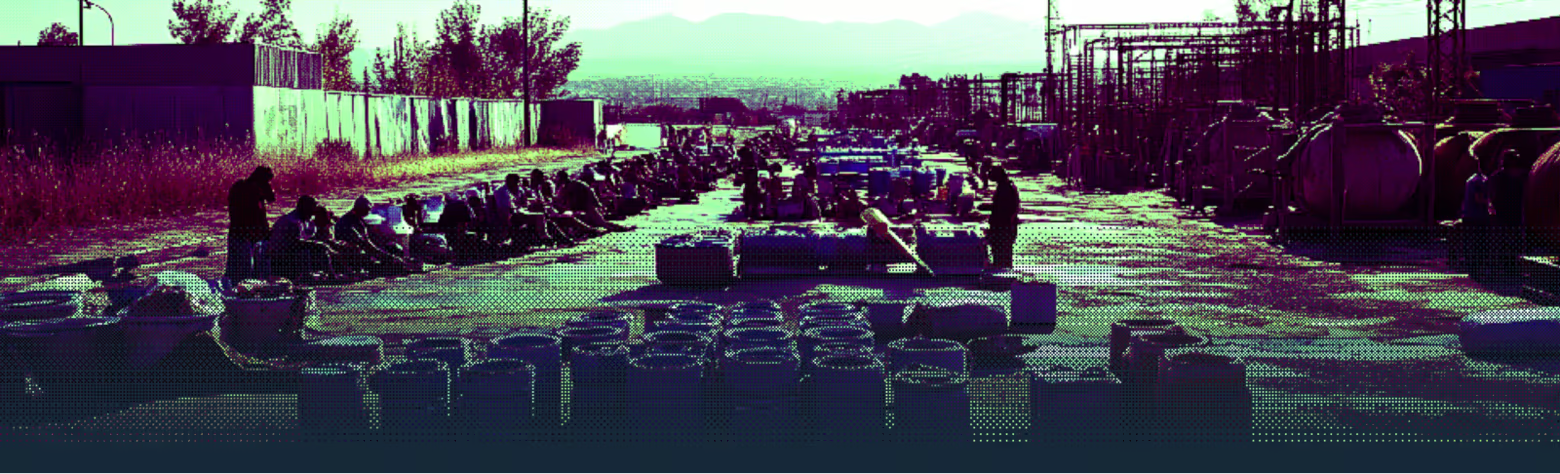
Families disappear into processing centres built to move millions of people without slowing down. Every queue has a purpose. Every checkpoint produces another record. Every official decision follows your household long after Earth has been left behind.

Identity scans.

Medical examinations.

Property declarations.

Guardian verification.

Manifest interviews.

Psychological screening.

You decide what to declare, what to conceal and when to argue.

Sometimes the safest decision is to remain invisible.

Sometimes silence costs more than honesty.

Not every family reaches the next checkpoint together.

Children can be reassigned. Records can be damaged. A single disagreement may leave one parent behind while the rest of the household continues towards launch.

The people processing your family are not villains.

Most are exhausted.

Many are making impossible decisions with incomplete information.

They are trying to preserve humanity by reducing it to paperwork.

Your choices determine far more than whether you board the transport.

They establish the official version of your family’s history.

Long after the people who made those decisions are dead, later generations may still be judged by records created during a single afternoon on Earth.

Earn your place on Lunar Base

The Moon is not a sanctuary.

It is an industrial survival system where every kilogram of food, water and oxygen has already been allocated.

New arrivals become another calculation.

Every resident consumes air.

Every resident consumes water.

Every resident must justify both.

Your family receives accommodation, work assignments and education according to what Lunar administration believes you can contribute. Reputation matters. Skills matter. Official records matter.

Sometimes those records are wrong.

Work wherever the Base needs you most.

Inspect water recycling systems.

Maintain pressure doors.

Repair damaged corridors.

Audit life-support equipment.

Assist construction crews expanding new habitation blocks.

Travel into the asteroid belt to recover materials that humanity can no longer obtain from Earth.

Explore restricted archives, industrial tunnels and shipyard rings where the evacuation is quietly becoming something larger.

The Ark is already under construction.

Everyone knows there will not be enough room.

Build a future before it exists

Life on Lunar Base settles into routine, even while humanity’s future becomes less certain.

Children grow older inside steel corridors without ever seeing rain.

Families celebrate birthdays beside recycled air systems.

Neighbours disappear after reassignment.

Schools teach engineering before history because keeping the station alive matters more than remembering how civilisation ended.

Your child learns from everything around them.

Who becomes their guardian?

Which adults do they trust?

What skills do they develop?

Do they become known for solving problems, following rules or questioning authority?

The answers affect every generation that follows.

Relationships built on Lunar Base often survive longer than governments.

Some become lifelong friendships.

Some become marriages.

Some become rivalries that echo through your family for centuries.

By the time the Ark begins accepting passengers, your household has already been changed.

Not by a single dramatic event.

By thousands of ordinary decisions that slowly became permanent.

Survive the selection

Humanity cannot save everyone.

Every berth aboard the Ark has to be justified.

Families compete for space without ever seeing the calculations that decide their future. Possessions become cargo allocations. Occupations become survival scores. Entire households are reduced to numbers on a manifest that nobody is allowed to inspect.

You decide what deserves a place.

Which heirlooms remain with the family?

Which memories are worth carrying across the stars?

Who should be protected if there is only room for one more person?

The Ark was built to preserve civilisation.

It cannot preserve every life.

Live and die aboard the Ark

The voyage lasts for generations.

You will not see the destination.

Your children may not see it either.

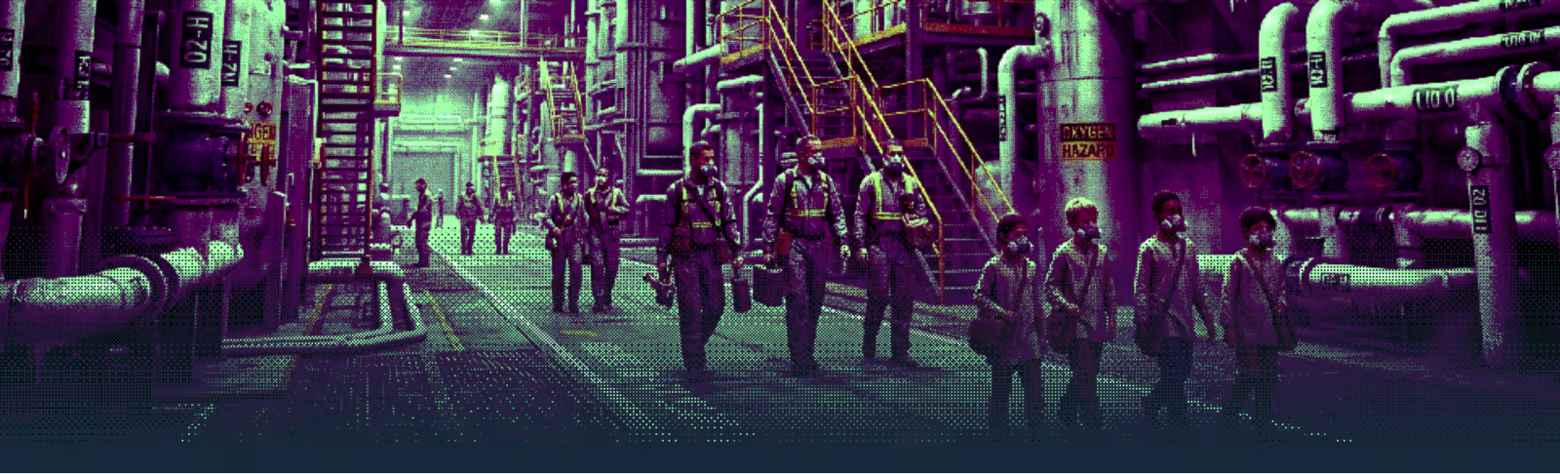
The Ark leaves the Solar System carrying the last organised remnants of humanity. It is enormous, damaged before departure and expected to remain operational for centuries without outside support.

Soon after launch, it begins to change.

Mechanical failures isolate whole sections of the ship. Corridors close permanently. Families lose contact. Children grow up believing their compartment is the whole world.

Then life settles into routine.

People fall in love.

Children are born.

Neighbours grow old.

Someone repairs the same water pump for forty years because nobody remembers how to build another.

Children born aboard the Ark know Earth only through stories. Grandparents become photographs. Languages change. Traditions drift. Every generation inherits a ship they did not build and a destination they have never seen.

The Ark stops feeling temporary.

It becomes home.

Every generation inherits the last

Long Shadow is a generational RPG built around succession.

When your character dies, control passes to the next generation.

Your descendants inherit more than possessions.

They inherit reputation.

Old promises.

Family disputes.

Friendships.

Political enemies.

Access rights.

Property.

Professional knowledge.

Some inherit questions nobody can answer.

You might spend thirty years building trust with another household only for your grandchild to inherit the consequences of breaking it.

A decision made during childhood may still define your family two hundred years later.

Every generation begins with a history that somebody else created.

Usually you.

Build relationships that survive you

The Ark is filled with ordinary people trying to build ordinary lives inside extraordinary circumstances.

Meet engineers keeping life-support systems running beyond their design life.

Teachers trying to preserve knowledge that no longer has practical value.

Doctors working with equipment assembled from parts intended for different centuries.

Archivists deciding which memories deserve permanent space.

Children who have never seen sunlight.

Form friendships.

Find a partner.

Raise children.

Support neighbours through shortages and loss.

Attend celebrations.

Settle arguments.

Watch familiar faces disappear as time moves on and new generations take their place.

The people around your family are not temporary companions.

Many remain connected to your descendants for centuries.

Explore a living generation ship

The Ark changes as it ages.

Maintenance tunnels become neighbourhoods. Storage bays become classrooms. Engineering decks become marketplaces. Entire districts disappear behind sealed pressure doors while forgotten compartments wait decades before anyone opens them again.

Explore industrial sectors, agricultural decks, archive vaults, engineering spaces, transit systems and abandoned compartments while uncovering the history of a ship that quietly rewrites itself.

Every expedition carries risk.

Pressure doors fail without warning.

Maintenance crews vanish.

Bridges collapse.

An archive recovered after three generations may contradict everything your family believed about the voyage.

Keep the Ark alive

The Ark survives because thousands of people perform work that history rarely records.

Repair life-support systems before another compartment loses pressure. Expand hydroponics when harvests fail. Recover machinery from abandoned sections where spare parts have not been touched for generations. Restore reactors, protect water reserves and keep ageing infrastructure functioning for one more year.

Every successful repair delays another crisis.

Every neglected system becomes somebody else’s emergency.

The condition of the Ark persists across generations.

Communities remember which households kept them alive.

They also remember who chose themselves first.

The record becomes another battlefield

The longer the voyage continues, the less certain its history becomes.

Witnesses die.

Documents disappear.

Official reports contradict family journals.

Governors revise events to preserve order.

Families preserve different versions of the same disaster.

You decide what deserves to survive.

Preserve uncomfortable truths.

Destroy dangerous records.

Protect private memories.

Expose official lies.

Or allow a simpler version of history to become accepted because people need stability more than accuracy.

Future generations inherit whatever survives.

Not necessarily what happened.

Reach New Earth

Centuries after leaving Earth, the Ark finally arrives.

It does not arrive safely.

Systems fail during descent.

Compartments separate.

Landing plans collapse.

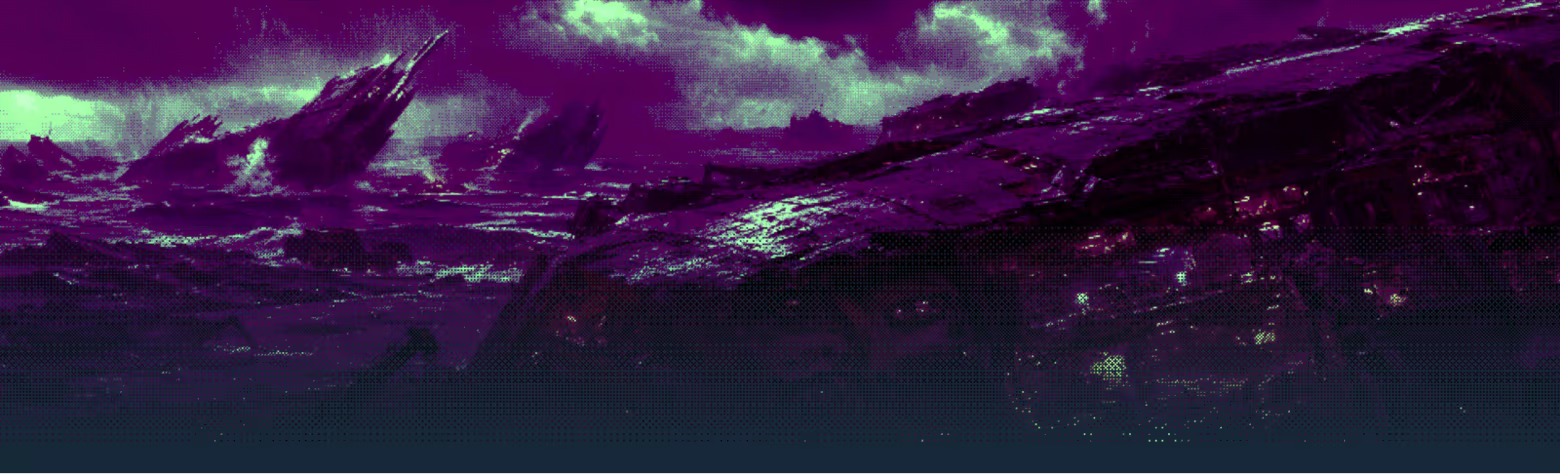
Entire sections of the ship strike the surface kilometres apart.

Families that survived the voyage may lose each other within sight of their destination.

The greatest achievement in human history ends as another struggle for survival.

The world below has no monuments waiting.

Only uncertainty.

Only opportunity.

Only the people who are still alive enough to build something from the wreckage.

Build a civilisation from the wreckage

New Earth does not begin with a victory.

It begins with survivors counting each other.

The Ark lies scattered across an unfamiliar world. Compartments have landed days apart. Cargo has been destroyed. Entire families are missing. Nobody knows how many people survived the descent.

There is no government waiting.

No established cities.

No rescue.

Only whatever your generation can build before the next winter arrives.

Recover tools. Salvage machinery. Establish shelter. Secure clean water before disease spreads. Decide how limited supplies should be shared when every choice leaves somebody without enough.

The first years are filled with practical problems.

Who receives medicine?

Who carries water?

Who records the dead?

Who settles disputes?

Those decisions stop being temporary surprisingly quickly.

Later generations simply call them tradition.

Every settlement tells a different story

Explore a new world one generation at a time.

Travel beyond the crash sites into forests, rivers, mountains and abandoned landing zones. Establish routes between isolated communities. Recover equipment from distant Ark fragments. Discover settlements founded by families who landed far from your own.

No settlement develops in the same way.

Some become centres of trade.

Some survive through engineering.

Others are built around farming, mining, archives or transport.

Each develops its own customs, priorities and version of history.

The world grows because people solve different problems in different ways.

Write the laws that future generations obey

Every society begins by solving practical problems.

Who owns recovered cargo?

Who inherits abandoned property?

Can food be stolen to save a child?

Who speaks for someone who cannot?

How should disputes be settled when nobody recognises the same authority?

Your family helps answer those questions.

Some decisions become local custom.

Others become recognised law.

Centuries later, judges may still rely on principles established during the first difficult years after landing.

A law written to survive famine may become unfair during prosperity.

A compromise accepted by one generation may burden ten more.

History rarely separates good intentions from bad outcomes.

Reputation lasts longer than memory

People remember your family.

Some remember kindness.

Others remember betrayal.

Settlements exchange stories alongside goods. Travellers carry rumours further than official reports ever could. Long after the original witnesses have died, descendants continue living with reputations they never earned.

Become known as explorers.

Builders.

Merchants.

Judges.

Engineers.

Doctors.

Or something less welcome.

A family trusted to negotiate peace may find itself expected to solve every future dispute. Another remembered for greed may discover that old accusations still close doors generations later.

Names become history long before anyone realises it.

Build a life among the stars

Humanity survives.

It expands.

New Earth becomes home, then becomes history in its own right. New settlements appear beyond the horizon. New worlds follow. Trade routes stretch between distant systems. Governments form, divide and compete. Institutions grow large enough to forget why they were created.

The problems change.

People do not.

Guide your descendants through centuries of exploration, politics, commerce and conflict as civilisation spreads beyond its first colony.

Every era introduces new opportunities, technologies, professions and challenges while preserving the consequences of everything that came before.

The family never starts again.

It only continues.

Command ships and the people aboard them

Eventually your household reaches the stars.

Purchase vessels ranging from small survey craft to heavy interstellar ships. Recruit engineers, navigators, medics, cargo specialists, security teams and civilian passengers whose experience shapes every voyage.

A ship is another community.

Crew members build friendships, hold grudges, suffer injuries, grow older and eventually retire or die. Their replacements inherit responsibilities alongside relationships that began generations earlier.

Customise propulsion, cargo systems, sensors, armour, defensive equipment and specialised modules to prepare for exploration, trade, diplomacy or dangerous expeditions beyond settled space.

Every voyage begins long before departure.

Explore, trade and negotiate

Accept contracts from governments, settlements, corporations and independent communities.

Transport vital cargo across dangerous routes. Deliver medicine before shortages become disasters. Survey unexplored systems. Recover lost vessels. Investigate abandoned stations. Negotiate access to disputed territories where diplomacy may succeed long before weapons become necessary.

The galaxy remembers reliability.

It also remembers broken promises.

Relationships built during one generation may still determine opportunities centuries later.

Combat has consequences

Conflict is dangerous because every casualty matters.

Every crew member has a purpose.

Every empty chair has a name.

Redirect power as systems begin to fail. Seal damaged compartments. Contain fires. Protect civilians. Decide whether victory is worth another life or whether retreat offers the family a future.

The fighting eventually stops.

Its consequences do not.

Ships require repairs.

Families receive casualty reports.

Trade partners lose confidence.

Political relationships deteriorate.

A battle may last twenty minutes.

Your descendants may still be living with the consequences fifty years later.

History becomes uncertain

The farther humanity travels, the harder it becomes to agree on the past.

Distance delays communication.

Records disappear.

Witnesses tell different stories.

Entire settlements develop competing versions of events that nobody can conclusively prove or disprove.

Your descendants inherit conflicting archives alongside conflicting loyalties.

Sometimes preserving history is harder than surviving it.

Enter the Afterless

For centuries, history behaves as expected.

Records survive.

Families inherit.

Governments remember.

Then something changes.

Ships report impossible journeys.

People return from expeditions that should have taken decades, carrying memories that cannot exist.

Household records begin referring to events that have not happened yet. Witnesses disagree about time itself. Families argue over whether a returned relative is the same person who disappeared generations earlier.

Every law your household helped build is tested by questions nobody expected to ask.

What makes someone the same person?

Is memory enough?

Does a family record matter more than a living witness?

Can history contradict itself and still remain law?

The Afterless is the final era of Long Shadow.

It does not replace everything that came before.

It asks whether everything your family built can survive contact with the impossible.

Every choice becomes history

Long Shadow is a fully authored narrative RPG backed by persistent deterministic simulation.

There are no AI-generated stories.

Every conversation, location, event and historical era has been deliberately written.

The simulation remembers what happened.

Families inherit property, friendships, reputation, debts, political alliances, legal rights and unfinished disputes. Settlements expand because people build them. Institutions survive because generations continue supporting them. Laws endure because somebody keeps enforcing them.

Random events ensure every playthrough develops differently while remaining consistent with the world’s underlying rules.

Nothing disappears simply because the scene has ended.

Accessible from the beginning

Long Shadow is designed as a text-first RPG with accessibility built into every screen.

  • Complete keyboard navigation

  • Screen reader support

  • Numbered choices

  • Adjustable text size

  • High contrast and colour-free modes

  • Structured interface designed for blind and low-vision players

  • Transcript export

  • Native save and autosave

Every historical era presents information differently, but the interface always remains fully accessible.

Features

  • Guide one family across four centuries of collapse, survival and interstellar expansion.

  • Branching narrative with persistent long-term consequences.

  • Generational gameplay where every descendant inherits the last.

  • Survive Earth’s collapse and humanity’s evacuation.

  • Build a life on Lunar Base before earning a place aboard the Ark.

  • Live through generations aboard a damaged generation ship.

  • Build settlements, establish laws and shape future civilisations.

  • Form relationships, marry, raise children and continue your family line.

  • Explore a fully authored science-fiction universe.

  • Recruit companions, command crews and customise starships.

  • Manage trade, exploration, diplomacy and interstellar conflict.

  • Fully authored narrative backed by deterministic simulation.

  • Keyboard-first and screen-reader accessible from the beginning.

You will not save humanity.

You will decide what survives it.

Mature Content Description

The developers describe the content like this:

References to drugs and alcohol. Textual depictions of intense violence, including graphic descriptions of violent acts and scenes of brutal bodily harm. Infrequent use of strong language and swearing.

System Requirements

Windows
macOS
SteamOS + Linux
    Minimum:
    • Requires a 64-bit processor and operating system
    • OS: Windows 10 64-bit
    • Processor: Dual-core 2.0 GHz
    • Memory: 2 GB RAM
    • Graphics: Integrated graphics with WebView2 support
    • Storage: 500 MB available space
    • Sound Card: Any standard audio device
    • Additional Notes: Keyboard recommended; screen-reader friendly text output supported.
    Recommended:
    • Requires a 64-bit processor and operating system
    • OS: Windows 11 64-bit
    • Processor: Quad-core 2.5 GHz
    • Memory: 4 GB RAM
    • Graphics: Modern integrated or dedicated GPU
    • Storage: 1 GB available space
    • Sound Card: Any standard audio device
    Minimum:
    • OS: macOS 12 Monterey
    • Processor: Apple Silicon or Intel dual-core
    • Memory: 2 GB RAM
    • Graphics: Integrated graphics
    • Storage: 500 MB available space
    • Sound Card: Any standard audio device
    • Additional Notes: Keyboard recommended; screen-reader friendly text output supported.
    Recommended:
    • OS: macOS 14 Sonoma or newer
    • Processor: Apple Silicon or Intel quad-core
    • Memory: 4 GB RAM
    • Graphics: Modern integrated graphics
    • Storage: 1 GB available space
    • Sound Card: Any standard audio device
    • Additional Notes: Keyboard recommended; screen-reader friendly text output supported.
    Minimum:
    • OS: Ubuntu 22.04 LTS or equivalent 64-bit Linux distribution
    • Processor: Dual-core 2.0 GHz
    • Memory: 2 GB RAM
    • Graphics: Integrated graphics with OpenGL 3.3 support and current Mesa/vendor drivers
    • Storage: 500 MB available space
    • Sound Card: Any standard audio device
    • Additional Notes: 1920×1080 display recommended
    Recommended:
    • OS: Ubuntu 24.04 LTS, SteamOS 3.0, or equivalent 64-bit Linux distribution
    • Processor: Quad-core 2.5 GHz
    • Memory: 4 GB RAM
    • Graphics: Integrated graphics or discrete GPU with OpenGL 3.3 support and current drivers
    • Storage: 500 MB available space
    • Sound Card: Any standard audio device
    • Additional Notes: 1920×1080 display recommended
There are no reviews for this product

You can write your own review for this product to share your experience with the community. Use the area above the purchase buttons on this page to write your review.

Review Filters