


A falling-sand sandbox built on the **real periodic table**. Every element has genuine physical properties, and reactions emerge from real chemistry — rust iron, ignite thermite, run a galvanic cell, split a uranium pile to criticality. Discover it all in an encyclopedia that fills as you play.

Sign in to add this item to your wishlist, follow it, or mark it as ignored

This game is not yet available on Steam

Planned Release Date: Jul 31, 2026

This game plans to unlock in approximately 13 days

Interested?
Add to your wishlist and get notified when it becomes available.
 

About This Game

Chemistry you can pour, burn, shake, and blow up.

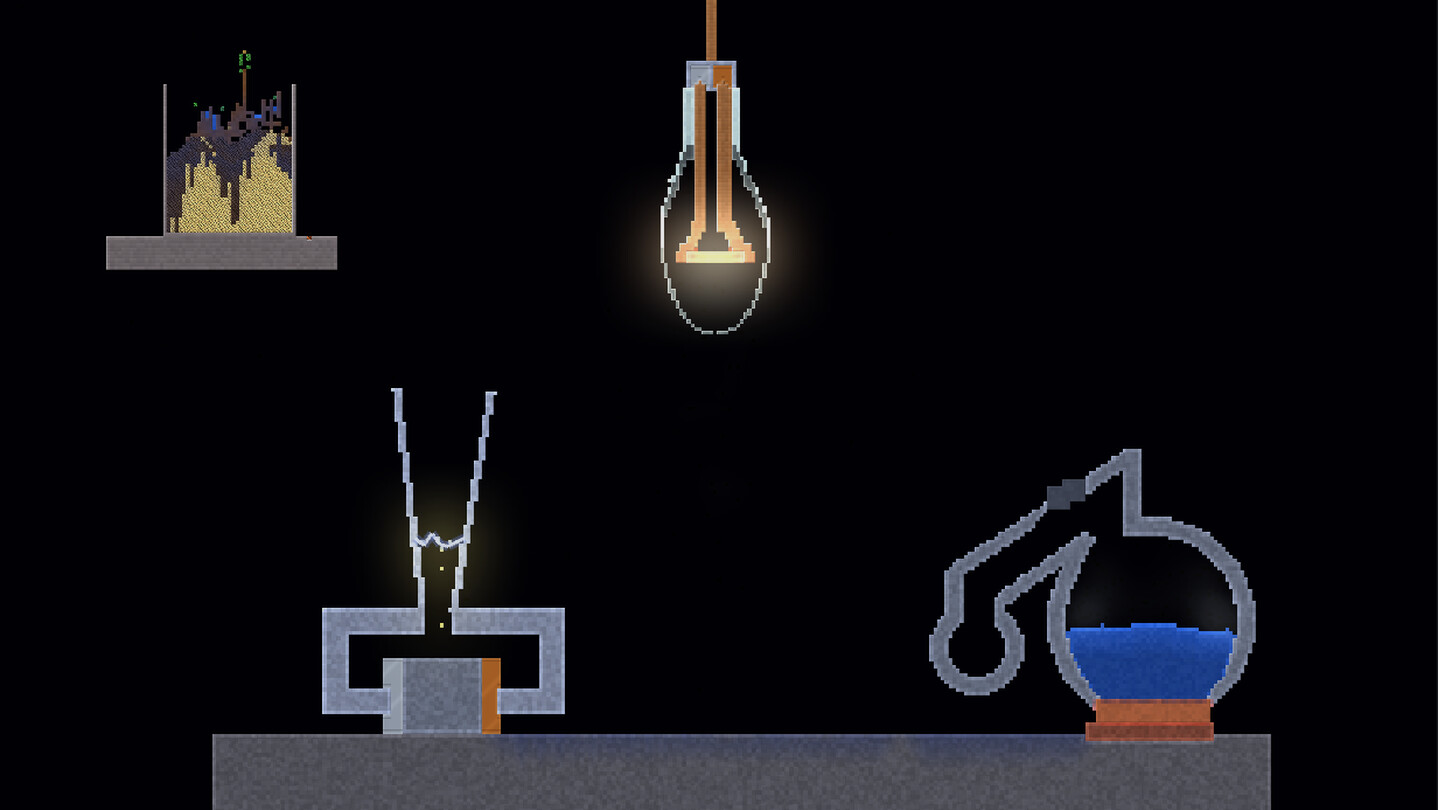
Alembic is a falling-sand sandbox where the sand is the real periodic table.

Every element carries its true properties — melting and boiling points, density,

electronegativity, valence — and the reactions aren't scripted gimmicks. They

emerge from that data, the same way they do in the real world.

Drop sodium in water and watch it fizz and ignite. Grind aluminium in the

mortar, dust it over rust, and strike a thermite burn hot enough to weld. Wire

two different metals into a galvanic cell and light a bulb. Pile up enough

uranium and it goes critical.

Your window is a lab flask

Hold Shift and **shake the actual game window**. The contents feel every jerk

and stop: powders slam into walls, leap for the lid, and fold into each other;

liquids slosh, surge, and swallow whatever you stirred up. It's

not a minigame. It's the mixing tool.

Liquids that actually behave

Water finds its level — through pipes, under walls, around corners, like real

communicating vessels. Trap gas under a diving bell and the sea compresses it;

crack the seal and it erupts. Mercury is so dense that nearly everything you

drop in it floats back out.

Two looks, one keypress

Alembic ships with two liquid render styles. Flow is soft and luminous — smooth surfaces, depth-lit pools, every droplet part of one living body of liquid. Classic is the raw falling-sand look, every cell exactly where the simulation says it is. Same physics underneath, down to the pixel. Tap F6 to toggle, whenever the mood strikes.

A living encyclopedia

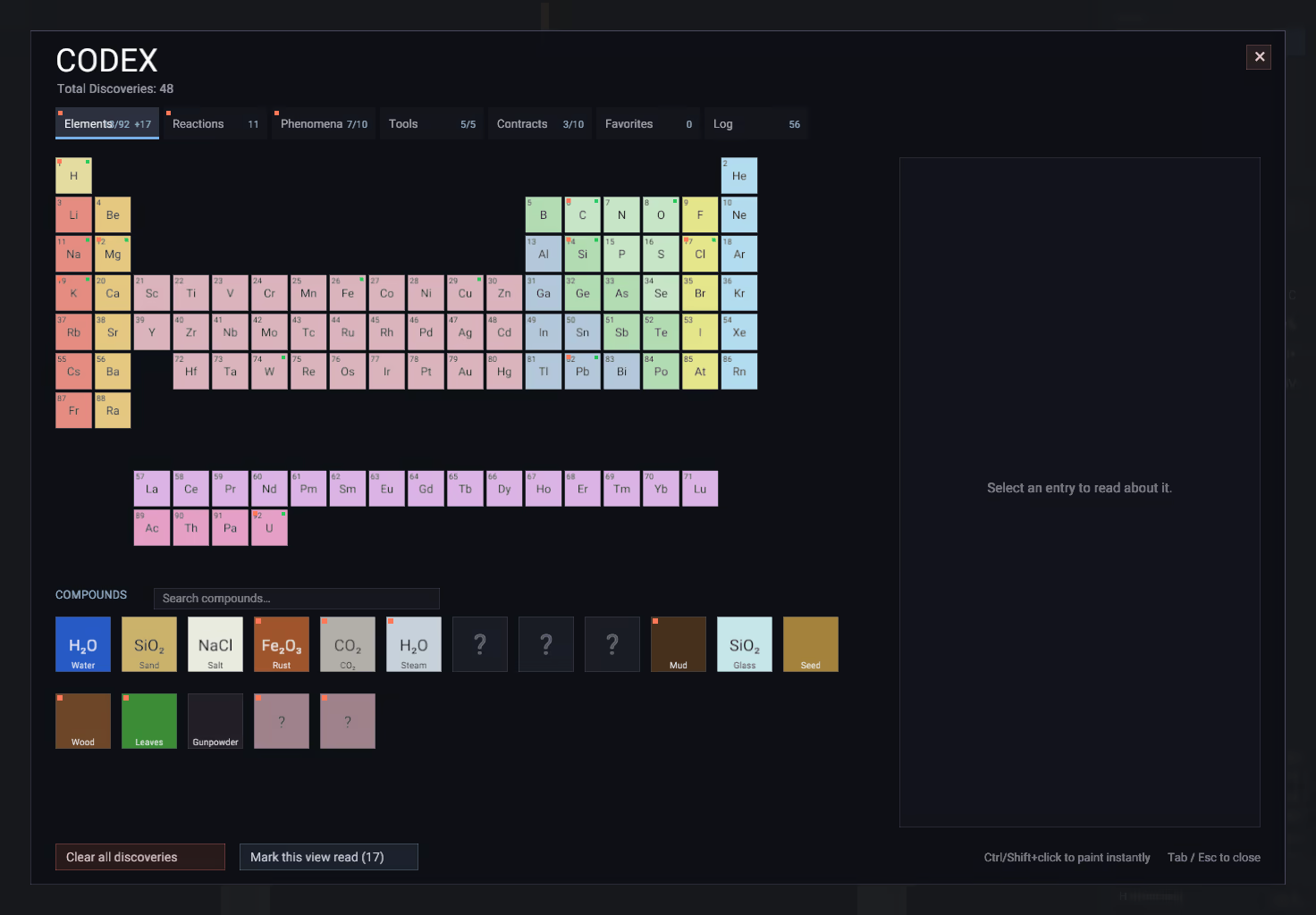
Everything you make gets recorded in the Codex — a periodic table, a log of

every reaction you've triggered, the dramatic phenomena you've witnessed, and

the tools you've earned. You start with a handful of elements; the rest of the

table unlocks as you hit real chemical milestones. It's a discovery engine

disguised as a sandbox.

Challenges

Want direction? Take on challenges — goals that range from gentle to fiendish:

evaporate a sea to recover its salt, forge a foundry of distinct alloys, reclaim

metal from its ore, neutralise an acid, grow a forest and then wipe it off the

map with a nuclear blast. Each has Bronze, Silver and Gold tiers.

Real phenomena

  • Combustion, oxidation and rust

  • Thermite reduction and brilliant metal flares

  • Flame-test colours across the metals

  • Galvanic cells, electrolysis, arcing high-voltage circuits and plasma glow

  • Radioactive decay, radioluminescent glow and nuclear criticality

  • Communicating vessels, diving bells, buoyancy — sink iron in water, float it on mercury

  • Alloys, amalgams, acid–base chemistry, distillation, glass etching, plant growth

Build, or just play

Stamp beakers, boxes, batteries and freehand wires. Heat, cool, vacuum, and

pipette. Turn the whole world's temperature, oxygen and gravity up or down.

Prefer a blank cheque? Flip on Sandbox mode and the entire table is yours.

The falling-sand sandbox that's actually chemistry.

AI Generated Content Disclosure

The developers describe how their game uses AI Generated Content like this:

Generative AI was used in the creation of reaction sound effects (burning, explosions, electricity etc.) only.

All music and imagery is human-made and attributed.

System Requirements

    Minimum:
    • Requires a 64-bit processor and operating system
    • OS: Windows 10 64-bit
    • Processor: Dual-core 2.0 GHz
    • Memory: 4 GB RAM
    • Graphics: Any GPU with OpenGL 3.0 support (Intel HD 4000 or newer integrated graphics is fine)
    • Storage: 500 MB available space
    Recommended:
    • Requires a 64-bit processor and operating system
    • OS: Windows 10/11 64-bit
    • Processor: Quad-core 3.0 GHz
    • Memory: 8 GB RAM
    • Graphics: Dedicated GPU with OpenGL 3.3 (GTX 750 / RX 550 class or better)
    • Storage: 500 MB available space
There are no reviews for this product

You can write your own review for this product to share your experience with the community. Use the area above the purchase buttons on this page to write your review.

Review Filters