
Found colonies, create spaceships from modules, colonize planets, form alliances and destroy your opponents in a turn-based game.

Sign in to add this item to your wishlist, follow it, or mark it as ignored

Coming Soon To Early Access

The developers of this game intend to release as a work in progress, developing with the feedback of players.

Note: Games in Early Access are not complete and may or may not change further. If you are not excited to play this game in its current state, then you should wait to see if the game progresses further in development. Learn more

What the developers have to say:

Why Early Access?

““Space Opera” is a turn-based 4X strategy game inspired by classics like “Space Empires V” and is currently being developed by a solo developer. The core gameplay is already in place and playable: exploring the galaxy, managing an empire, and engaging in tactical real-time battles that flow seamlessly from the strategic map.
We’re launching Early Access to drive development forward with direct support from players and to shape some of the most important upcoming game systems—including AI-controlled empires, fog of war, and more—together with the community at an early stage.”

Approximately how long will this game be in Early Access?

“Realistically, I can't give an estimate for that. I work full-time, have a family, and have a lot of features, graphics, and animations to work on. Realistically, it will take years rather than months.
A preliminary, cautious estimate is that the game will be available for download in December 2026 and will be in Early Access for at least 12–18 months.”

How is the full version planned to differ from the Early Access version?

“Space Opera is a solo development project. Although there are already a number of planned features and ideas for the future, the game is in continuous development. As a solo developer, it’s important to me to be able to respond flexibly to feedback, test results, and new insights.

Therefore, the currently planned features do not constitute binding commitments. Content, priorities, and development goals may change, be expanded, or give way to new approaches during development if this benefits the game as a whole. The goal is to gradually build Space Opera into the best possible gaming experience.”

What is the current state of the Early Access version?

“At launch, “Space Opera” offers a small core gameplay experience:

- Procedural galaxy generation and exploration
- Empire management: colonies, resources, and research
- Ship movements on the strategic map
- Real-time tactical battles against pirates with a seamless transition from the strategic level
- Load and save


At the moment, the game feels more like a somewhat advanced prototype. However, many systems are still unfinished or only very superficially implemented, with placeholders, and translations are missing.

Systems such as AI-controlled enemy empires, the fog of war, the advanced ship designer, and Steam Deck-specific optimizations are still in active development and are not yet included.”

Will the game be priced differently during and after Early Access?

“The game is currently free because it is still in the early stages of development; several core systems have not yet been implemented. Once these systems are more fully developed, we will introduce a price for Early Access. The price has not yet been determined.”

How are you planning on involving the Community in your development process?

“Space Opera's development has been public from the start, with regular devlogs covering progress (the "ShortLog" series on YouTube, plus updates on X and Mastodon, in both German and English).
During Early Access, we're expanding this with several channels for direct community involvement:

A Discord server for discussion, bug reports, and feature suggestions
The Steam Community Hub for announcements, discussions, and a public roadmap
Opt-in beta branches for major new systems (such as AI opponents or fog of war), so interested players can test and give feedback before features reach the main branch
Changelogs that credit community suggestions that make it into the game ("Community Spotlight")

Feedback from these channels directly shapes our development priorities throughout Early Access.”
Read more

Join the Space Opera Playtest

The Playtest will be added to your Steam Library.
This game is not yet available on Steam

Planned Release Date: To be announced

Interested?
Add to your wishlist and get notified when it becomes available.
 

Report bugs and leave feedback for this game on the discussion boards

See all discussions

About This Game

Space Opera is a turn-based 4X strategy game for people who would rather design their fleet than pick it from a list. You lead a people you put together yourself, from the first colony through the fight over resources to the first clashes with foreign empires.

The strategy map is turn-based, battles run in real time. There is no loading screen in between, and the map stays alive in the background.

Four presets are ready at the start:

  • Teru Concord: Scholars of an ocean moon who value knowledge above ore.

  • Vash Forge League: Mountain folk who carve ships from the rock of glowing worlds.

  • Ilun Collective: A hive species that turns every fertile world into gardens.

  • Haar’Sek Hegemony: Warrior clans who measure honour in conquered systems.

Or build your own people. You spend a point budget on strengths and weaknesses such as Mining, Farming, Isotope Extraction or Research. Every strength costs points, every weakness gives some back. You also choose the names, a ruler with a title, a crest, empire and ship colours and the style of your ships.

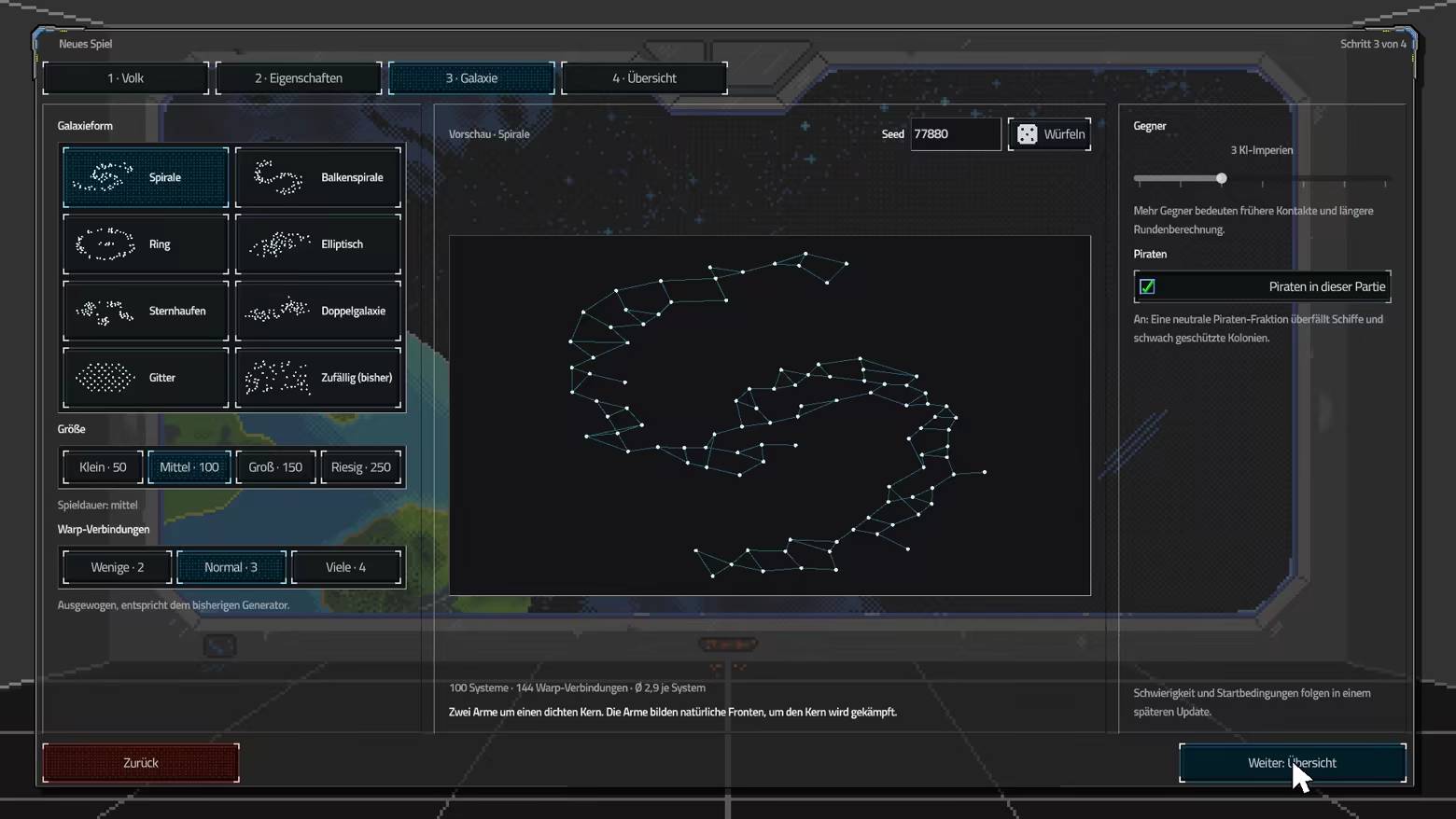
Then comes the galaxy: eight shapes (Spiral, Barred Spiral, Ring, Elliptical, Clusters, Twin Galaxy, Grid, Random), four sizes from 50 to 250 systems, the number of AI empires and whether pirates join the game. The shape decides the war: in a spiral the arms form natural fronts, on a ring only a few bridges lead to the core.

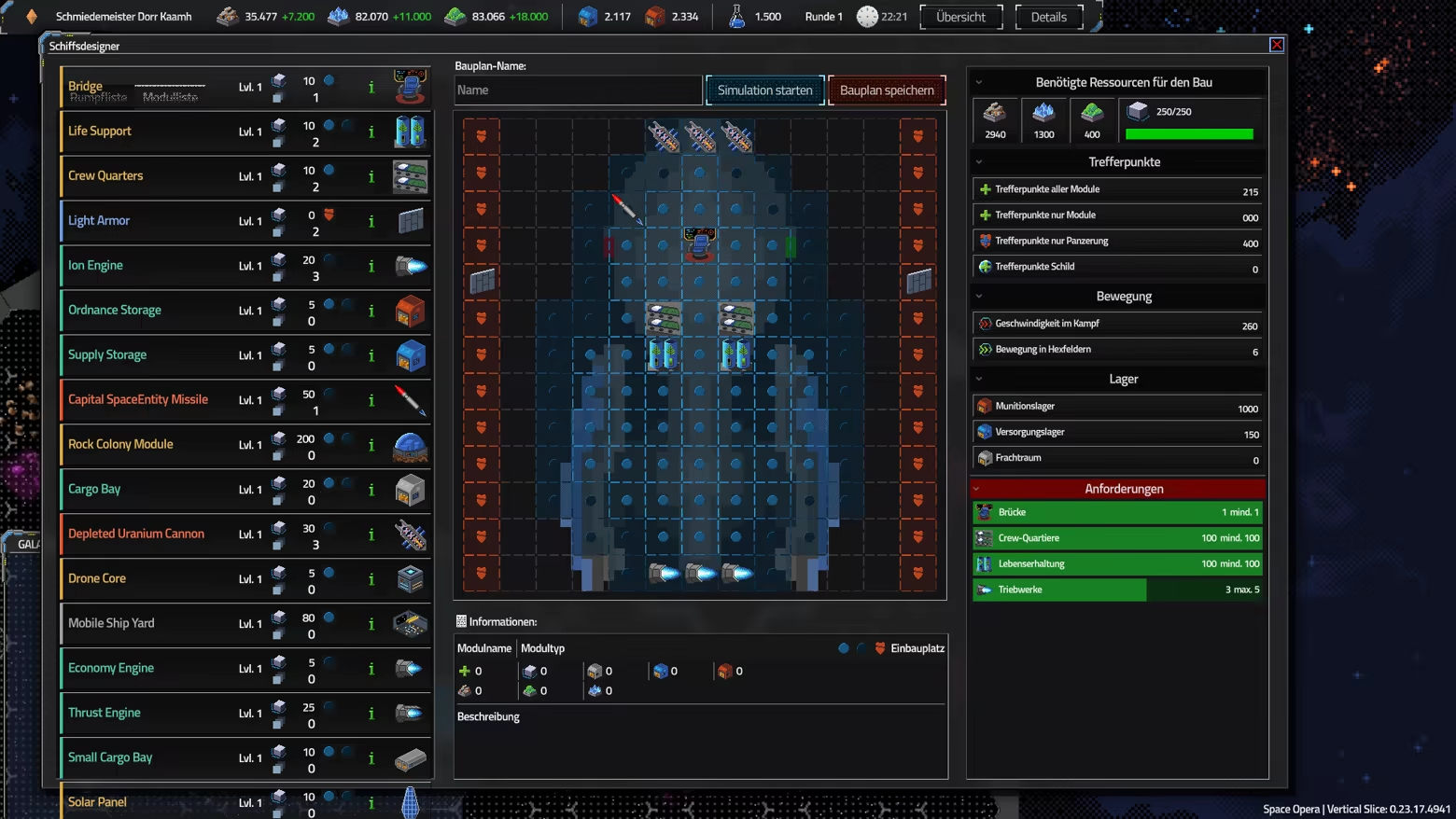
In the ship designer you place modules on the grid of a hull. Bridge, crew quarters and life support are required, everything else is up to you: ion or thrust engines, uranium cannons or missiles, armour, shield generators, cargo bays, solar panels.

The designer shows you at all times whether your design can fly, how many hit points it has, how fast it is in battle and how much ammunition and supply it carries. The simulator sends a design into a test battle before you build it.

You design warships, colony ships, freighters and supply drones. Modules get better with every research level: engines, storage, life support, shields and missile damage all grow with it.

On your colonies you mine ore, organics and radioactives, research and build. Two more goods are not delivered by any planet on its own: supply and ammunition. Dedicated buildings produce both, and both have to be brought to your ships.

Freighters and supply drones do that, and you design and dispatch them yourself. If the supply line breaks, your fleet runs out of ammunition in the middle of a fight, and the game tells you where the bottleneck is.

Storage is limited, buildings need space on the planet and every construction order goes into a queue. The build lists show by colour what is possible and what only fails because a store is full or empty. The Empire Overview lists all colonies, fleets and storage warnings, searchable, filterable and sortable. You save your own views as layouts.

When two fleets meet, the game switches to a battlefield of its own without a loading screen. You select ships with a selection box, give move and attack orders and decide whether your weapons spread their fire or focus on one target.

Shields absorb the first hits, after that individual modules fail. The damage window shows the layout of your ship and the condition of every module. Ammunition is limited. If it goes badly, you pull ships back to a neighbouring tile or surrender the battle.

Colonies are vulnerable: an armed ship wipes out an undefended colony. If your fleet is on site, it fights the planet, destroyed buildings are lost and the rest repair over time.

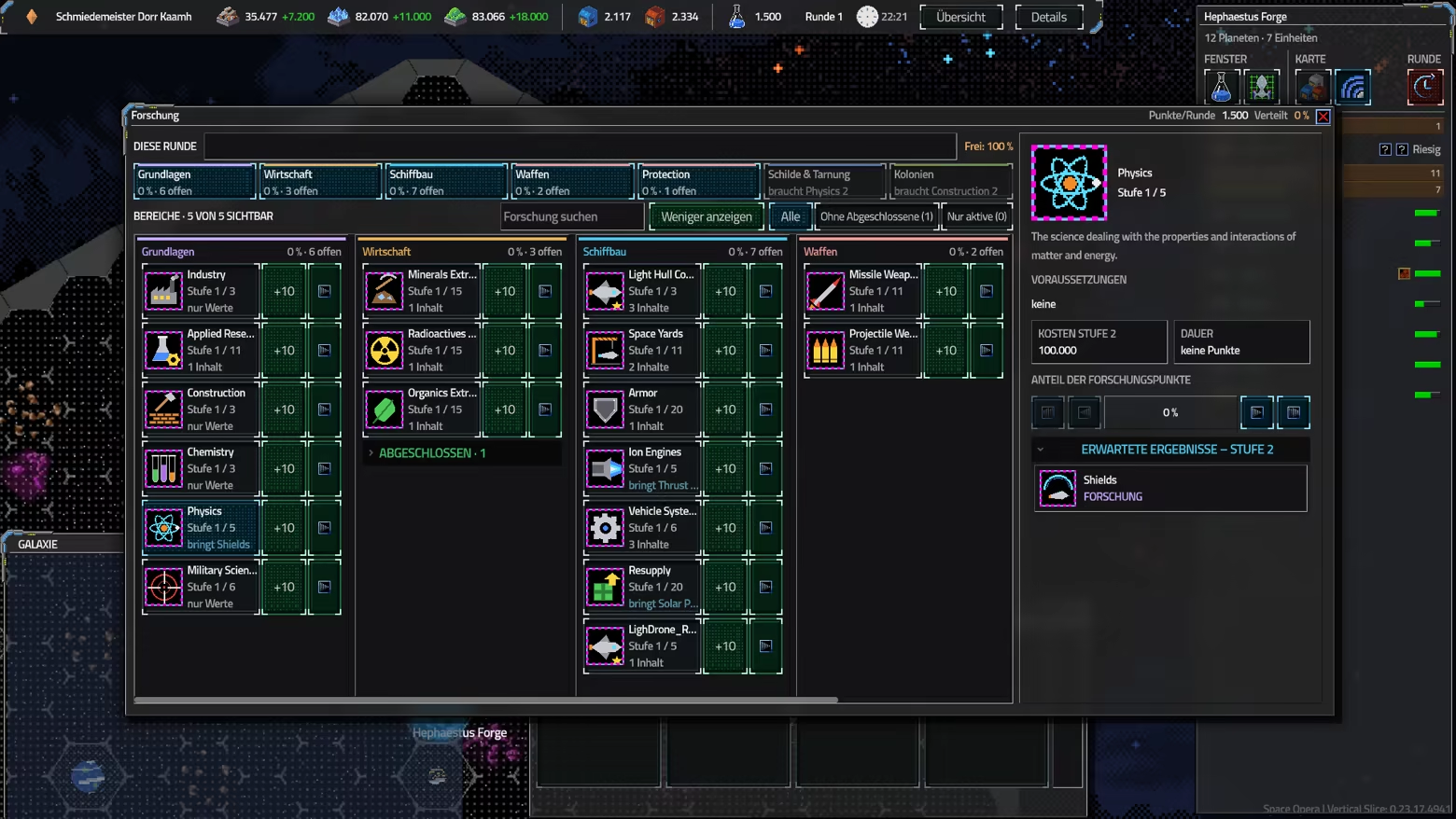
Research is split into seven areas (Basics, Economy, Ships, Weapons, Protection, Shields, Colonies) with 23 technologies and up to 21 levels. A budget bar lets you distribute your research points yourself. The screen shows in advance what the next level unlocks and improves.

The AI empires play by the same rules as you. They explore the galaxy, design their own ships, build fleets, look for you and attack your colonies. Every empire starts with one guard ship, which will not last long against a real attack. Pirates join in as well.

You only see what your sensors detect. Tiles outside your range are shown in a grey grid, and foreign ships stay invisible there.

The planets are handmade: rock, ice, gas, lava and water worlds are generated from hand-drawn heightmaps and colour palettes and get clouds, light and atmosphere from shaders. The game is available in German and English, and the size of the interface can be set from 75 to 150 percent.

Buildings, modules, ships and research are stored as open JSON data. That is the foundation for later mods.

[h3]Available today[/h3]

  • A people with presets, a point budget and eight galaxy shapes

  • Ship designer with 18 modules and 4 hull types

  • 13 buildings, 23 technologies in 7 research areas

  • Physical logistics with freighters and supply drones

  • Real-time battles without a loading screen

  • AI empires, pirates, sensor range

  • Empire Overview with search, filters and layouts

  • Victory condition: last one standing

[h3]On the roadmap[/h3]

Space Opera is still in development. What follows is described in the game design document and is planned, but not built yet. Order and details may change, and there are deliberately no fixed dates.

[h3]Diplomacy and trade[/h3]

Today every empire is at war as soon as they meet. That will change. Between two empires there is a relationship status that runs from No Contact through War, Non-Aggression, Trade and Military Alliance up to Partnership. At the start nobody knows anybody, and the AI is not hostile by default, neither towards you nor towards other empires.

  • Treaties built from elements: non-aggression, mutual defence, free passage, shared vision, shared supply, shared research, trade. You combine them freely, even one-sided if you are the stronger party.

  • Messages: proposals, gifts, demands, calls for help, peace offers and surrender. Whoever surrenders becomes subjugated or a protectorate and hands over part of their production.

  • Trade: the trade rate grows from turn to turn up to a cap, tariffs skim off a share. The income lands on planets with a trade centre and has to be distributed from there.

  • Alliances of several empires, where members vote by majority on rules, joining and expulsion.

  • AI personalities: Warlord, Merchant, Scholar, Isolationist, Opportunist. If one empire leads far ahead in score, the others turn against it together.

[h3]Intelligence and espionage[/h3]

An intelligence centre produces intel points that you distribute like research points: on defence and on projects against other empires. Whether a project succeeds depends on your effort against the target’s defence. If it is discovered, it costs you reputation.

  • Espionage: spy on empire reports, planet locations, fleet concentrations and build orders, inspect foreign designs, steal research and designs.

  • Sabotage: destroy stockpiles, lower morale, cause plague and unrest, damage ships or change their orders, disrupt trade, intercept messages.

  • Terror: terror cells carry out recurring attacks until your defence finds them.

[h3]Conquest and ground combat[/h3]

Today you can wipe out colonies, but not take them over. Later there will be real conquest:

  • Troops are built in barracks, loaded into troop carriers and land as soon as the orbit is clear.

  • Defenders are stationed troops and the planet’s militia. Ground combat runs in real time on a planet map of its own with a time limit, or you let it be calculated automatically.

  • Ships without shields can be boarded and captured.

  • Bombardment devastates planets step by step: first shields, then buildings, then population. This damages your standing with every empire.

[h3]More units and structures[/h3]

  • Space stations and starbases, satellites, weapon platforms, mines, fighters and carriers, more drones and ground troops as separate blueprint families with hulls of their own.

  • Fleets: group ships into a fleet with a name and a crest. It moves as one, and the slowest ship sets the range. Custom crests can be added through a data file.

  • Blueprint iterations: turn an existing ship into the next version (Mk II) with one click, for example after new research.

  • Building blueprints: you design buildings yourself from modules, too. Research unlocks new modules, and buildings can be converted for the difference in cost.

  • In battle, engine thrust and mass decide how agile a ship is. Small hulls with many engines become more agile than large hulls with few.

[h3]Peoples and planets[/h3]

  • You choose the type (rock, ice, lava, water) and atmosphere of your home world. At the start you can only settle fitting planets, research unlocks further types and atmospheres.

  • Population, workforce and morale: buildings need staff, and mood depends on food, living conditions and work. Housing, terraforming and forms of government as mod data follow later.

  • A large horizontal technology tree with prerequisite chains you can see before you research them, and many more technologies than today.

One more thing about the end of a game: right now a game ends when only one empire is left. Planned on top are a turn limit with a score and victories through subjugation or alliance, which you choose before the start.

Space Opera is still in development. The core is playable, the rest comes with the updates. What comes next is also decided by your feedback.

System Requirements

Windows
SteamOS + Linux
    Minimum:
    • OS: Windows 10
    • Processor: AMD Ryzen 5 3600
    • Memory: 4 GB RAM
    • Graphics: GTX 1060
    • Storage: 500 MB available space
    Recommended:
    • OS: Windows 11
    • Processor: AMD Ryzen 5 5600X
    • Memory: 8 GB RAM
    • Graphics: RTX 2060
    • Storage: 500 MB available space
    Minimum:
    • OS: Nobara 40
    • Processor: AMD Ryzen 5 3600
    • Memory: 4 GB RAM
    • Graphics: GTX 1060
    • Storage: 500 MB available space
    Recommended:
    • OS: Nobara 40
    • Processor: AMD Ryzen 5 5600X
    • Memory: 8 GB RAM
    • Graphics: RTX 2060
    • Storage: 500 MB available space