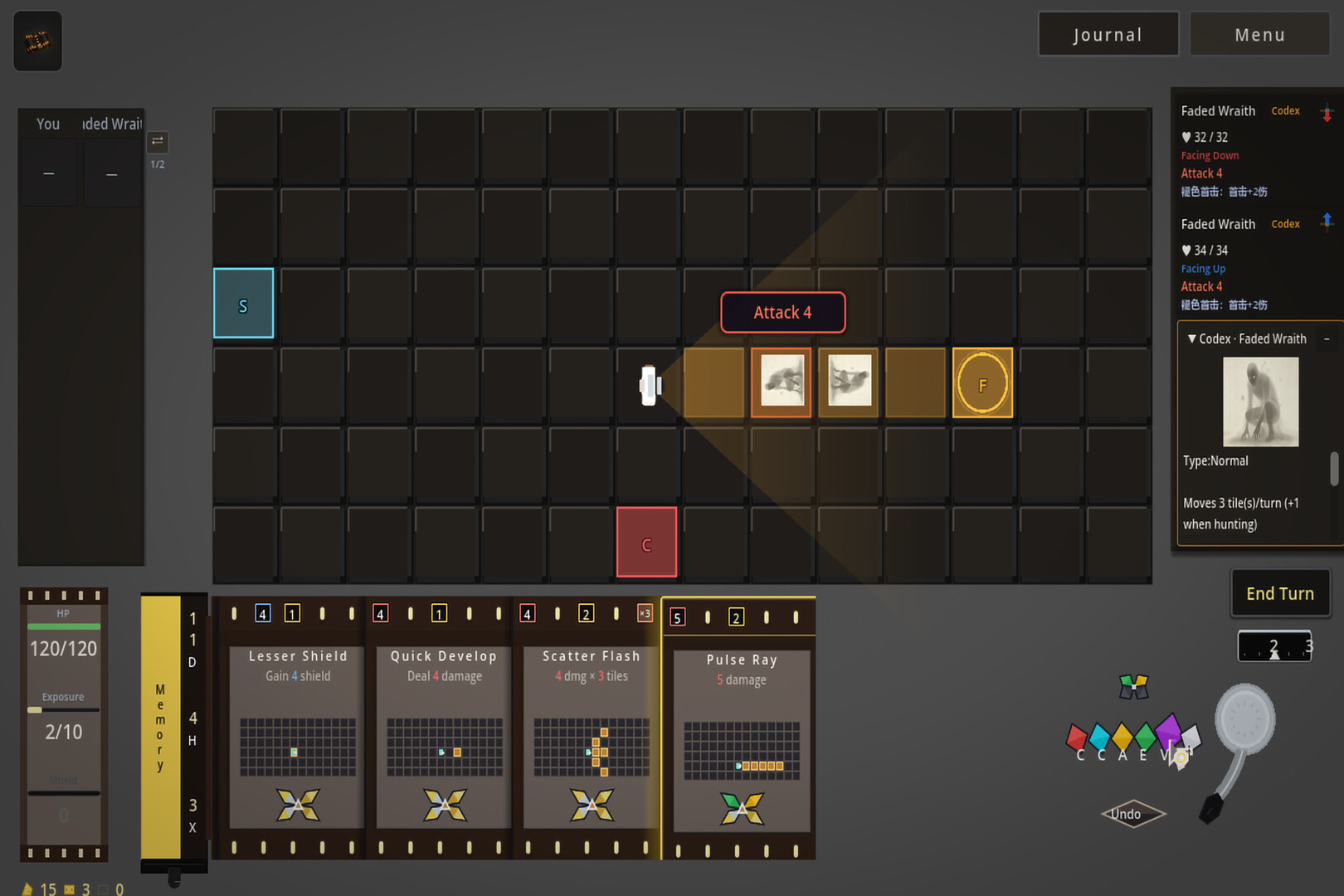


Drag film cards on a 16×6 grid—facing and dyeing shape every hit. Face-up draws; chain Start, Instant, and End timings each turn. A 54-floor roguelike with four camera travelers, ~100 cards, and 30 relics.

Sign in to add this item to your wishlist, follow it, or mark it as ignored

Download Fission Mirror Grid Demo

This game is not yet available on Steam

Coming soon

Interested?
Add to your wishlist and get notified when it becomes available.
 

About This Game

The shutter clicks. The grid develops again.

Fission Mirror Grid is a turn-based roguelike that merges grid tactics, deckbuilding, and facing puzzles. A mirror-smith forged a cursed mirror to hold his love; an archaeologist unearthed it centuries later; a photographer trapped his soul inside a film camera—four travelers meet inside the Mirror Grid, a labyrinth of stolen memories, and fight by dragging negative-style skill cards across the board.

On a 16×6 battlefield you drag cards onto cells, reshape ranges with movement and card dyeing, and sequence Start, Instant, and End timings within the same turn. Fights aim for a tight 8-turn pace—every step and every facing change can flip the outcome.

16×6 mirror grid: drag to cast, move, preview

• Drag cards from the film-strip hand onto cells; each card shows range preview and sprocket-readable stats (damage, block, cost, heal)

• Facing drives forward shapes (single, line, cone, rectangle); other patterns include around-self, any cell, and self-only

• First 2 tiles moved each turn are free; further moves cost 1 Exposure each. Walking and dye-driven steps do not rotate facing—you need turn cards or dye settings for that

• Enemies telegraph intent; tiles can hold ongoing effects—right-click for intel

Card dyeing: turn and step before or after effects

Many cards add a facing turn or 1-tile move before or after they resolve, set via the dye ring (cool compass colors for facing, warm colors for movement). Builds are about dye, reposition, then cast: the same card hits different cells depending on how you dye it.

Start, Instant, End

All three timings are played during your action phase; resolution timing differs:

• Instant (red) — resolves immediately on play: main damage, movement, control

• Start (gold) — played now, resolves at next turn start: setup buffs, auras, energy and shield refresh

• End (blue) — played now, resolves at this turn end (before discard): delayed burst, counters, cleanup

A typical turn: lay Start cards for next turn, spend Instant cards for damage and positioning, then close with End. Energy-cap buffs usually kick in at next turn start to prevent one-turn spikes.

Exposure energy and hand flow

• Turn start: resolve queued Start effects, then face-up draw (about half your energy cap, rounded up; no blind pick) into the film hand; relics may add extra draws

• Action: play cards, move, turn—spend Exposure

• Turn end: resolve End effects; if hand size exceeds the keep limit (about half your energy cap, rounded down), choose which extras to discard—the rest stay in hand (not a full hand wipe)

• Energy cap shifts in battle (hard cap 3 to 15), changing both draw and keep limits

Deckbuilding: 35–40 cards, about 100 cards and 30 relics

• Run decks target 35–40 cards; copy limits: 2 per common, rare, or epic, 1 legendary

• About 100 designed cards plus character-exclusive picks and 30 relics—damage, block, control, rule-benders

• Rewards, shops, and events reshape your deck each run

Branching mirror routes

Full game: 54 floors (3 acts × 18) with combats, elites, events, shops, and act bosses at floors 18, 36, and 54. Spend Exposure Shards and pick routes—trade-offs between path, resources, and deck plan, not just bigger numbers.

Four camera travelers

All four are selectable from the start, each with a unique starter relic, exclusive cards, and canister color:

• Shutter Prisoner (hero, compact 35mm) — soul sealed in a camera. Film-roll loop: spend full rolls to release sealed memories, then empty rolls; Memory Imprint Shop on his route refills with negatives (no finished cards for sale)

• Mirror Smith (brass box camera) — the mirror's ancient maker. Blanks, block, mirror copy

• Archaeologist (half-frame silver) — modern scholar pulled into the grid. Rubbings, parsing, rewind—control and mechanic breaks

• Mirror Lord (heroine, warped mirror body) — the mirror's host. Reflection, memory devour, spatial fracture

Cross-era encounters, character-specific events, and mirror hazard zones weave one narrative line.

Light meta: expand pools, not stats

Meta progression unlocks card and relic reward pools and a gallery—no permanent attack or HP inflation. Deeper runs and total wins widen what you can roll; each run still starts from a character kit and fresh choices inside the grid.

Film-strip UI

Negative-style cards, sprocket stat chips, canister deck and discard counts, horizontal film hand—battle info you can read at a glance. Click the canister to browse deck and discard piles (read-only).

For you if…

• You want roguelike deckbuilders with real grid positioning, facing, and range geometry

• You enjoy sequencing dye, movement, and timing layers under pressure

• You like darkroom film

AI Generated Content Disclosure

The developers describe how their game uses AI Generated Content like this:

Localization (translations) in this game was completed with AI assistance.

System Requirements

    Minimum:
    • OS: Windows 10 64-bit
    • Processor: Dual-core CPU, 2.0 GHz
    • Memory: 4 GB RAM
    • Graphics: GPU with Vulkan 1.0 or DirectX 12 support
    • DirectX: Version 12
    • Storage: 500 MB available space
    • Sound Card: DirectX compatible sound card
    • Additional Notes: 1280×720 display recommended. Keyboard and mouse required.
There are no reviews for this product

You can write your own review for this product to share your experience with the community. Use the area above the purchase buttons on this page to write your review.

Review Filters