

Sign in to add this item to your wishlist, follow it, or mark it as ignored

This game is not yet available on Steam

Planned Release Date: Q4 2027

Interested?
Add to your wishlist and get notified when it becomes available.
 

About This Game

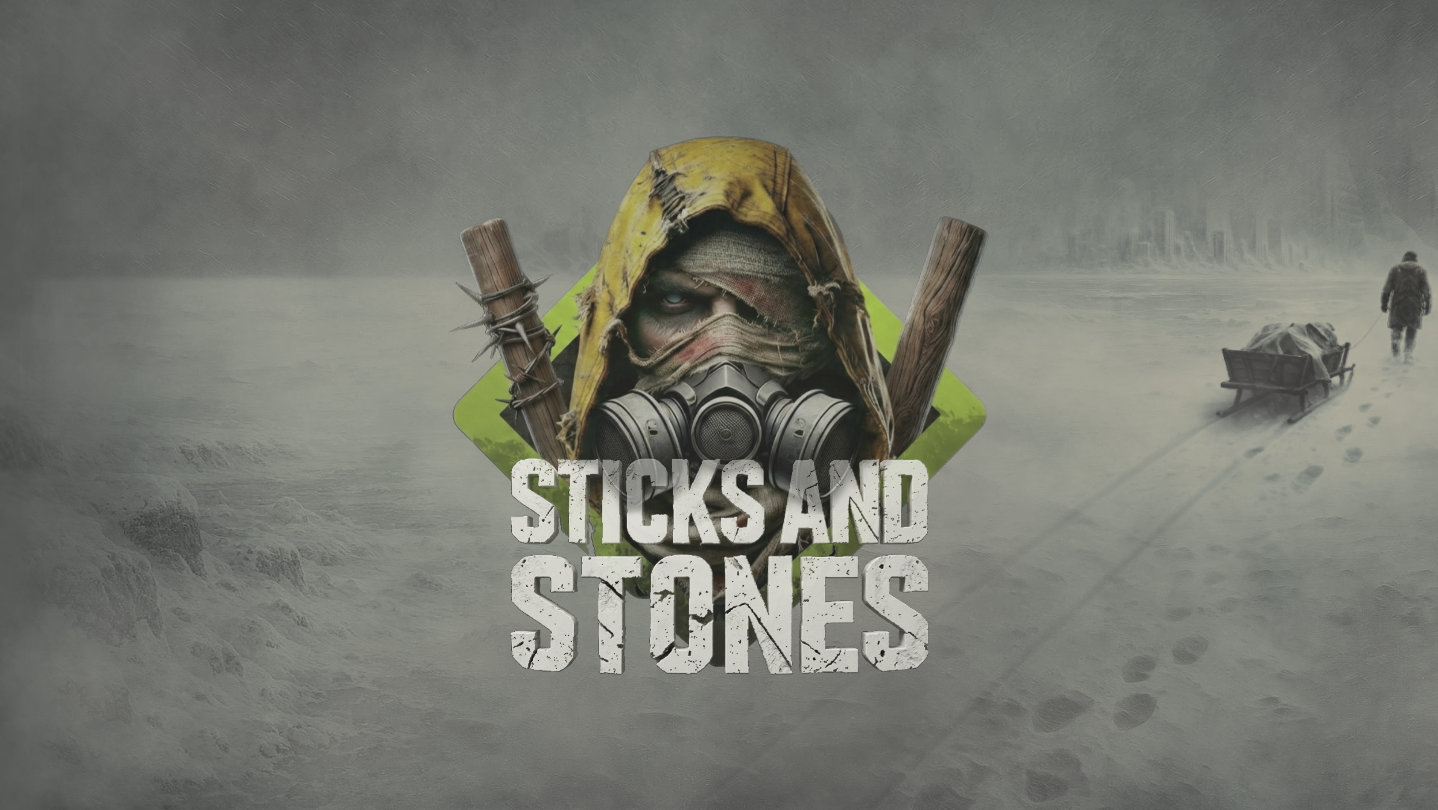
Sticks and Stones is a post-apocalyptic survival simulator set after an asteroid (or asteroids) impact.
Other cataclysms might be added over time, but they will always involve massive, global-scale destruction.

1. What happens before you start the game?

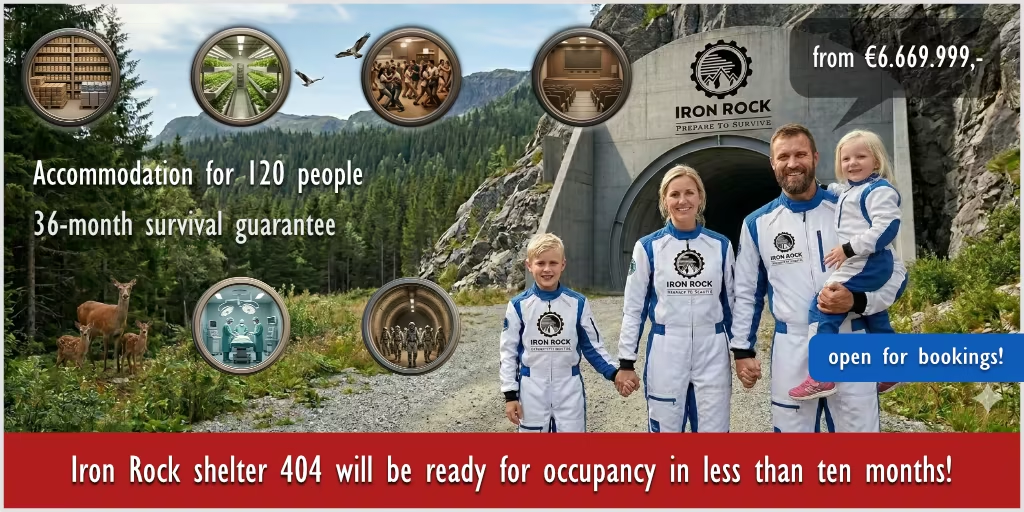
The Iron Rock Corporation builds hundreds of shelters for millionaires - the chosen few who will have a chance to survive the destruction of the planet.

Shelter "Iron Rock 404" is currently under construction, just a few months away from completion.
Security systems are being installed, and supplies are being stockpiled to sustain over a hundred people for at least 36 months.

But an asteroid is about to hit the Earth (one massive impact or several smaller ones) - sooner than everyone expected.
Luckily - for you - you just happened to be nearby Iron Rock 404.

2. No two games will be the same.

Installed systems (including the AI managing the shelter), delivered equipment, seeds/seedlings, food, water, crafting materials, gas/fuel, medicine, clothing, weapons, etc. 
Available items are shaped by earlier deliveries (and sometimes by mistake), offering different resource ratios each game. 
Just like the meteorite impact itself, this creates a completely new challenge for the player in every single game.

3. You - the Hero.

When creating your character, you can either build one from scratch or choose one of several specialized presets with fixed attributes:

  • Shelter Mayor: As useless as humanly possible. Always carries a pistol but has terrible aim. Zero skills, but he is the only character with access keys to every room - including those that are otherwise impossible to open.
    (Though depending on the asteroid impact, the walls of these rooms might collapse, making their contents accessible even if you aren't the Mayor).

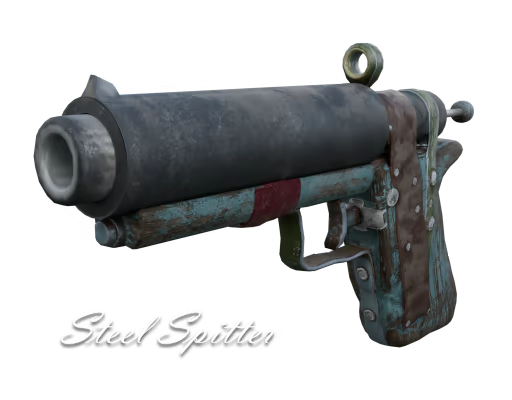
  • Head of Security: Zero practical skills, but massive theoretical knowledge. Read and watched a lot on the job but never actually did anything. Always starts with a weapon (not necessarily a pistol) and knows how to use it.

  • IT Specialist: Like the Mayor, physically useless, but high IQ, and holds full system access. Can unlock every AI function or shut the AI down without much hassle. Survival, farming, and physical fitness skills are practically zero.

  • Construction Worker: Strong, fit, averagely intelligent, but can fix anything, craft many items, and always comes with one random extra perk (farming, survival, amateur chemist, etc.).

  • Farmer: Hired to deliver and process the shelter's food stockpiles. Huge knowledge of crops (both practical and theoretical). Sometimes gets extra perks at the cost of slightly lower farming skills.

  • Warehouse Worker: The only character capable of operating forklifts and other warehouse equipment.
    Good at fixing machinery, an avid hunter and weekend trekker, and grows a home garden.
    And he is a smoker - he really (REALLY!) needs cigarettes.

3.1. Custom Character

Creating a custom character lets you tailor the protagonist to your exact preferences, though certain abilities will be capped.

4. Game Start - The First Impact.

An asteroid (or asteroids) is about to hit Earth.

Once the seismic tremors stop, the AI reboots and runs a damage assessment. If any of the three communication links (cable, radio or satellite) reconnects with the company's main server and/or NASA, the AI will pull data on the destruction, provide a estimated (ETA) for the shockwave, and plan your next steps.

5. Time.

Time passes at different rates:

  • x3 when in a safe area (any shelter, tent, igloo, or outdoor shelter).

  • x6 - x60 when outside safe zones (e.g., wandering the wasteland, exploring ruined towns).

  • Performing complex tasks (reading, cooking, repairing, crafting) or sleeping advances time by a set amount specific to that action.

Important!

Sticks and Stones is a realistic simulator: there is no classic HUD, including an on-screen clock.
You check the time by looking at a watch (if you have a working one) or via the terminal (if the power is on, it works, and the AI isn't currently planning your demise - see point 16. AI).
Time isn't just hours and minutes; days matter too (see point 14. Everything is relative).

Sound works similarly. Aside from bodily status notifications ("you feel cold," "you lost feeling in your left foot," "your backpack feels lighter"), there are no UI sounds. You only hear ambient noises, machinery, the AI voice, footsteps etc.
You'll hear an item drop on concrete.  You won't hear it drop on snow during a blizzard.
If you find a working music player, you can always listen to tunes.

6. Aftermath.

Once the immediate threats (tremors, shockwaves) pass, going outside remains impossible due to extreme heat, fires, falling debris, and hurricane winds - unless you have specialized hazmat gear.
This lockdown lasts from a few days to several weeks, depending on the impact severity.

7. Inventory Check.

Your first major task is assessing available supplies.
The easiest method is scanning all products for the AI to analyze.
(Unless you're the Warehouse Worker, you probably don't know how to use the scanner, but there's a manual lying around somewhere).
Input the number of residents (just you, so "1"), and the AI calculates how long supplies will last based on your diet (eating to your heart's content, strict bare-minimum rationing. etc.).

You might hit the jackpot and find the full 36-month stockpile for 100+ people delivered intact - securing your survival for a very long time.

But... When it turns out you have massive stockpiles of fresh food early on, or an amazing harvest (see point 10. Farming), most of it might rot before you can eat it.

8. Cooking, Processing, and Storage.

Some foods will make you sick if eaten raw; others just taste worse or spoil quickly.
You have access to a gas and electric stove, microwave, dehydrator, and freeze-dryer.
You'll find appliance manuals and cookbooks scattered around.
You can also freeze food if the freezer works and has free space inside.

Important!

Eating takes time. A normal meal takes about 5 minutes, but a delicious one vanishes in 2–3 minutes.
Conversely, if you dump a hell of a lot of salt into your soup, you might sit there for 10 minutes, barely force down a few spoons, and suffer side effects.

Speaking of food...

9. What goes in, must come out.

Physiology is part of the game.
Whatever you eat or drink, most of it eventually leaves your body - front or back, top or bottom.
Inside the shelter, it's fine (toilets on every floor). But on long expeditions, especially in freezing cold or irradiated zones, taking off your hazmat suit has severe consequences.

10. Farming.

To survive, you need to eat. You can't buy food - you must grow it.

Stockpiles buy you weeks, but crops need time to grow.

You have growboxes - assuming they arrived on time - to quickly grow veggies and fruits.

You just need seeds, water, power, a few supplies, and the know-how.

If the growboxes didn't arrive or broke and you can't fix them, use the old-school pre-apoc method your parents or grandparents used: dump soil on a room floor or into containers and plant away.

11. Water.

If the surface isn't irradiated (it likely is), you have endless snow to melt.

Luckily, water inside the shelter doesn't magically disappear; it changes form into food moisture, sewage, or humidity. (By the way, humidity is your worst enemy in a sealed reinforced concrete bunker... black mold).

If water stocks drop, set up water reclamation.

12. Energy.

Energy is critical. Gas and diesel run out fast.
Thick clouds block the sun, leaving two options:

  • a wind farm (which acts as a beacon for bandits)

  • or scavenging runs.

13. Expeditions.

You can go on short runs to nearby ruins for loot: canned beans, painkillers, coal, maybe a jerrycan of fuel.
Ignore cash, gold, or jewelry - they are worthless. Food and meds are the new currency.

13.1 Short runs require just a warm clothes and a sled.

13.2 Long expeditions are a massive challenge. You need enough food and water for the whole trip (you might find nothing), a weapon (encounters won't be friendly), and a first-aid kit.
Shelter is paramount. You might find an intact bunker in the ruins, or you might walk the wasteland for days, so..
A tent is a must-have for any long expeditions - especially if you get lost.

14. Everything is relative.

In Sticks and Stones, everything is relative.
No watch? You don't know the time.
No calendar and the AI fails? You don't know the date, meaning you don't know if food/meds are fresh or expired and poisonous.

The map works the same way.
You must physically possess a map (found or draw one).
Your position on it is relative - it's only accurate if you actually know where you are (e.g. standing next to a known landmark like the bunker, a specific building, canyon, or mountain).
Otherwise, it relies entirely on your survival / orienteering skills.
High skills = accurate map marker.
Low skills = wrong position and - worse - wrong directional facing.
Until you level up those skills, stick to known routes or leave markers on the ground, or you become frozen food for bandits.

15. Crafting Clothing and Equipment.

Like cooking, crafting and repairing gear requires knowledge and raw materials.
Scavenge materials via recycling items found in the shelter or on runs.
Or craft your own textiles and spare parts.

14.1 In Sticks and Stones, you cannot craft a gun out of a piece of wood and a spam can.
Crafting even the simplest firearm (highly rare guarantees of safety) requires immense skill.
Producing complex guns or ammo (especially primers) requires master-level skills, extensive tooling, and incredibly scarce materials impossible to manufacture post-apocalypse.

16. AI.

The pinnacle of pre-disaster human achievement will help you manage the shelter early on.
The AI automates many tasks, heavily easing the early game.
But... it has one major flaw: just like you, it wants to survive.
If power levels drop critical, the AI will treat you as the primary threat, and... dangerous, weird things will start happening. You have two choices: secure enough power, or pull the plug on the AI. Neither is easy.

17. Early Access

A Kickstarter campaign is launching soon, dictating the Early Access release date.
I'm tentatively planning Early Access around version 0.6 or 0.7.
If the Kickstarter succeeds, backers get access starting at version 0.3.

18. Roadmap / Release Schedule.

  • Version 0.3 (September or October 2026)
    Book learning, warehouse management, farming, and cooking a dozen or so meals.

  • Version 0.4 (November or December 2026)
    Crafting everyday items, recycling, side effects/diseases, and medical treatment.

  • Version 0.5 (January or February 2027)
    Expeditions to nearby towns/villages, item repairs, basic degradation (clothes, tools), and bodily injuries (cuts, fractures, frostbite).

  • Version 0.6 (March or April 2027)
    Advanced crafting (weapons, fertilizers, specialized gear, tents), and longer expeditions.

  • Version 0.7 (May or June 2027)
    Less aggressive enemies (muggers who rob rather than kill) and combat system. Small shelters in towns/villages with better loot.

  • Version 0.8 (July or August 2027)
    Aggressive, lethal, cannibalistic enemies. Drastic medical procedures (e.g., amputation for severe infection or frostbite).

  • Version 0.9 (September or October 2027)
    Mostly visual polish - more clothes, everyday items, plus highly requested quality-of-life items I might have missed.

  • Version 1.0 (November or December 2027)
    Full Release, with a few surprises thrown in for good measure.

AI Generated Content Disclosure

The developers describe how their game uses AI Generated Content like this:

Some product photos and some sounds were generated using artificial intelligence.

System Requirements

    Minimum:
    • OS: Windows 10 or later 64-bit
    • Processor: Intel Core i5-11400f or AMD Ryzen 5 5600
    • Memory: 16 GB RAM
    • Graphics: NVIDIA GeForce RTX 3060 or AMD Radeon RX 6600 XT
    • DirectX: Version 12
    • Additional Notes: SSD drive
    Recommended:
    • OS: Windows 10 or later 64-bit
    • Processor: Intel Core i5-11400f or AMD Ryzen 5 5600
    • Memory: 16 GB RAM
    • Graphics: NVIDIA GeForce RTX 40xx or AMD Radeon RX 70xx
    • DirectX: Version 12
    • Additional Notes: SSD drive
There are no reviews for this product

You can write your own review for this product to share your experience with the community. Use the area above the purchase buttons on this page to write your review.