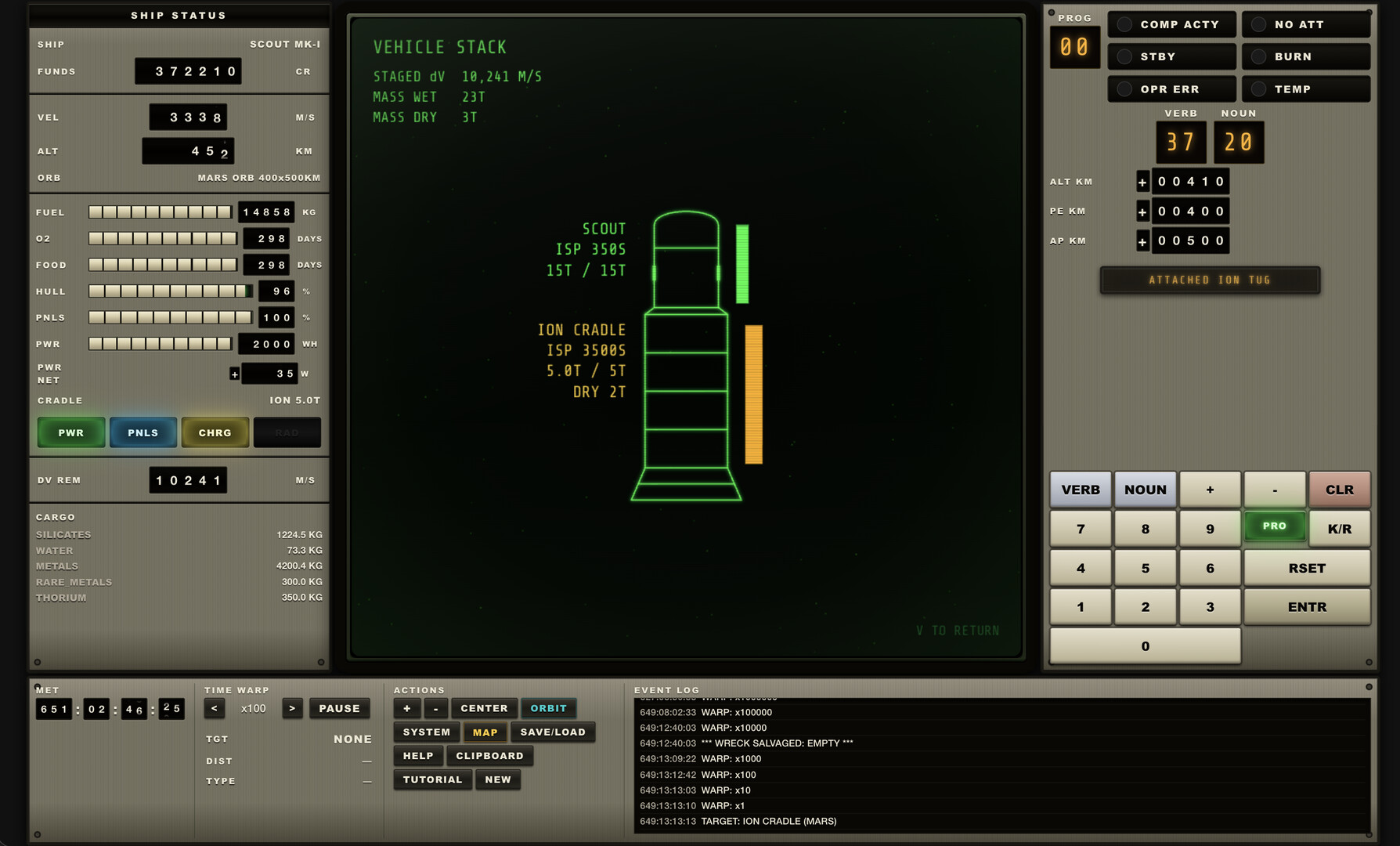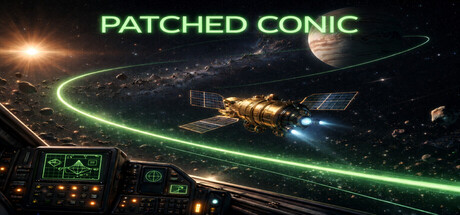

Fly real astrodynamics from an Apollo-era DSKY. Plan Lambert transfers, mine asteroids, build a fleet, and survive a 38-body solar system where every trajectory is solved from Kepler's equation. No autopilot, no cheating.

Daftar masuk untuk menambah item ini ke senarai hajat anda, ikuti atau tandakannya sebagai diabaikan

Bahasa Bahasa Melayu tidak disokong

Produk ini tidak menyokong bahasa tempatan anda. Sila semak senarai bahasa yang disokong di bawah sebelum membuat pembelian

Sertai Patched Conic Playtest

Minta akses dan anda akan diberitahu apabila pembangun bersedia untuk menerima lebih ramai peserta.
Permainan ini belum tersedia di Steam lagi

Akan datang

Berminat?
Tambah ke senarai hajat anda dan terima pemberitahuan apabila permainan sudah tersedia.
 

Tentang Permainan Ini

You are a freelance pilot working a single ship, a fragile budget, and a logbook full of jobs nobody else will fly. Haul cargo and passengers between stations, prospect bodies for ore and ice, stand up surface refineries, build out a fleet, and take on the megamissions that earn a name out past the frost line.

Every trajectory you fly is one a real spacecraft could fly. There is no "go to planet" button. The propagator never cheats on your behalf.

Real orbital mechanics, not an approximation


The simulation is built on a closed-form two-body propagator and a patched-conic sphere-of-influence model — the same baseline mission designers used in the Apollo era and still use today for first-order trajectory work.

  • Kepler's equation solved every tick with a Danby starter and Newton–Raphson iteration; the hyperbolic form handles escape and flyby trajectories
  • Lambert's problem solved with Izzo's 2015 universal-variable algorithm and a Householder iterator — a porkchop search over departure and arrival dates picks the minimum-Δv window, the same way NASA's Trajectory Browser does
  • Hohmann transfers compute the phase angle and Δv for the cheapest two-impulse hop between circular orbits
  • The vis-viva equation governs speed at every point on every conic, elliptic through hyperbolic
  • The Tsiolkovsky rocket equation costs out every burn, with a two-stage form for cradle-and-ship staging
  • Hill-sphere SOI radii decide when you leave one body's gravity well and enter another's, with nested moon SOIs taking precedence
  • Gravity assists modeled as hyperbolic flybys with turn angle set by periapsis radius and excess velocity
  • Solar power falls off as 1/r² from the Sun; RTG output decays on the real Pu-238 half-life of 87.7 years

What you do


  • Plan and execute burns from an Apollo-style DSKY: local orbit changes, Hohmann transfers, rendezvous, circularization, interplanetary Lambert transfers, gravity assists, and full heliocentric multi-leg trajectories
  • Run cargo, passenger, resupply, and survey contracts across the solar system; build station reputation to unlock trusted and elite tiers, then chase the eight endgame megamissions
  • Land on planets, moons, and minor bodies; mine ore, ice, volatiles, and fissionables; deploy ISRU refineries and bioharvest plants to sustain operations past Jupiter
  • Buy and fly a fleet of six ship classes, from the bare Scout to the ion-driven Endurance; build staged propulsion cradles for missions your ship can't reach on its own tanks
  • Survive micrometeorite swarms in LEO, the belt, and Saturn's rings; solar flares that fry unshielded avionics; depleted batteries; and the slow decay of your RTGs over the years
  • Install upgrades — Whipple shields, panel shrouds, flare-hardened avionics, radioisotope generators — and salvage the wrecks of pilots who didn't

Features


  • Patched-conic orbital mechanics — no approximations, no autopilot
  • Apollo DSKY flight computer interface with 20+ programs
  • 38-body solar system: planets, moons, asteroids, and Kuiper Belt objects
  • 8 endgame megamissions with permanent career titles
  • 6 ship classes with distinct role bonuses
  • Procedural SID/Amiga chiptune soundtrack
  • Runs fully offline — no network connection required

Keperluan Sistem

Windows
macOS
SteamOS + Linux
    Minimum:
    • OS: Windows 10
    • Pemproses: Dual core 2 GHz
    • Memori: 2 GB RAM
    • Grafik: Integrated GPU
    • Storan: 500 MB ruang tersedia
    Minimum:
    • Memerlukan pemproses Apple
    • OS: Mac OS Catalina 10.15
    • Pemproses: Apple M1
    • Memori: 2 GB RAM
    • Grafik: integrated Graphics
    • Storan: 500 MB ruang tersedia
    Minimum:
    • OS: Ubuntu 20.04+
    • Pemproses: Dual core 2 GHz
    • Memori: 2 GB RAM
    • Grafik: Integrated Graphics
Tiada ulasan untuk produk ini

Anda boleh menulis ulasan anda untuk produk ini untuk berkongsi pengalaman anda dengan komuniti. Untuk menulis ulasan anda, gunakan kawasan di atas butang pembelian pada halaman ini.

Penapis Ulasan