

HagiCode is a product that combines an AI coding tool, a gamified feedback system, and a full development workspace into one platform. and a game~

Войдите, чтобы добавить этот продукт в список желаемого или скрыть его

Программы с ранним доступом

Примите участие в развитии этой программы.

Примечание: данная программа в раннем доступе находится на стадии разработки. Она может измениться в будущем, а может остаться в текущем состоянии, так что если вам не по вкусу то, что программа может предложить сейчас, рекомендуем дождаться ее дальнейшего развития. Узнать больше

Сообщение от разработчиков

Почему ранний доступ?

«Hagicode already provides a usable core experience, and
Early Access allows us to improve it with feedback from real
users in real development workflows. The current version
already supports onboarding, project setup, AI-assisted
sessions, proposal-driven work, and multi-agent workflows,
but we are still refining stability, usability, and the
overall product experience. Releasing in Early Access helps
us validate priorities with the community while continuing
to improve the software in the open.»

Сколько примерно эта программа будет в раннем доступе?

« We currently expect Hagicode to remain in Early Access for
approximately 12 months. That may change depending on
development progress and community feedback.»

Чем планируемая полная версия будет отличаться от версии в раннем доступе?

« We plan for the full version to offer a more complete and
polished experience across onboarding, workflow clarity,
stability, and feature depth. We also plan to continue
improving multi-agent collaboration, project management
workflows, customization, platform support, and the
software’s game-inspired systems. Our goal is to make the
full version more robust for everyday use while keeping the
experience easier to understand and more consistent overall.»

Каково текущее состояние версии в раннем доступе?

« The Early Access version is already functional and usable.
Players can install the desktop application, complete
onboarding, create or import a project, choose a supported
Agent CLI, start read-only or edit sessions, use proposal-
driven workflows, and access features such as AI-assisted
commit generation and multi-agent project organization.
However, the product is still under active development. Some
workflows, integrations, and game-inspired systems are still
being refined, and certain supported tools may require
separate local installation, authentication, or external AI
service access.»

Будет ли разница в цене до и после раннего доступа?

« We plan to keep pricing stable during Early Access. If the
scope and feature set expand significantly over time, we may
review pricing closer to full release, but we do not
currently plan a major pricing change.»

Как вы планируете вовлекать сообщество в разработку игры?

« Community feedback will play an important role in shaping
Hagicode during Early Access. We plan to gather feedback
through Steam discussions, community channels, livestreams,
GitHub, and direct user reports. We are especially
interested in feedback on onboarding, workflow design,
multi-agent collaboration, usability, and overall product
direction. We want development priorities to be informed by
how people actually use the software.»
Подробнее
Не поддерживается русский язык

Этот продукт не поддерживает ваш язык. Пожалуйста, перед покупкой ознакомьтесь со списком поддерживаемых языков.

Эта игра ещё не доступна в Steam

Запланированная дата выхода: 2026

Заинтересовала игра?
Добавьте её в список желаемого и получите уведомление, когда она выйдет
 
Просмотреть обсуждения

Сообщайте об ошибках этой программы и оставляйте отзывы на ее странице обсуждений

Об этом ПО

Hello, fellow creators. I’m Yukun Yu, the creator of HagiCode.

On this page, I want to explain more directly what I am actually trying to build with HagiCode.

When you first hear HagiCode, a few questions usually come to mind.

Is HagiCode an AI coding tool?

Is HagiCode a game?

Is HagiCode an IDE?

Maybe the answer to all of them is yes.

HagiCode was never meant to be another chat box that can only talk about code. What it wants to do is bring AI into the full software development process. You can use it to understand repositories, write proposals, break down tasks, modify code, organize commits, manage multiple repositories, and build a reusable knowledge base. In the same workspace, you can also see achievements, daily reports, efficiency multipliers, token throughput, and a themed interface.

So if you really want one short definition, it is closer to this:

HagiCode is a product that combines an AI coding tool, a gamified feedback system, and a full development workspace into one platform.

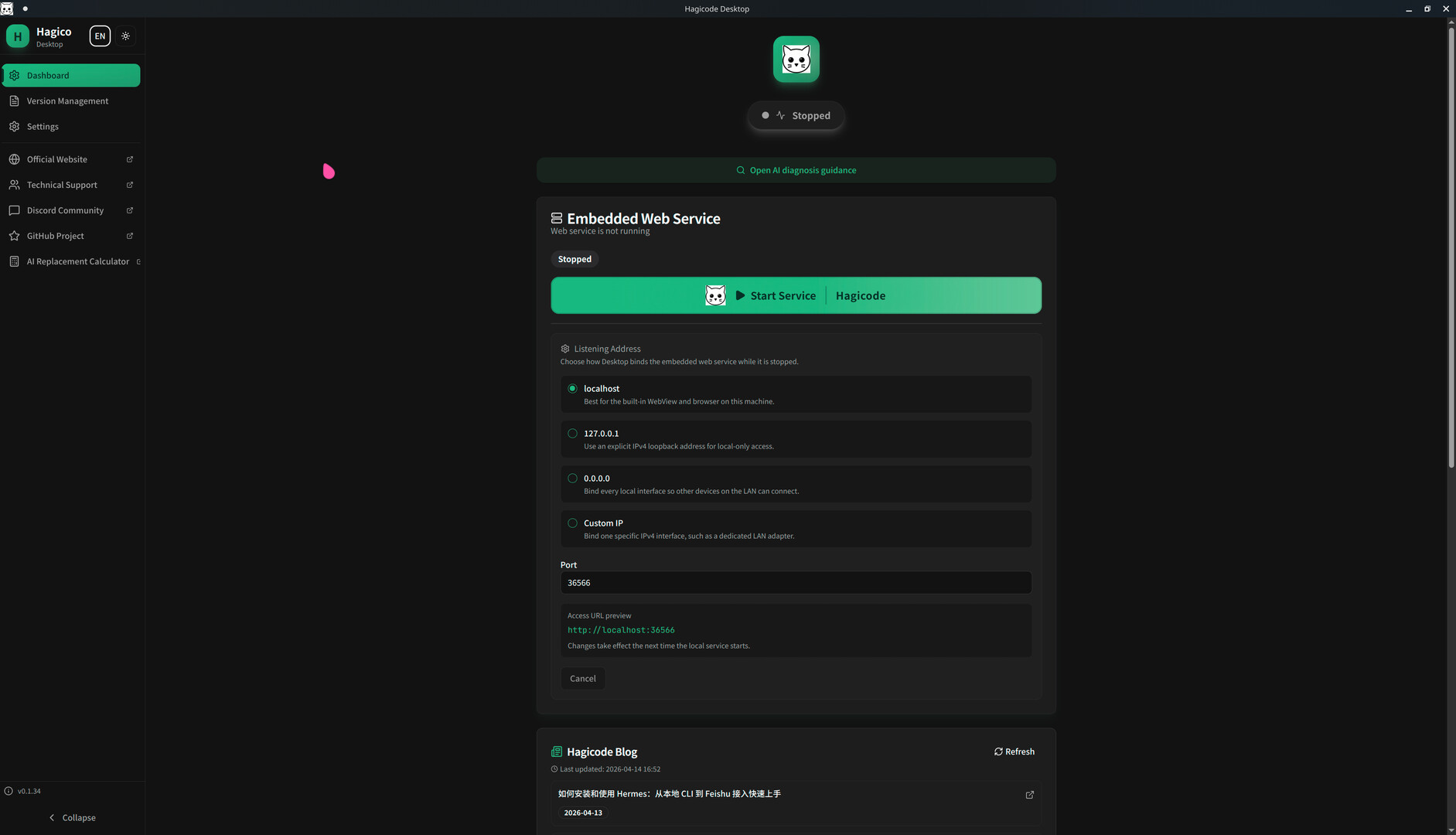
That screenshot already says a lot. HagiCode does not leave “conversation” stranded in the middle of a page. It brings sessions, status, workflows, metrics, and actions into the same workspace. You do not open it just to ask, “Can you write some code for me?” You open it to move an entire stretch of development work forward.

Why HagiCode does not look like a traditional AI coding tool

Traditional AI coding tools often focus on generation. HagiCode cares more about drifting less, shipping reliably, and being reviewable afterward.

That means its design leans toward real software development workflows instead of one-off question-and-answer interactions:

  • understand the repository before changing code

  • clarify the goal before execution starts

  • define the boundaries before the AI acts

  • preserve not only the result, but also the process and the reasoning

That is also the foundation for HagiCode’s three identities that follow. It is an AI coding tool, a gamified workspace, and a platform that brings multiple development capabilities together.

1. HagiCode as an AI coding tool

If you look only at the “AI coding” layer, HagiCode is not trying to make AI write flashier code. It is trying to make AI write more reliably.

1. It organizes the work before it generates code

HagiCode has the OpenSpec workflow built in. For anything slightly more complex, the AI does not jump straight into editing files. It first turns the request into a proposal, tasks, impact scope, and validation steps.

That point matters. Many AI coding tools feel risky not because they cannot generate code, but because they start changing things too quickly when context is incomplete. HagiCode tries to reverse that:

  • clarify the problem first

  • confirm which modules will be affected

  • break out tasks and acceptance criteria

  • then move into implementation

The direct result is that AI is less likely to make random, intuition-driven edits in complex projects. Put differently, HagiCode is not chasing the shortest path. It is chasing the more reliable path.

2. It emphasizes project-level understanding, not just finishing the current task

Many IDEs can already edit multiple files, and some can even change multiple directories in a single session. So HagiCode’s advantage can no longer be summarized as simply “it is not single-file autocomplete.”

What I want to emphasize instead is that HagiCode aims for a whole-project perspective.

It does not care only about “which files need to change for this task.” It also cares about the higher-level questions:

  • what problem the project as a whole is solving

  • how the current repository relates to other repositories

  • whether this change also touches the frontend, backend, docs, deployment, or scripts

  • what similar decisions were made before, and why

  • how today’s proposals, commits, and knowledge should be reused later

In other words, HagiCode is not just trying to complete one task for you. It is trying to pull AI into the perspective of participating in a project over the long term.

From that perspective, a single task is only the visible surface. What matters more is that the following capabilities can be connected naturally:

  • switching and coordinating across multiple projects

  • building shared understanding across multiple repositories

  • preserving historical proposals, commits, and knowledge over time

  • turning individual conversations into durable project context

That is why I designed HagiCode as a workspace rather than a simple chat window. I want AI to see not an isolated request, but where the entire project is going.

From this angle, HagiCode feels more like “an AI that thinks from the perspective of the whole project” than “an AI that helps you finish one temporary edit.”

3. It supports multiple mainstream Agent CLIs and cleanly separates the CLI from the model

HagiCode’s current active support range covers multiple mainstream Agent CLIs, including:

  • Codex

  • Claude Code

  • GitHub Copilot

  • OpenCode

  • Hermes

  • QoderCLI

  • Kiro

  • Kimi

  • Gemini

  • DeepAgents

  • Codebuddy

There is one important point I want to make clear here: the CLI and the model are not hard-bound to each other.

Many products treat “which CLI you are using” and “which model subscription you are using” as the same decision. HagiCode does not want to do that.

4. OmniRoute separates the model layer from the CLI and makes routing more flexible

HagiCode integrates OmniRoute so that model access becomes its own infrastructure layer. That way, the CLI handles the interaction style you prefer, while models and subscriptions can be selected through a unified routing layer.

The value of that is straightforward:

  • you can keep using the CLI you already like

  • you are not forced into the model subscription a CLI happens to default to

  • you can manage model selection, model catalogs, and endpoint access in one unified layer

  • multiple CLIs can reuse the same model routing strategy

In other words, even if you want to use Claude Code as the CLI, you can still connect it to other model sources and subscriptions through OmniRoute. For example, if you want to use the subscription capacity of GitHub Copilot instead of hard-binding the CLI to its default subscription path, that can work in HagiCode.

What I want is simple: you should choose a CLI because you like how it feels to use, and choose a model or subscription because you trust its cost, capability, and availability. Those should not be forced into a single bundled choice.

2. HagiCode as a comprehensive AI development platform

If the first section answers “Can it handle coding?”, then this section answers a different question: why does it feel like an IDE, and in some ways more like a complete platform than a traditional IDE?

The answer is that HagiCode does not stop at chat, and it does not stop at proposals either. It pulls together capabilities that would normally be scattered across different tools and turns them into one continuous system.

1. MonoSpecs stops cross-repository development from turning into a patchwork

For real teams, a requirement rarely lands in just one repository. The frontend, backend, documentation, scripts, and deployment configuration may all need to change together.

HagiCode introduces MonoSpecs to bring that kind of cross-repository collaboration back under one view. In a single project, you can maintain a repository inventory, proposal scope, and archive strategy. You can also let AI understand more clearly which boundaries a change really crosses.

For single-repository users, this may not be the first capability they touch. But once you start dealing with frontend-backend coordination, keeping documentation aligned with the product, or maintaining multiple subprojects, its value becomes obvious.

2. The Skills system lets the platform keep growing

Many AI products extend themselves in a rough way: either you wait for official features, or you make users tinker in the terminal on their own. HagiCode turns Skills into a formal product module instead.

Inside HagiCode, you can:

  • view skills already installed locally

  • search the skills catalog

  • get skill recommendations based on the current project

  • inspect skill details, install commands, and trust status

  • batch update local skills

That means HagiCode is not a sealed product. It is more like a shell that can keep taking in new skills, capabilities, and workflows.

3. The Vault system keeps the knowledge base from being scattered everywhere

You can think of Vault as HagiCode’s knowledge storage layer.

It supports bringing different types of material into the platform, including:

  • code reference repositories

  • ordinary folders

  • Obsidian vaults

  • system-managed directories

That way, analysis notes, reference code, and design records collected in one project do not remain trapped inside a single session. They can be cited again, organized further, and reused as context in future work.

For many teams, this matters a lot. AI becomes truly valuable not because it “answered once,” but because it can continue working from a body of knowledge that has already been organized.

4. AI Compose Commit extends “finished coding” into “clear commit writing”

For many teams, the real pain point is not the coding itself, but the final step: the code is done, but nobody wants to write the commit message carefully.

HagiCode provides AI Compose Commit, which brings commit message generation into the workflow as well.

  • you do not need to remember every change line by line

  • you do not need to improvise a rushed commit description at the last minute

  • you can let AI organize a clearer commit message based on the actual diff

Its value is not just saving a few dozen seconds. It is that “commit” finally stops being detached from the rest of the context.

5. Code Server integration makes both local and remote editing smoother

HagiCode also integrates browser-based editing through code-server. Whether your project lives locally, on a server, in a container, or in a remote runtime, you can open the project or Vault more easily and jump straight into editing.

That makes HagiCode feel more like a real development platform instead of only a front-end surface that analyzes code. Many times, the AI has already traced the problem down to a specific file. If you still have to jump back into another tool and relocate everything yourself, the workflow loses momentum. Code Server integration solves that break.

6. It treats convenience features as real capabilities, not leftovers

Beyond proposals, execution, skills, and knowledge management, HagiCode also includes quite a few features that genuinely affect day-to-day experience:

  • GitHub integration

  • speech recognition

  • hydration reminders

  • theming and interface personalization

  • reporting and statistics entry points

These may look like “small features,” but they decide whether a platform is something people want to keep open over time. HagiCode does not hide them at the edges. It tries to make them visible, complete, and configurable parts of the product.

3. HagiCode as a game

The gamification inside HagiCode is not there as decoration. It exists to make long-term use of an AI development platform feel more responsive, more rhythmic, and easier to stick with.

1. You can see your progress instead of only seeing chat logs

In HagiCode, many actions are turned into explicit progress feedback. Creating sessions, sending messages, executing plans, switching projects, and submitting annotations no longer disappear as one-off actions. They accumulate into daily achievements, milestone progress, and completion records.

The point of this design is not just “fun.” It is that it becomes easier to feel what you actually moved forward in a day. For many long-term developers, the exhausting part is not the workload itself. It is the lack of feedback. HagiCode is trying to fill that gap.

2. It does not stop at achievements. It also gives you daily reports

Beyond achievements, HagiCode also uses daily reports to show what you really got done yesterday, where the points came from, and how your streak is progressing.

That means the platform does not just record what you did. It reorganizes those actions into a review surface with actual rhythm. You can tell more easily whether you are blocked on session progress, tool usage, code execution, or simply active time and task continuity.

3. It turns productivity into visible feedback too

Many products tell you “AI makes you more productive,” but cannot explain how much more productive. HagiCode would rather express that with visible data.

In these productivity reports, you can see runtime duration, AI time spent, efficiency uplift, and concurrency distribution. It is not mythologizing AI. It is trying to turn “productivity” from a slogan into concrete feedback.

4. It even turns token usage into something you can feel in real time

If you are a heavy user, the value of this design becomes obvious. In many cases, the cost and performance issues of AI do not reveal themselves at the end of the month. They show up while a session is already in progress.

HagiCode shows input tokens, output tokens, total token counts, and throughput tiers directly in the product. That gives you a more immediate sense of how heavy a session really is, whether the current model is under high load, and whether the conversation has become too bloated.

5. Heroes, professions, and levels are not gimmicks. They map the workflow

HagiCode includes a full presentation layer built around heroes, professions, load, and level progression. This is not just a cosmetic rename. It maps different agents, responsibilities, and work states into interface language that is easier to understand and manage.

That makes multi-agent collaboration, role switching, and multi-model management feel less abstract. What you see is not just “a configuration item,” but “what this hero is doing right now, what the primary and secondary professions are, and how the state is progressing.”

Who HagiCode is really for

If you fit one of the roles below, HagiCode’s value usually becomes easy to understand:

RoleWhat you are likely to valueNew engineersFaster understanding of repositories, workflows, and context instead of getting only fragmented answersEveryday developersA continuous workflow that brings proposals, coding, commits, and metrics togetherTechnical leadsBetter traceability for decisions and knowledge through OpenSpec, MonoSpecs, and VaultMulti-repository teamsA single system for coordinating linked changes across frontend, backend, docs, and scriptsHeavy AI usersClearer management of models, throughput, productivity, achievements, and long-term usage rhythm

Let me answer the opening questions one more time

Is HagiCode an AI coding tool?

Yes, and it puts more emphasis on reducing hallucinations, avoiding drift, and producing changes that really land.

Is HagiCode a game?

Yes as well, because it takes achievements, daily reports, multipliers, heroes, professions, and feedback loops seriously inside the workspace.

Is HagiCode an IDE?

In some ways, it is even closer to a platform. It does not only cover the editor surface. It connects proposals, sessions, skills, the knowledge base, cross-repository collaboration, commit organization, and browser-based editing into one complete flow.

So what HagiCode ultimately wants to promote is not one isolated feature, but a new way of working:

Upgrade AI development from “ask once, answer once” into a full chain of understanding, planning, execution, knowledge capture, and feedback.

Системные требования

Windows
SteamOS + Linux
    Минимальные:
    • 64-разрядные процессор и операционная система
    • ОС: Windows 10
    • Оперативная память: 4 GB ОЗУ
    • Сеть: Широкополосное подключение к интернету
    • Место на диске: 10 GB
    Рекомендованные:
    • 64-разрядные процессор и операционная система
    • ОС: Windows 11
    • Оперативная память: 32 GB ОЗУ
    • Сеть: Широкополосное подключение к интернету
    • Место на диске: 1024 GB
    Минимальные:
    • Оперативная память: 4 GB ОЗУ
    • Место на диске: 10 GB
    Рекомендованные:
    • Оперативная память: 32 GB ОЗУ
    • Место на диске: 1024 GB
У этого продукта нет обзоров

Вы можете написать обзор этого продукта, чтобы поделиться своим опытом с сообществом. Для этого воспользуйтесь разделом над кнопками покупки.