
CRT sound emulator which uses your monitor's displayed graphics in real time to produce CRT sounds, bringing back the subtle, forgotten noises of cathode-ray tube displays. Perfect for 80s, 90s, 2000s nostalgia alongside retro game emulation, CRT shaders, and watching TV series/movies/documentaries.

로그인하셔서 게임을 찜 목록에 추가하거나, 팔로우하거나 또는 제외로 지정하세요.

한국어(을)를 지원하지 않습니다

이 제품은 귀하의 로컬 언어를 지원하지 않습니다. 구매하기 전에 아래에 있는 지원하는 언어 목록을 확인해주세요.

crt_synthesizer 구매


소프트웨어 정보

CRT Synthesizer is a passion project turned tool — a simple yet detailed CRT sound emulator which uses your monitor's displayed graphics in real time to produce CRT sounds, bringing back the subtle, forgotten noises of cathode-ray tube displays.

It doesn’t try to be a studio plugin or a sound workstation. Instead, it focuses purely on authenticity — from the variable pitch of flyback transformers to the faint hum and corona buzz that defined the atmosphere of 80s and 90s screens.

Whether you’re streaming retro games, creating nostalgic videos, or just miss the immersive analog warmth of old displays, this program runs quietly in the background and reproduces those sounds in real time.

Features
• Real-time CRT flyback and yoke resonance emulation
• Adjustable parameters: pitch, hum, arcing, corona noise, and more
• Minimal, functional interface — simple to understand controls
• Works alongside any emulator, game, or desktop environment
• Lightweight CPU footprint and simple setup

Who It’s For
• Retro gaming enthusiasts
• Streamers and YouTubers seeking authentic CRT ambience
• Developers and sound designers who appreciate real hardware character

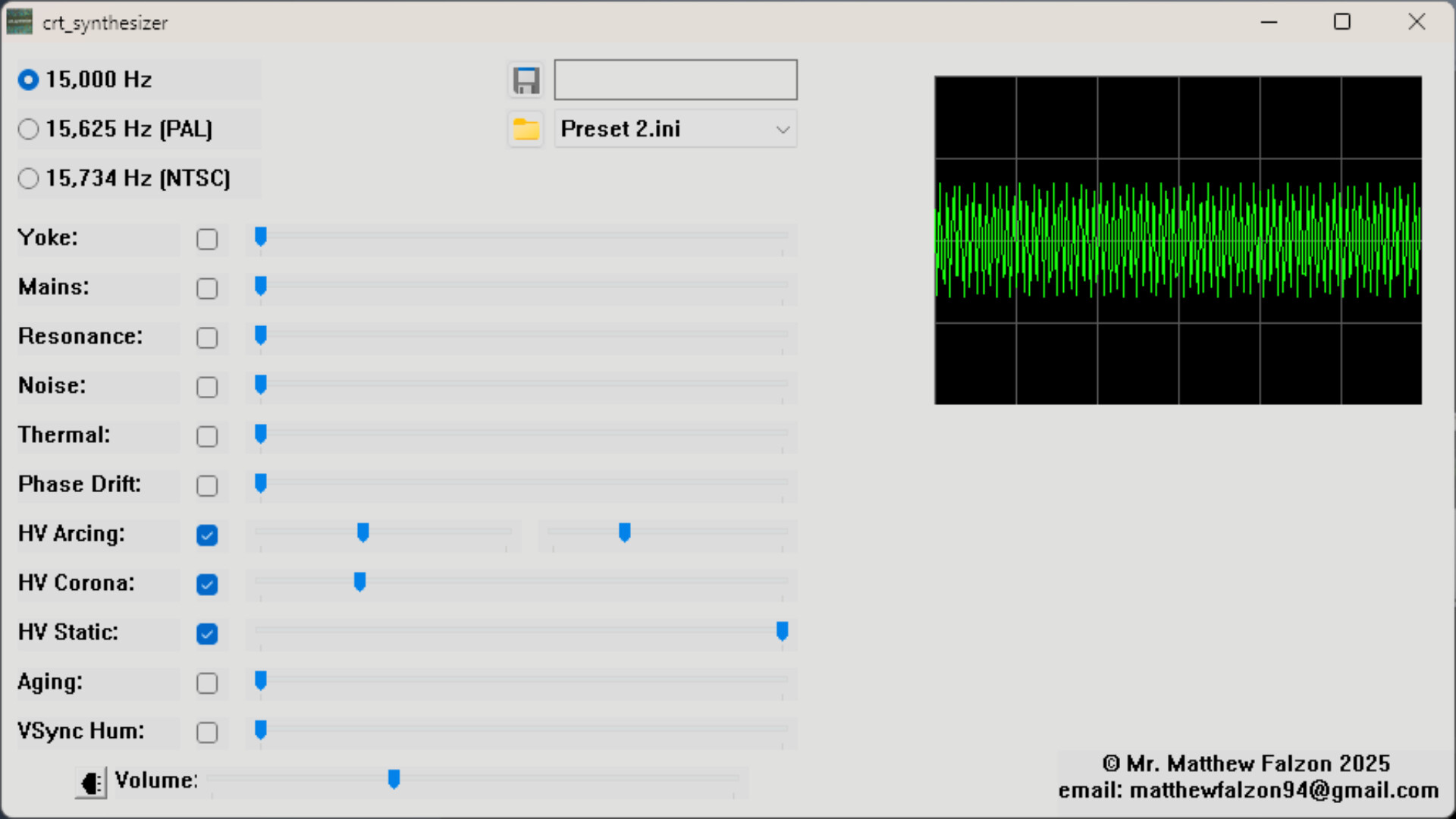
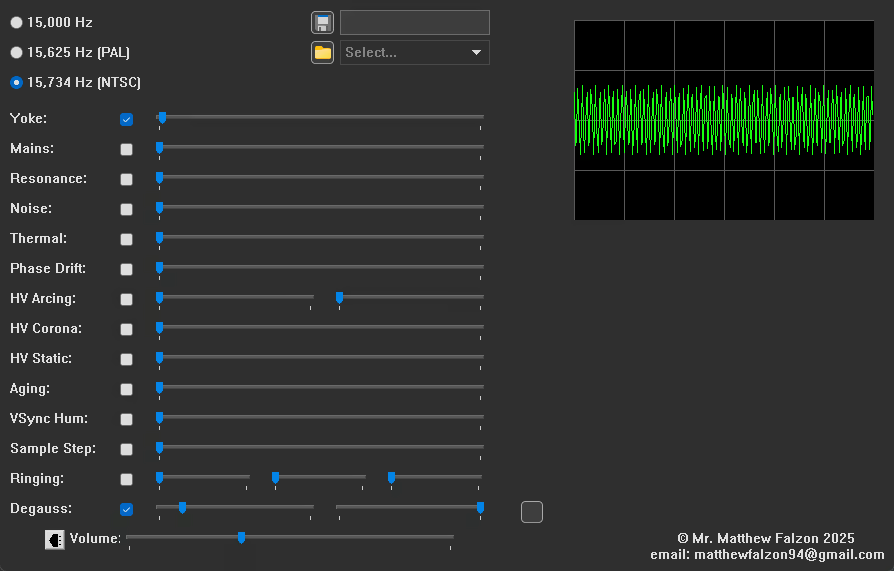
With this tool you are able to control the following features:

Three radio buttons which switch between the most renowned CRT functional frequencies 15000 Hz, 15645 Hz, 15734 Hz.

14 effects to regulate and turn on or off at will;

Yoke coil hum — The deflection yoke (coils around the CRT neck) carries high-current sawtooth waveforms for horizontal/vertical scanning. Magnetostriction or loose windings cause audible vibration, often a low-frequency hum or buzz (around 50-60 Hz for vertical or higher for harmonics).

Mains power hum — 50/60 Hz hum from the main power supply transformer or rectified AC ripple leaking into circuits, causing vibration in transformers or chokes due to magnetostriction.

Resonance harmonic — Higher-order harmonics or resonant vibrations in coils/transformers (e.g., from the flyback or yoke), amplifying specific frequency components beyond the base hum or whine.

Background noise — General low-level electrical hiss or white noise from circuitry, resistors, or minor discharges in the analog high-voltage system.

Thermal drift — Simulated subtle variations in frequency/pitch of hums or whines due to temperature changes affecting component values (e.g., coils expanding/contracting).

Phase drift — Gradual shifting or instability in the phase/timing of signals (e.g., sync or deflection), causing audible beating or wavering in periodic noises.

High-voltage arcing — Crackling or popping from occasional electrical arcing/sparking in the high-voltage section (e.g., around the anode cap, flyback, or CRT socket), often due to dust, humidity, or insulation breakdown.

Corona discharge buzz — Rate of intermittent high-voltage arcing events (every 0.02 to 0.2 seconds), producing repeated zap or tick sounds.

Static — Random crackling or popping from static charge buildup/discharge on the CRT screen or internal coatings.

CRT aging noise and drift — Increased random noise, hum variation, or instability simulating wear in older tubes (e.g., loose windings, degraded components amplifying vibrations or drift).

Vertical sync hum — Low-frequency (50-60 Hz) hum primarily from the vertical deflection yoke/coils vibrating at the frame rate.

Pixel distance per sample — Adjusts effective resolution of synthesized noise, affecting how finely spatial/brightness changes modulate sounds (higher value means more space per sample/less resolution).

Flyback ringing — Additional oscillatory effect in the flyback transformer beyond the core tone, producing a crackling or sizzling sound; intensity varies with screen brightness and beam current.

Degauss — Loud "thump" or "bonk" from the degaussing coil (around the CRT front) activating on power-on to demagnetize the shadow mask/aperture grille.

A Note from the Developer
This project started as a personal experiment in nostalgia — a curiosity about whether the sound of a flyback transformer could be synthesized convincingly in software.
It grew into something people seemed to love, and with your support, it continues to improve.

Thank you for supporting small, independent projects like this — they keep these little pockets of history alive in sound form.

Just a remark - if you observed with browser streaming services the program does not react to monitor changes, this is because it most probably is caused by 'DRM'. What you have to do is disable 'hardware acceleration' in your browser settings, and it should work fine.

시스템 요구 사항

    최소:
    • 운영 체제: Windows 10/11 (64-bit).
    • 프로세서: Any modern dual-core CPU (e.g., Intel i3 / AMD Ryzen 3 or better).
    • 메모리: 4 GB RAM
    • 그래픽: Integrated graphics is fine; no dedicated GPU required.
    • 저장 공간: 4 MB 사용 가능 공간
    • 추가 사항: Speakers recommended for basic experience.
    권장:
    • 운영 체제: Windows 10/11 (64-bit).
    • 프로세서: Modern quad-core CPU (e.g., Intel i5 / AMD Ryzen 5).
    • 메모리: 8 GB RAM
    • 그래픽: Integrated graphics is fine; no dedicated GPU required.
    • 저장 공간: 4 MB 사용 가능 공간
    • 추가 사항: Good speakers recommended for best experience.

CRT Synthesizer에 대한 사용자 평가 사용자 평가 정보 환경 설정

종합 평가:
사용자 평가 1개 (평가 1개)


특정 날짜 범위에 속하는 평가를 보려면, 위의 그래프에서 선택 항목을 클릭한 후 드래그하거나 원하는 바를 클릭하세요.


평가를 작성한 시점의 사용자 플레이 시간을 기준으로 평가를 필터링:


최소 시간 없음 ~ 최대 시간 없음

선택한 표시 순서로 평가 보기


자세한 정보
필터
게임과 관련없는 평가 활동 제외
플레이 시간:
주로 Steam Deck에서 플레이
운영 체제:
CPU:
GPU:
기기 유형:
위에서 설정한 필터 조건에 맞는 평가가 없습니다
다른 평가를 보려면 위에서 필터를 조정해주세요
평가 불러오는 중...