
A small, handcrafted tool that recreates the authentic hum, buzz, and flyback resonance of classic CRT displays. Built for retro gaming fans, streamers, and anyone chasing that nostalgic analog soundscape.

Connectez-vous pour ajouter cet article à votre liste de souhaits, le suivre ou l'ignorer

Français non disponible

Ce produit n'est pas disponible dans votre langue. Veuillez consulter la liste des langues disponibles ci-dessous avant de l'acheter.

Acheter crt_synthesizer


À propos de ce logiciel

About This Software

CRT Synthesizer is a passion project turned tool — a simple yet detailed CRT sound emulator which uses your monitor's displayed graphics in real time to produce CRT sounds, bringing back the subtle, forgotten noises of cathode-ray tube displays.

It doesn’t try to be a studio plugin or a sound workstation. Instead, it focuses purely on authenticity — from the variable pitch of flyback transformers to the faint hum and corona buzz that defined the atmosphere of 80s and 90s screens.

Whether you’re streaming retro games, creating nostalgic videos, or just miss the immersive analog warmth of old displays, this program runs quietly in the background and reproduces those sounds in real time.

Features
• Real-time CRT flyback and yoke resonance emulation
• Adjustable parameters: pitch, hum, arcing, corona noise, and more
• Minimal, functional interface — no fluff, just control
• Works alongside any emulator, game, or desktop environment
• Lightweight CPU footprint and simple setup

Who It’s For
• Retro gaming enthusiasts
• Streamers and YouTubers seeking authentic CRT ambience
• Developers and sound designers who appreciate real hardware character

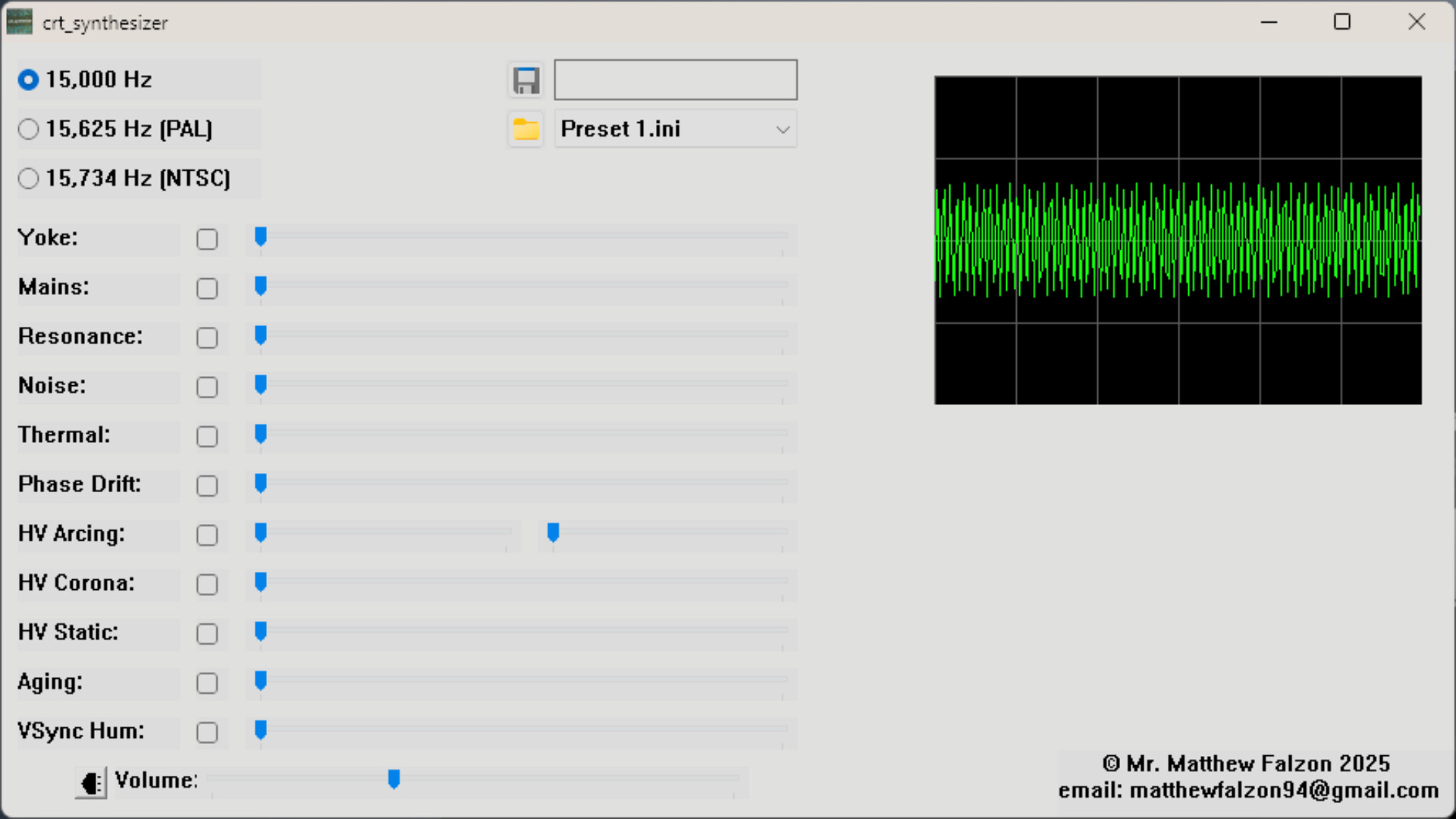
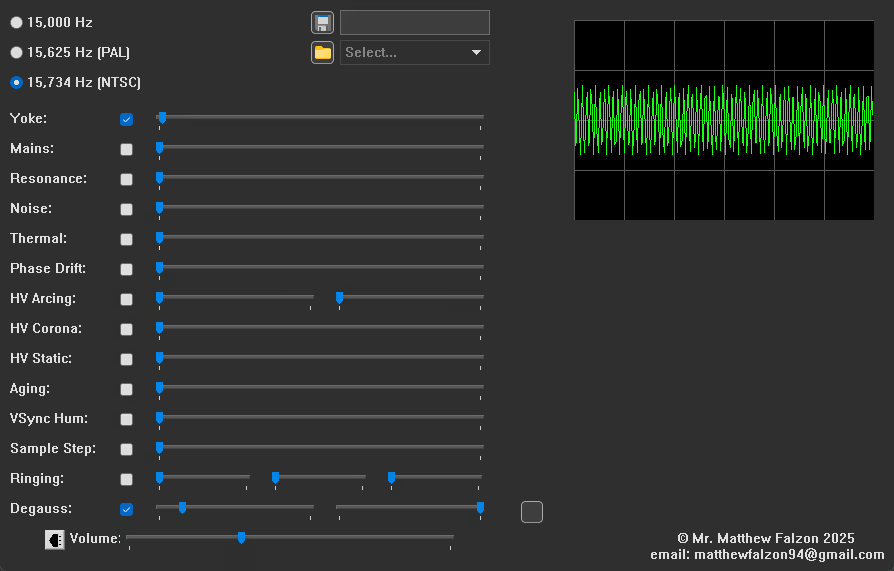
With this tool you are able to control the following features:

Three radio buttons which switch between the most renowned CRT functional frequencies 15000 Hz, 15645 Hz, 15734 Hz.

14 effects to regulate and turn on or off at will;

Yoke coil hum — The deflection yoke (coils around the CRT neck) carries high-current sawtooth waveforms for horizontal/vertical scanning. Magnetostriction or loose windings cause audible vibration, often a low-frequency hum or buzz (around 50-60 Hz for vertical or higher for harmonics).

Mains power hum — 50/60 Hz hum from the main power supply transformer or rectified AC ripple leaking into circuits, causing vibration in transformers or chokes due to magnetostriction.

Resonance harmonic — Higher-order harmonics or resonant vibrations in coils/transformers (e.g., from the flyback or yoke), amplifying specific frequency components beyond the base hum or whine.

Background noise — General low-level electrical hiss or white noise from circuitry, resistors, or minor discharges in the analog high-voltage system.

Thermal drift — Simulated subtle variations in frequency/pitch of hums or whines due to temperature changes affecting component values (e.g., coils expanding/contracting).

Phase drift — Gradual shifting or instability in the phase/timing of signals (e.g., sync or deflection), causing audible beating or wavering in periodic noises.

High-voltage arcing — Crackling or popping from occasional electrical arcing/sparking in the high-voltage section (e.g., around the anode cap, flyback, or CRT socket), often due to dust, humidity, or insulation breakdown.

Corona discharge buzz — Rate of intermittent high-voltage arcing events (every 0.02 to 0.2 seconds), producing repeated zap or tick sounds.

Static — Random crackling or popping from static charge buildup/discharge on the CRT screen or internal coatings.

CRT aging noise and drift — Increased random noise, hum variation, or instability simulating wear in older tubes (e.g., loose windings, degraded components amplifying vibrations or drift).

Vertical sync hum — Low-frequency (50-60 Hz) hum primarily from the vertical deflection yoke/coils vibrating at the frame rate.

Pixel distance per sample — Adjusts effective resolution of synthesized noise, affecting how finely spatial/brightness changes modulate sounds (higher value means more space per sample/less resolution).

Flyback ringing — Additional oscillatory effect in the flyback transformer beyond the core tone, producing a crackling or sizzling sound; intensity varies with screen brightness and beam current.

Degauss — Loud "thump" or "bonk" from the degaussing coil (around the CRT front) activating on power-on to demagnetize the shadow mask/aperture grille.

A Note from the Developer
This project started as a personal experiment in nostalgia — a curiosity about whether the sound of a flyback transformer could be synthesized convincingly in software.
It grew into something people seemed to love, and with your support, it continues to improve.

Thank you for supporting small, independent projects like this — they keep these little pockets of history alive in sound form.

Just a remark - if you observed with browser streaming services the program does not react to monitor changes, this is because it most probably is caused by 'DRM'. What you have to do is disable 'hardware acceleration' in your browser settings, and it should work fine.


                                                                                    +  |    |  +

                                                                           Α     |John 3:16|     Ω

                                                                                    +  |    |  +


Configuration requise

    Minimale :
    • Système d'exploitation : Windows 10/11 (64-bit).
    • Processeur : Any modern dual-core CPU (e.g., Intel i3 / AMD Ryzen 3 or better).
    • Mémoire vive : 4 GB de mémoire
    • Graphiques : Integrated graphics is fine; no dedicated GPU required.
    • Espace disque : 4 MB d'espace disque disponible
    • Notes supplémentaires : Speakers recommended for basic experience.
    Recommandée :
    • Système d'exploitation : Windows 10/11 (64-bit).
    • Processeur : Modern quad-core CPU (e.g., Intel i5 / AMD Ryzen 5).
    • Mémoire vive : 8 GB de mémoire
    • Graphiques : Integrated graphics is fine; no dedicated GPU required.
    • Espace disque : 4 MB d'espace disque disponible
    • Notes supplémentaires : Good speakers recommended for best experience.

Évaluations pour crt_synthesizer À propos des évaluations Vos préférences

Évaluations globales :
1 évaluations (1 évaluation(s))


Pour consulter les évaluations publiées lors d'une période spécifique, cliquez et faites glisser votre sélection sur un graphique ci-dessus ou cliquez sur une barre.


Filtrer les évaluations en fonction du temps de jeu des utilisateurs au moment de leur publication :


Pas de minimum à pas de maximum

Afficher les évaluations dans l'ordre sélectionné


En savoir plus
Filtres
Activité d'évaluation hors sujet exclue
Temps de jeu : 
A joué surtout sur Steam Deck
Plus aucune évaluation ne correspond aux filtres définis ci-dessus
Ajustez les filtres ci-dessus pour voir d'autres évaluations
Chargement des évaluations...