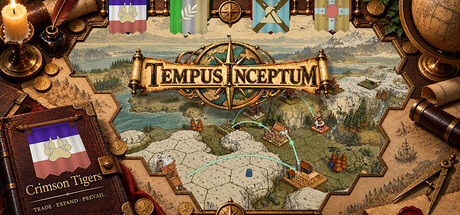


Compete in daily global economic strategy challenges. Build production chains, manipulate markets, and outscore rival AI factions on shared leaderboards.

Sign in to add this item to your wishlist, follow it, or mark it as ignored

This game is not yet available on Steam

Coming soon

Interested?
Add to your wishlist and get notified when it becomes available.
 

About This Game

Build an Economy. Master the Market. Outmanoeuvre Your Rivals.

Tempus Inceptum is a competitive economic strategy game set across procedurally generated hex worlds. Claim territory, exploit the resources the land provides, and turn raw materials into increasingly valuable goods through interconnected production chains.

But you are not building alone.

Rival AI factions develop their own economies alongside yours — claiming land, harvesting resources, producing goods and trading on the same dynamic market. Their decisions affect prices and opportunities, forcing you to adapt as the economy evolves.

Expand your territory. Specialise your production. Trade the market. Use tactical gambits against your competitors. There is no single route to economic dominance.

Your faction also builds a history of its own. The evolving Faction Journal records notable achievements, decisions and events from your games, creating a growing chronicle of the faction you have created.

And through shared daily, weekly and monthly challenges, you can put your strategy against other players facing the same economic conditions.

Build Around the World You Are Given

Every game begins on a procedurally generated hex landscape shaped by terrain, climate and available resources.

Choose where to establish yourself, claim new territory and build an economy around the opportunities the land provides. Farms, mines, lumber mills and other harvesting buildings supply the raw materials needed to support increasingly complex production networks.

A strong economy is not simply about building more. It is about building the right things, in the right places, at the right time.

Create Production Chains

Raw resources are only the beginning.

Transform them into more valuable products through interconnected production buildings. Crops can become food, ore can become steel, wood can become timber, and increasingly advanced goods can open new economic opportunities.

Your production network can grow in different directions depending on the resources available, the demands of the market and the strategy you choose to pursue.

Trade and Adapt

Resources and products can be bought and sold through the in-game Stock Exchange.

Prices move as supply and demand change during each game, creating opportunities for trade as well as production. Sell into strong markets, buy when prices are favourable, or use the exchange to support an economy that cannot produce everything it needs locally.

The strongest strategy may not always be the largest production network. Sometimes the better opportunity is simply recognising what the market is telling you.

Compete Against Rival Factions

AI factions operate under the same economic pressures as you.

They claim land, build harvesting and production networks, trade resources and pursue their own priorities. Their actions can alter the availability of territory, affect market prices and change which strategies remain attractive.

You are not solving an isolated optimisation puzzle. You are competing inside an economy that is changing around you.

Use Tactical Gambits

Economic competition does not have to remain peaceful.

Gambits give you ways to influence the contest beyond ordinary expansion and trade. Disrupt rival production, interfere with markets, protect your own faction or create temporary advantages when the opportunity arises.

Using them well means judging not only what benefits you, but when intervention is worth the cost.

Choose Your Route to Victory

Tempus Inceptum supports different approaches to economic success.

You might build broad production networks, specialise around a handful of valuable goods, expand aggressively across the map, exploit movements in the Stock Exchange or use gambits to undermine stronger rivals.

Different game modes place the emphasis on different measures of success, rewarding adaptation rather than a single fixed build order.

Take on Shared Challenges

Daily, weekly and monthly challenges give players the same underlying objective and economic conditions to compete against.

Rather than playing together in the same world, players tackle comparable scenarios independently and compete through shared leaderboards.

This makes each challenge a test of decision-making: given the same opportunity, what can you make of it?

Build a Faction History

The faction you create has an identity beyond a single result.

Your evolving Faction Journal records notable events, achievements and decisions from your games, gradually building a chronicle of what that faction has experienced.

It is a record of the strategies you tried, the successes you earned and the stories that emerged along the way.

Play at Your Own Pace

Alongside competitive challenges, sandbox and standard game modes let you experiment with production chains, markets and strategies without the same leaderboard pressure.

Learn the systems, try unusual approaches, refine your economic thinking — or simply build and see what happens.

AI Generated Content Disclosure

The developers describe how their game uses AI Generated Content like this:

Some building art assets were created using AI-assisted 3D model generation, then manually refined, rendered, and composited as final 2D sprites. No live AI content generation occurs during gameplay.

System Requirements

    Minimum:
    • Requires a 64-bit processor and operating system
    • OS: Windows 10 (64-bit)
    • Processor: Intel Core i5-7500 or AMD Ryzen 3 1200
    • Memory: 8 GB RAM
    • Graphics: NVIDIA GTX 1050 Ti or AMD RX 560
    • DirectX: Version 11
    • Storage: 2 GB available space
    • Additional Notes: Designed for stable performance on mid-range systems.
    Recommended:
    • Requires a 64-bit processor and operating system
    • OS: Windows 11 (64-bit)
    • Processor: Intel Core i7-9700 or AMD Ryzen 5 3600
    • Memory: 16 GB RAM
    • Graphics: NVIDIA GTX 1600 / RTX 2060 or AMD RX 5700
    • DirectX: Version 12
    • Storage: 2 GB available space
    • Additional Notes: Runs best on modern hardware; no ray tracing required.
Review Filters