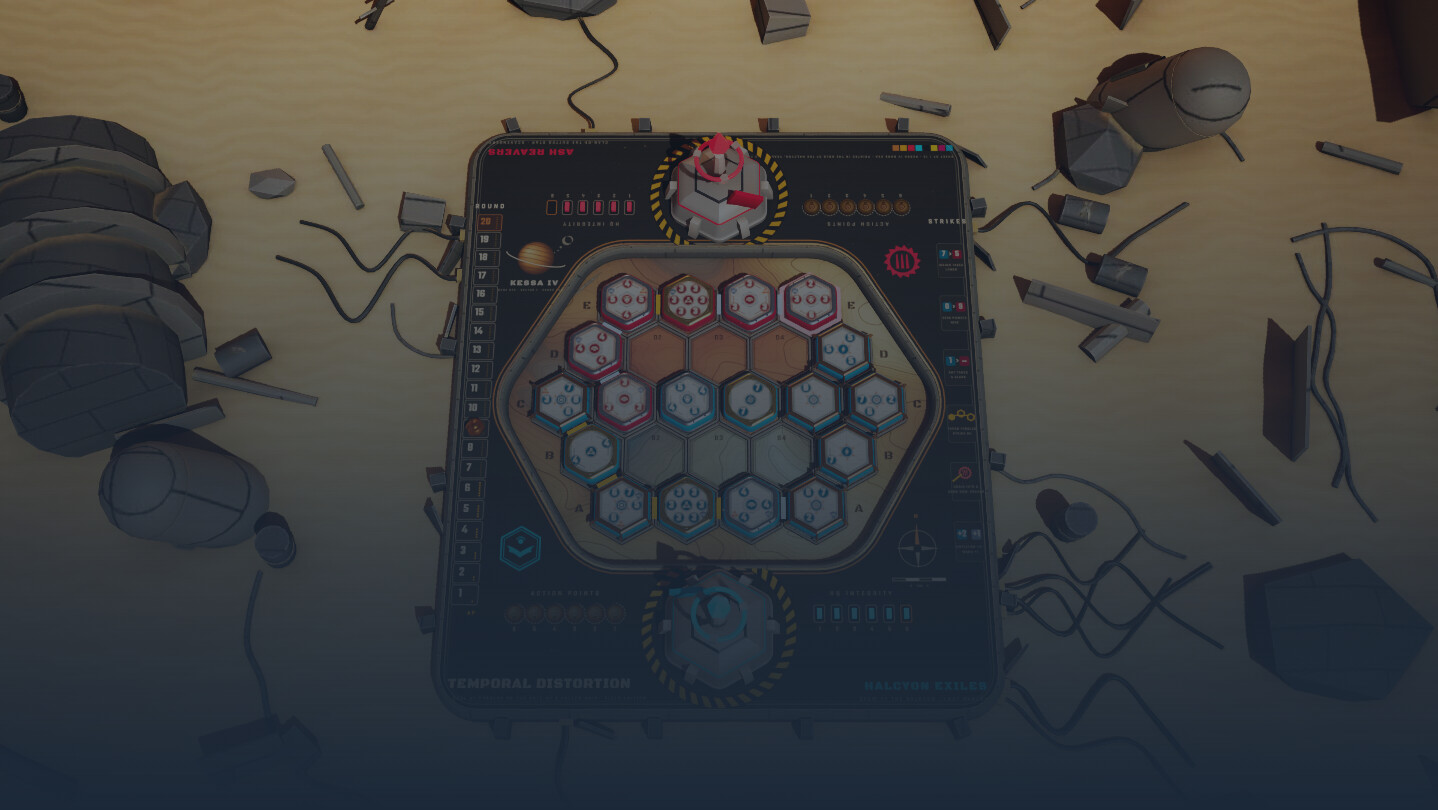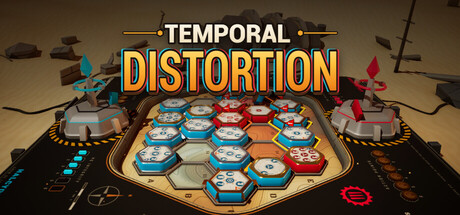

A board game of hex pebbles at a lamplit table, on four hostile worlds. Place a pebble, turn it to strike: higher numbers take lower, and every pebble taken strikes on in a chain. No dice. Across the table, a patient stranger tells you whose story you're playing.

Sign in to add this item to your wishlist, follow it, or mark it as ignored

This game is not yet available on Steam

Coming soon

Interested?
Add to your wishlist and get notified when it becomes available.
 

About This Game

Place. Rotate. Chain. Breach.

Temporal Distortion is a single-player board game of hex pebbles, played at a lamplit table on four worlds that want you dead. Every pebble has six edges, and every edge a number. Place a pebble, then turn it to strike: the higher number takes the lower, and every pebble taken strikes on with its own edges, wave after wave, until nothing more falls. Run the chain into the enemy's home row and their HQ cracks.

No dice, no hit chances. Every strike is exact, and you see what it takes before you turn. Each campaign level deals the same way every time, so every loss teaches you something.

A stranger, a board, and all the time in the world

The Halcyon came down in the dunes, and you lay down in her shadow to wait for death. It didn't come. Then you noticed a board under your hands, and someone across from you, and that you were already playing. The stranger is in no hurry. Between games it sets a scene: a town in the desert, a girl in her wedding blue, waiting in the square for someone who never comes.

Turn to strike

  • Placing positions, rotating attacks. Each 60° turn costs an action point and strikes all round. Where you put a pebble decides what its numbers can reach; how you spend your few points decides what falls.
  • Chain reactions. One good turn can flip half the board. Line your pebbles up so that each one taken sets off the next.
  • Breach the HQ. Run a chain into the enemy's home row, or past an empty slot of it, and their HQ loses integrity. Bring it to zero and the game is yours.
  • Blanks and the zero point. A blank edge never strikes and any number takes it. A 0 takes a 9. Every edge matters, even the low ones.
The captures of Triple Triad and the exact, readable turns of Into the Breach, on a hex board where one turn can set off the whole table.

Four worlds, and time slipping between them

Beat a world, and time slips: the table turns to ice, to spore forest, to ash, and the stranger is already waiting with the next story. You were a trader once. You moved whatever you were paid to move, and never asked what it was for. You'll remember.
  • Crash Site, the sand world. Where it starts: ten levels that bring in every kind of pebble.
  • Glacier Shelf, the ice world. Slick ice turns a pebble twice, frost stops a chain cold, and thin ice cracks under every turn until it swallows what stands on it.
  • Spore Thicket, the bio world. Roots bridge the gaps in the board, spore pods burst when a chain runs past them, and clouds of gas drift round the middle and soften whatever they touch.
  • Caldera, the volcanic world. A ring of heat round a crater: pebbles on it hit harder and break easier, the mountain erupts every third round and turns them, and the lava claims the ring, slot by slot.

A campaign told in tales

  • Forty-seven levels: ten on each world (matches, breaches, one-turn puzzles, sieges to survive and races against the clock, each with a bonus goal, and a boss at the end), then a final chapter that takes you back across all four boards.
  • Five tales, told a part at a time after each win: the people of each world, and what happened to them, and why. The ledger keeps every telling.
  • A piece of the story for every level. A strip of wedding blue, a sealed crate, a ticket that wasn't enough: each laid in your hand and kept in a case you can open and turn in your hands, with thirteen relics, stronger versions of the pebbles you hold.

Sixteen pebbles, three roles

  • Attack: Cores with the strongest numbers, Sparks that overcharge through equal numbers, Breachers that hit the HQ directly.
  • Defence: Aegis plates that no chain can take, Wards that harden everything beside them.
  • Utility: Gyros that spin for free, Gears that turn their neighbours the other way, Amplifiers that make a 7 into a 9.
Who stands next to whom is half the game.

Learn it in minutes, sharpen it for hours

  • A ten-lesson tutorial: the stranger reminds you of a game you once knew, one idea at a time on a real board.
  • Eleven puzzles, each a single turn with a goal and just enough action points, proved solvable and with hints when you need them.
  • Free matches against an AI at three levels that reads the board exactly and looks ahead at your answer.
  • A threat overlay that shows which of your pebbles the enemy can take next turn, what a move would leave open, and on the Caldera when the mountain erupts next and what the lava will take.

A board game on four worlds

Every match is played on a printed survey map of the world it is set on, at a table among the dunes, the ice, the spore forest or the ash: resin pebbles with printed faces, cards with foil seals, coins that flip as you spend them, tracks round the rim of the board. Bright as a table under lamplight.

What it is not

  • Not a roguelike or a deckbuilder. A hand-made campaign of forty-seven levels, each the same every time you play it.
  • Not a game of dice. Shuffled decks decide what you hold, never whether a strike lands.
  • Not online. Single-player, no accounts, nothing to buy inside the game.

AI Generated Content Disclosure

The developers describe how their game uses AI Generated Content like this:

AI tools supported our small team behind the scenes: they helped with programming, automated parts of our workflow, assisted with game balancing, and helped write the scripts behind the game's procedurally generated content.

System Requirements

    Minimum:
    • Requires a 64-bit processor and operating system
    • OS: Windows 10 64-bit
    • Processor: Intel Core i5-6600 / AMD Ryzen 5 1600
    • Memory: 8 GB RAM
    • Graphics: NVIDIA GeForce GTX 1060 6 GB / AMD Radeon RX 580 8 GB (DirectX 12)
    • DirectX: Version 12
    • Storage: 1 GB available space
    Recommended:
    • Requires a 64-bit processor and operating system
    • OS: Windows 11 64-bit
    • Processor: Intel Core i5-10400 / AMD Ryzen 5 3600
    • Memory: 16 GB RAM
    • Graphics: NVIDIA GeForce RTX 2060 / AMD Radeon RX 6600
    • DirectX: Version 12
    • Storage: 1 GB available space
    • Additional Notes: SSD recommended
Review Filters