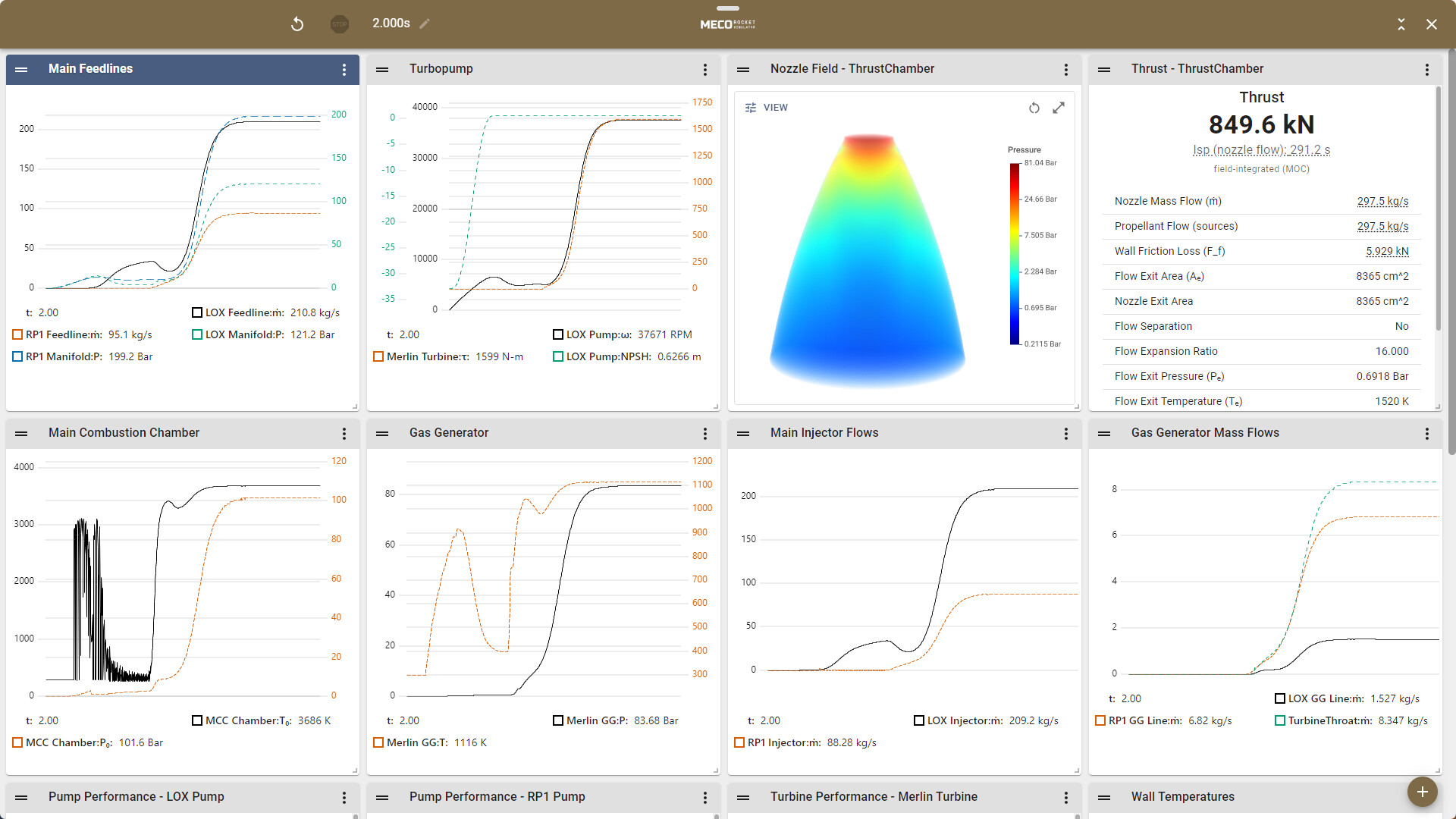


Design real rocket engines with real physics; learn by doing with interactive feedback. See hardware come to life in 3D as you enter the numbers. So serious, it comes with a research paper. Built solo. Want a story? You're an underpaid engineer at Mecodyne, building without regard for your safety.

Sign in to add this item to your wishlist, follow it, or mark it as ignored

Early Access Game

Get instant access and start playing; get involved with this game as it develops.

Note: Games in Early Access are not complete and may or may not change further. If you are not excited to play this game in its current state, then you should wait to see if the game progresses further in development. Learn more

Leaving Early Access: 2027

What the developers have to say:

Why Early Access?

“Meco is a deep, niche simulator, and the people who care about real engine internals are exactly who I want shaping it. Early Access lets that community steer which cycles, components, and missions come next.

I'm on a mission to get honest rocket engine simulation into the hands of everyone curious enough to want it. Your feedback in Early Access is how it gets deeper, faster.”

Approximately how long will this game be in Early Access?

“As long as it takes to do it justice. I'd estimate three years or more, and I ship updates regularly along the way, so you're buying into something that visibly moves, not a promise that sits still.”

How is the full version planned to differ from the Early Access version?

“The longer-term plan is to have the following features:
  • Tutorials and Missions (Chapters I to IV of V live)
  • 3D Engine Builder
  • Campaigns
  • Simulated Space Missions
  • Components for Expander Cycle and Staged Combustion Engines
  • Methods-Of-Characteristics Nozzle Designer

The above will likely evolve as the community chimes in on what rocks their world and what doesn't.

For the Simulated Space Missions, it will not be Kerbal-style grab the joystick/smash the keys seat of the pants execution. Key mission parameters will be planned before launch and followed.”

What is the current state of the Early Access version?

“It has the Core Simulation Loop, which features the following:
  • Rocket engine components sufficient to design most gas generator cycle cryogenic regeneratively cooled engines.
  • 2D Node Graph for assembling components into an engine.
  • Component Editor to view and edit component properties.
  • Simulated Engine Test Fire
  • Test Fire Data Interactive Graphs

For missions I have:
  • Mission 0: accidental first fire-up on Miku's workstation (onboarding)
  • Missions Chapter I (1 to 3): "Getting Started"
  • Missions Chapter II (4 to 6): "Feel The Pressure, Feed The Burn"
  • Missions Chapter III (7 to 9): "Spin Machines"
  • Missions Chapter IV (10 to 12): "Don't Break The Cycle"

The mission ladder now walks you end-to-end through building a complete gas generator cycle engine - from your first accidental fire-up to a full turbopump-fed engine with regenerative cooling, a gas generator, and an injector. And when you get stuck, in-mission diagnostic hints tell you what's off and point you at the fix - it's a guided path, not a blank canvas you're left to figure out alone.

Note:
  • This is an early, focused build.
  • I make quality software, but expect some rough edges, and I fix them fast.
  • Only the Gas Generator Cycle is currently supported, with the Expander Cycle coming next.

These are the components currently available in-game:
  • Liquid and Gas Channels, Pipes, and Ducts.
  • Fittings for Pipes and Ducts (Elbows, T-junctions, etc.)
  • Liquid and Gas Valves (Controlled by points set in time)
  • Supersonic Turbines
  • Radial Pumps
  • Transmission Gear Boxes
  • Electric Motor
  • Coaxial Shear Injector
  • Combustion Simulation for Hydrolox (Kerolox next)
  • Conduction of Heat from Gas to Metal to Liquid in Cooling Channels
  • Simple Expansion Ratio Nozzle Design

Not in yet (on the roadmap):
  • Missions Chapter V: "Building On The Past" (historic engine recreations)
  • Simulated Space Missions
  • Converging-Diverging Truncated Ideal Bell Nozzle and Rectangular Ideal Nozzle
  • Ignition - It is assumed that the oxidizer and fuel will ignite when they mix in the combustion chamber.
  • Fuel Tanks - The simulation is supplied with a never-ending supply of oxidizer or fuel at a set pressure.
  • Combustion Instability and Lag
  • 3D assembly of components
  • Failure due to thermal meltdowns and loads exceeding the limits of components.
  • Mass representation of most components - useful to get the thrust-to-weight ratio of an engine.

Will the game be priced differently during and after Early Access?

“The price will gradually increase as I add more advanced features.”

How are you planning on involving the Community in your development process?

“I develop Meco solo, so community feedback has a direct line to what gets built. I'm active on the Steam Discussions and Discord, reading every bug report and feature request, and I'll keep a public roadmap that's shaped by what players ask for most. Many of my players have real aerospace and rocketry experience, and that feedback is what keeps the simulation honest - so if you spot an inaccuracy or want a particular component supported, tell me.”
Read more

Buy Meco Rocket Simulator

SPECIAL PROMOTION! Offer ends September 10

-30%
$39.69
$27.78

Buy Meco Rocket Simulator - Pro Edition

Includes 2 items: Meco Rocket Simulator (Pro DLC), Meco Rocket Simulator

-5%
-30%
$79.70
$55.78
 
See all discussions

Report bugs and leave feedback for this game on the discussion boards

0.5 Out Now

COMPLETE ENGINE CYCLES.

Turbopumps. Gas Generators. Injectors.

Every component to build a cryogenic GG-cycle engine is taught.

Design. Test. Fail. Learn.

About This Game

Design. Test. Fail. Learn.


A realistic rocket engine sim you learn by doing. Every number you change answers back, on the live graphs and in the 3D hardware.


You're an underpaid engineer at Mecodyne, the kind of propulsion company that ships rockets aggressively and has opinions about your eyebrows. On your first day, you accidentally fire up a Vulcain 1 on your coworker's workstation. The graphs come alive. The Vulcain runs. You probably shouldn't be doing this.


From there, you design real rocket engines using actual physics: cold-gas thrusters, gas generators, full pump-fed turbopump beasts. Combustion. Fluid dynamics. Heat transfer. Component-level engineering. Twist an injector orifice, and the chamber pressure curve responds in real time. Tighten the cooling channels and watch the thermal margin shrink. Reshape the nozzle and see what it does to Isp.


It's a sim that won't lie to you about the numbers on the graph. Every node is inspectable. Every graph is live. The engine model behind it is described in a publicly available research paper , with a DOI and all, so you can check my work.

Three ways to play


Missions (start here)


Fourteen guided challenges, from "what's a model?" to recreating the Merlin 1D that flies Falcon 9. Senior engineer Miku Aoyama walks you through, deadpan, accurate, mostly patient. You don't need to arrive as an expert. Mission 0 starts you with that accidental engine fire-up on her workstation, and the missions build from there.


Free build


Skip the missions. Empty canvas, node-based editor, live graphs. Drop in components, wire them up, hit run, see what happens. Good for "what if I just…" experiments.


Recreate real engines


Same components, same physics. Build a Merlin 1D from scratch. Or an F-1. Or something that's never existed and probably shouldn't. Push materials, propellants, and geometry until something gives.

Key features


  • Mission Mode with real engineering challenges. Guided builds with senior engineer Miku Aoyama, from your first model to a complete gas-generator turbopump cycle.
  • Live performance graphs and samplers. Chamber pressure, thrust, Isp, and thermal margins update in real time, with pump and turbine performance curves you can sample as you tune.
  • 2D node-graph assembly. Drop in components, wire them together, and fire the engine on an open canvas.
  • Engine assemblies in 3D. Set the handful of numbers that define a Thrust Chamber or Turbopump and watch the hardware materialize: a real Rao bell nozzle contour, regenerative cooling channels, pump and turbine internals, rendered live.
  • See the flow, not just the hardware. The supersonic flow field through your bell, rendered as a 3D volume, graying out past the point where the flow separates. Thrust comes from integrating that field, not from a lookup table.
  • Staged startup sequences. Author every valve on a schedule: pumps spin up, valves crack open, the gas generator lights, in the order you set. Get the sequence right, and the engine runs nominal.
  • Real physics, no shortcuts. Combustion, fluid dynamics, and heat transfer through regenerative cooling channels, all solved in real time.
  • Recreate real engines. Build a Merlin 1D, an F-1, or a Vulcain 1 from the same components and physics.
  • Display Units. Read every output in the units you actually think in, from kN to bar, across charts, samplers, and mission text.

Pro Content (optional add-on)


Soundtrack, technical reference PDFs, 3D-printable component models (STL/3MF), and high-resolution wallpapers. For the people who want the lore in their toolbox.

What's new


  • 0.6: Engine assemblies. The Thrust Chamber builds a real Rao bell nozzle from five numbers, cooling channels and all, live in 3D; the Turbopump sizes its own shafts and gears. A brand new Mission 13: test-fire your own Merlin 1D. It also ships as a free-build template, yours to tinker with from the start. And undo/redo, everywhere in the editor.
  • 0.5: Mission 0, your accidental first day on Miku's workstation. Three new gas-generator cycle missions (Turbopump Integration, Gas Generator Genesis, Injector Insights). Display Units, so you can finally read pressure in bar instead of pascals.
  • 0.4: Real-time pump and turbine samplers with live performance curves. Auto-run on every edit. Pinned component editor with nudge buttons and mouse-wheel tweaking. Colorblind-safe chart colors (Okabe-Ito).

Early Access roadmap


Meco is in Early Access and playable today. The full core loop is here: design an engine, fire it, read the graphs, and iterate. I ship updates regularly. Here's what's already in, and what I'm building next.


Playable now:


  • Missions Chapters I to IV complete, and Chapter V (Legendary GG Engines) opened with Mission 13: recreate the Merlin 1D
  • Thrust Chamber and Turbopump assemblies with live 3D hardware, from the nozzle bell to the gear train
  • Staged startup: author every valve on a schedule
  • Thrust and engine Isp measurement, the numbers real datasheets quote

Building next:


  • The rest of Chapter V: A-7 Redstone and Vulcain 1 recreations
  • Expander-cycle components
  • Component mass, for thrust-to-weight numbers
  • Thermal and load stress limits
  • Historical campaigns

I intend to finish the roadmap in 2027. I build Meco solo, so every purchase directly funds the work, and if enough people who think as you do buy it, I can do this full-time. Your support genuinely makes the difference.


Dannie Sim

Solo Indie Dev, Meco Rocket Simulator (formerly at Activision/Blizzard on Candy Crush and Sony PlayStation on Spider-Man 2)

Heads up


This isn't a casual arcade game. It's a serious engineering sim with a real learning curve, and honestly, your first designs probably won't hit their targets. That's the point. In the missions, when a build misses, a "Need a hint?" diagnostic tells you what's off and walks you to the fix one item at a time: run the test at least once; your mixture ratio is still stoichiometric, so dial the gas-generator valve richer; that component name looks like a typo. In free build it's you and the graphs. Either way, you figure out which assumption was off, and try again.


If you've spent time curious about what actually goes on inside a running rocket engine, and why a 5% change in injector geometry can ruin your whole afternoon, Meco was built for you.


Come build something that works. Or something that doesn't, and work out why. Both are fine outcomes.

AI Generated Content Disclosure

The developers describe how their game uses AI Generated Content like this:

As a solo dev, I use custom-trained AI tools for a small portion of the visuals/audio, based on assets I own or created. The vast majority of my development effort goes into the realistic rocket simulation and engineering systems.

System Requirements

Windows
macOS
    Minimum:
    • Requires a 64-bit processor and operating system
    • OS: Windows 10
    • Memory: 4 GB RAM
    • DirectX: Version 10
    • Storage: 1 GB available space
    Recommended:
    • Requires a 64-bit processor and operating system
    • OS: Windows 11
    • Memory: 8 GB RAM
    • DirectX: Version 12
    • Storage: 2 GB available space
    Minimum:
    • OS: macOS 12
    • Processor: Apple M1 or Intel Core M
    • Memory: 4 GB RAM
    • Storage: 1 GB available space
    Recommended:
    • OS: macOS 15
    • Processor: Apple M4
    • Memory: 8 GB RAM
    • Storage: 2 GB available space
Review Filters