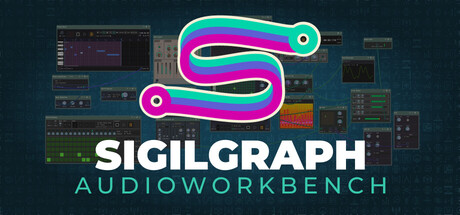

A modular non-linear DAW and sandbox for sound designers and generative musicians. Connect synthesizers, sample tools, MIDI modifiers, and modulation sources on a visual canvas with virtual cables. Break free from the traditional linear timeline to construct evolving, self-playing soundscapes.

Sign in to add this item to your wishlist, follow it, or mark it as ignored

Early Access Software

Get involved with this software as it develops.

Note: This Early Access software is not complete and may or may not change further. If you are not excited to use this software in its current state, then you should wait to see if it progresses further in development. Learn more

What the developers have to say:

Why Early Access?

“Sigilgraph is a highly modular, non-linear audio environment designed around node-graph workflows. Because audio synthesis and generative routing can lead to infinitely complex patching configurations, we believe the best way to evolve the software is alongside a community of experimental musicians, sound designers, and technical audio enthusiasts. Early Access allows us to test our core audio engine across a diverse array of user workflows, gather direct feedback on user interface intuition, and prioritize the development of new nodes based on what artists actually need to create.”

Approximately how long will this software be in Early Access?

“We plan to keep Sigilgraph in Early Access for approximately 6 to 12 months. This window gives us sufficient time to expand the node library, optimize performance, and ensure total stability before freezing the core API for a full 1.0 release. However, this timeline is flexible and may shift depending on community feedback and the scope of requested features.”

How is the full version planned to differ from the Early Access version?

“The full version of Sigilgraph is planned to feature a significantly expanded library of functional blocks, including more advanced DSP modules, specialized math nodes for generative sequencing, and deeper modulation utilities. We also plan to implement refined user interface features such as customizable keyboard shortcuts, enhanced graph navigation tools, and broader file format support for importing and exporting audio assets. Additionally, we hope to focus heavily on optimization to maximize the stability and density of massive node layouts. Since this app also interact with external devices, there is a limited amount of hardware we can use to test. Most modern devices built on standard should work but we can encounter an uncountable variety of such.

Currently it will not have Steam Cloud saves since it produces big files and uncompressed audio files that might overwhelm the Steam Cloud. We want to explore what is worthy of storing in the cloud ( maybe project metadata) by first allowing users to decide their own workflow knowing they need to mind that aspect themselves. So we plan to allow to some usable extent the steam cloud saves.

We are also planning on introducing remote session allowing two or more musicians to connect on a single session and do music together. This feature is one of the further away on the roadmap before improving the core app itself.”

What is the current state of the Early Access version?

“Sigilgraph is already fully functional, stable, and highly usable. The custom low-latency audio engine, node-graph patching architecture, and UI navigation framework are completely implemented. Users can currently build intricate, non-linear patches using a robust starting suite of foundational audio generators, modulators, and sequencing nodes. Full compositions can be done from A to Z. They can be rendered to WAV files and be used with other tools or published. ”

Will this software be priced differently during and after Early Access?

“We plan to gradually raise the price as we ship major content updates, add complex new features, and expand the utility of the tool. Joining during Early Access offers a lower entry point as a token of appreciation for supporting the software's initial development and actively shaping its future.”

How are you planning on involving the Community in your development process?

“We intend to treat our community as active collaborators in the workshop. We will be closely monitoring the Steam Discussion Forums to track bug reports, discuss UI ergonomics, and review user suggestions for new DSP or modulation modules. We also plan to share regular devlogs detailing our engineering progress, architectural optimization breakdowns, and roadmap updates, ensuring our users always know where the system is headed next.”
Read more
This game is not yet available on Steam

Planned Release Date: Q3 2026

Interested?
Add to your wishlist and get notified when it becomes available.
 
See all discussions

Report bugs and leave feedback for this software on the discussion boards

About This Software

Sigilgraph Audioworkbench: Break the Grid. Unbind Your Sound.

Sigilgraph Audioworkbench is a non-linear modular DAW built for sonic exploration, sound design, and generative music composition. Move beyond the linear timeline and construct interactive audio environments on an open, visual canvas. Connect audio generators, MIDI logic, and modulation sources with virtual patch cables to create self-playing soundscapes, evolving drones, or custom instruments.

True Generative Freedom

In Sigil, there is no global clock enforced. You aren't tied to a master BPM unless you choose to sync your instruments with a Global Transport device. This open structure enables true generative composition—allowing you to build self-playing patches and texturing soundscapes that live, breathe, and interact without being quantized to an artificial grid.

Features

  • Visual Cable-Based Patching: Connect audio signals, MIDI data, and control modulations dynamically on an infinite workspace canvas.

  • Patches Within Patches: Group complex modular graphs, package them into reusable Composite Devices, and build custom modular chains without workspace clutter.

  • Composer Mode: Bridge the gap between modular chaos and traditional organization. Arrange piano roll notes, draw precise automation curves, and trigger audio clips along an opt-in timeline.

  • The Generate-Capture-Reinvent Loop: Drop a Recorder/Player device anywhere in your signal chain to record samples on the fly, then immediately drop them back into a Slicer or Sampler to feed your generative machines.

  • Tactile Performance Mapping: Map any parameter in your graph to physical MIDI hardware with bipolar scaling and audio-rate slew limiting to eliminate "zipper noise" for smooth live sweeps.

A Rich Ecosystem of Devices

  • Audio & Sample-Based Tools: FM synthesizers, Wavetable generators, noise machines, sample recorders, drum machines, and audio-slicers.

  • MIDI & Note Logic: Piano rolls, scale quantizers, matrix arpeggiators, note delays, and chord devices.

  • Modulation & Control: LFOs, step sequencers, clock dividers, and envelope followers to drive your graph with its own audio.

  • Professional Audio FX: High-fidelity algorithmic reverbs, saturators, and spectral polishers to shape your sound.

System Requirements

Windows
macOS
SteamOS + Linux
    Minimum:
    • Requires a 64-bit processor and operating system
    • OS: Windows 10+ (64-bit)
    • Processor: 3.0 GHz Dual-Core (Intel Core i3 / AMD Ryzen 3)
    • Memory: 4 GB RAM
    • Graphics: Intel HD Graphics 6000
    • Storage: 300 MB available space
    • Sound Card: Stereo sound card (ASIO compatible recommended)
    • VR Support: No
    Recommended:
    • Requires a 64-bit processor and operating system
    • OS: Windows 10+ (64-bit)
    • Processor: 3.2 GHz Quad-Core or higher (Intel Core i5 / AMD Ryzen 5)
    • Memory: 8 MB RAM
    • Graphics: NVIDIA GeForce GTX 1050
    • Storage: 1 GB available space
    • Sound Card: ASIO compatible audio interface / sound card
    • VR Support: No
    Minimum:
    • Requires an Apple processor
    • OS: macOS 10.15 (Catalina) or later
    • Processor: Apple Silicon (M1 or newer) or Intel Core i5
    • Graphics: Metal-compatible integrated graphics
    • Storage: 250 MB available space
    • Sound Card: CoreAudio-compatible sound card or interface
    Recommended:
    • Requires an Apple processor
    • OS: macOS 11.0 (Big Sur) or later
    • Processor: Apple Silicon (M1 or newer) or Intel Core i7
    • Graphics: Metal-compatible dedicated graphics or M-series GPU
    • Storage: 500 MB available space
    • Sound Card: CoreAudio-compatible professional audio interface
    Minimum:
    • OS: Ubuntu 20.04 LTS / SteamOS 3.0+ (64-bit)
    • Processor: 3.0 GHz Dual-Core (Intel Core i3 / AMD Ryzen 3)
    • Memory: 4 GB RAM
    • Storage: 250 MB available space
    • Sound Card: ALSA / PulseAudio / PipeWire compatible sound card
    • VR Support: No
    Recommended:
    • OS: Ubuntu 22.04 LTS / SteamOS 3.0+ (64-bit)
    • Processor: 3.2 GHz Quad-Core or higher (Intel Core i5 / AMD Ryzen 5)
    • Memory: 8 GB RAM
    • Storage: 500 MB available space
    • Sound Card: JACK / PipeWire compatible professional audio interface
    • VR Support: No
There are no reviews for this product

You can write your own review for this product to share your experience with the community. Use the area above the purchase buttons on this page to write your review.

Review Filters