
此内容需要在 Steam 上拥有基础游戏 JR EAST Train Simulator 才能畅玩。

想要将此项目添加至您的愿望单、关注它或标记为已忽略,请先登录

不支持简体中文

本产品尚未对您目前所在的地区语言提供支持。在购买请先行确认目前所支持的语言。

DLC

此内容需要在 Steam 上拥有基础游戏 JR EAST Train Simulator 才能畅玩。

购买 JR EAST Train Simulator: Tobe Railway (Kita-kasukabe to Kita-senju,Shiki to Ikebukuro) 10030 Series


关于此内容

■TOBU SKYTREE Line

The “TOBU SKYTREE Line” is the nickname for a section of the 114.5 km-long Tobu Isesaki Line, specifically the segment between Asakusa Station in Taito Ward, Tokyo, and Tobu-dobutsu-koen Station in Miyashiro Town, Minami-Saitama District, Saitama Prefecture, as well as the branch line from Oshiage Station to Hikifune Station in Sumida Ward, Tokyo.The name “TOBU SKYTREE Line” has been in use since 2012 to commemorate the opening of the TOKYO SKYTREE. Although the line is connected to the Tobu Tojo Line via the Chichibu Railway, it operates as an independent line. It uses the TSP-type ATS (Automatic Train Stop) system for train protection.

This DLC features the upbound section (toward Asakusa) of the TOBU SKYTREE Line, covering the 29.7 km stretch from Kita-kasukabe Station to Kita-senju Station. The journey takes you through residential and commercial areas, then onto an elevated section that includes the longest quadruple-track section operated by any private railway in Japan. Along the way, enjoy distant views of the TOKYO SKYTREE and the impressive Arakawa River bridge before arriving at Kita-senju Station. Experience the vivid transition in scenery as you travel from the suburbs into the heart of the city.

※This simulation reproduces the 2022 operating timetable.

Highlights

Kita-Kasukabe Station
This station houses the Kasukabe Depot of the Minami-kurihashi Rolling Stock District, from which many trains are dispatched.
The track on the left is Sub-Platform 1, from which out-of-service trains depart.

Kita-kasukabe Station to Kasukabe Station
As the train departs, the scenery gradually changes from rural landscapes to more residential areas, signaling a shift from a suburban to a commuter railway.
After a left-hand curve, the train merges with the TOBU URABAN PARK Line, arriving at Kasukabe Station.

Kasukabe Station
This is one of Tobu Railway’s major stations, and on the right side is an inbound center track without a platform, where out-of-service trains wait to pass.
Note: Due to ongoing grade separation work, the station layout has changed. The scene described here can no longer be observed.

Kasukabe Station to Ichinowari Station
There is a storage track for the TOBU URBAN PARK Line on the right-hand side.
The line diverges from the TOBU URBAN PARK Line and curves to the right, passing over a grade-separated crossing with it.
After crossing this overpass, a straight track stretches for more than 6 kilometers.

Sengendai Station
After a long stretch of flat terrain, the track begins to undulate slightly before the station, requiring careful brake control.

□ Obukuro Station to Kita-koshigaya Station
At the end of the long straight section, a right-hand curve leads into an elevated section.
Here begins the longest quadruple-track section operated by a private railway in Japan.
The line features route indicator signals that show the upcoming route, and express signal lamps that flash when the train is entering the express track.
To the right near the station is a row of cherry blossom trees along the Moto-Arakawa Riverbank.

Kita-koshigaya Station
This was the first station on the TOBU SKYTREE Line to be equipped with platform screen doors.
There is a siding track, and many first trains of the day are scheduled from there.

Koshigaya Station / Soka Station
On the left you can see the express passing track where express trains and out-of-service trains pass.

Shin-koshigaya Station
To cross over the JR Musashino Line, the train climbs to a height of around 20 meters.

Shinden Station to Dokkyodaigakumae Station
The line crosses over the Tokyo Gaikan Expressway via a grade-separated junction.

Yatsuka Station to Takenotsuka Station
This section features a grade-separated crossing with National Route 4.

Takenotsuka Station
This area was under active grade separation construction at the time, with only the work on the turn-back track remaining.
Note: The construction has since been completed, and this scenery is no longer visible.

Takenotsuka Station to Nishi-arai Station
On the right-hand side is the Tokyo Metro Hibiya Line depot.
The left-hand curve before Nishi-arai is a popular photo spot among rail enthusiasts.
Just before arrival, the train merges with the Daishi Line.

Nishi-arai Station to Umejima Station
This section includes a crossover used during "TH Liner" operations to switch from the express to the local tracks.

Umejima Station
This station has a unique layout where the up and down platforms are arranged in tandem (one after the other).

Gotanno Station
On the left side, remnants of the former up platform from the double-track era can still be seen.

Gotanno Station to Kosuge Station
While navigating a right-hand curve, the Tokyo Skytree comes into view straight ahead.
This section also features a grade-separated crossing with the JR Jōban Line and Tokyo Metro Chiyoda Line.

Kosuge Station to Kita-senju Station
This section includes a long bridge over the Arakawa River.
To the right, you can see the bridges of the Tsukuba Express, JR Jōban Line, and Tokyo Metro Chiyoda Line.
After crossing the bridge, a branch track leads directly to the Tokyo Metro Hibiya Line, allowing through service from the local track.

Kita-senju Station
One of the key stations on the TOBU SKYTREE Line, Kita-senju serves as the starting point of the Tobu Isesaki Line, marked by the 0-kilometer post.
The station has a three-story structure:

·       1st floor: TOBU SKYTREE Line

·       3rd floor: Tokyo Metro Hibiya Line

Route Information

Section: TOBU SKYTREE Line Inbound Kita-kasukabe⇒Kita-senju

Total length: 29.7km

Number of Stations: 20

Security equipment: TSP type ATS

Train schedules that can be operated

Train Number:2524

Type/Destination: Section Express to Asakusa(weekday)

Section where you can drive: Kasukabe(08:09)→Kita-senju(08:43)

Type of train: Series 10030 6 cars

Responsible for real voice train announcements:Tobu Railway Transportation Department

Train Number:2604

Type/Destination: Section Express to Asakusa(weekday)

Section where you can drive: Kasukabe(08:52)→Kita-senju(09:23)

Type of train: Series 10030 6 cars

Responsible for real voice train announcements:Tobu Railway Transportation Department

Train Number:3502

Type/Destination: Section Semi Express to Asakusa(holiday)

Section where you can drive: Kita-kasukabe(09:21)→Kita-senju(09:59)

Type of train: Series 10030 6 cars

Responsible for real voice train announcements:Tobu Railway Transportation Department

Train Number:5802(fiction)

Type/Destination: (Special Train)Not In Service to Kita-senju(weekday)

Section where you can drive: Kita-kasukabe(09:30)→Kita-senju(10:06)

Type of train: Series 10030 6 cars

Responsible for real voice train announcements:None

■Tobu Tojo Line

The Tobu Tojo Line is a 75 km railway that runs from Ikebukuro Station in Toshima Ward, Tokyo, to Yorii Station in Yorii Town, Osato District, Saitama Prefecture, near the Chichibu region. Its official name is the “Tojo Main Line,” but it is commonly referred to as the “Tojo Line.” As a major commuter route starting from Ikebukuro, the line plays a key role in supporting heavy passenger traffic, particularly for work and school commutes. Although the Tobu Skytree Line is physically connected to the Tobu Tojo Line via the Chichibu Railway, it operates as an independent service system. It is equipped with the T-DATC (Tobu-type Automatic Train Control) safety system.

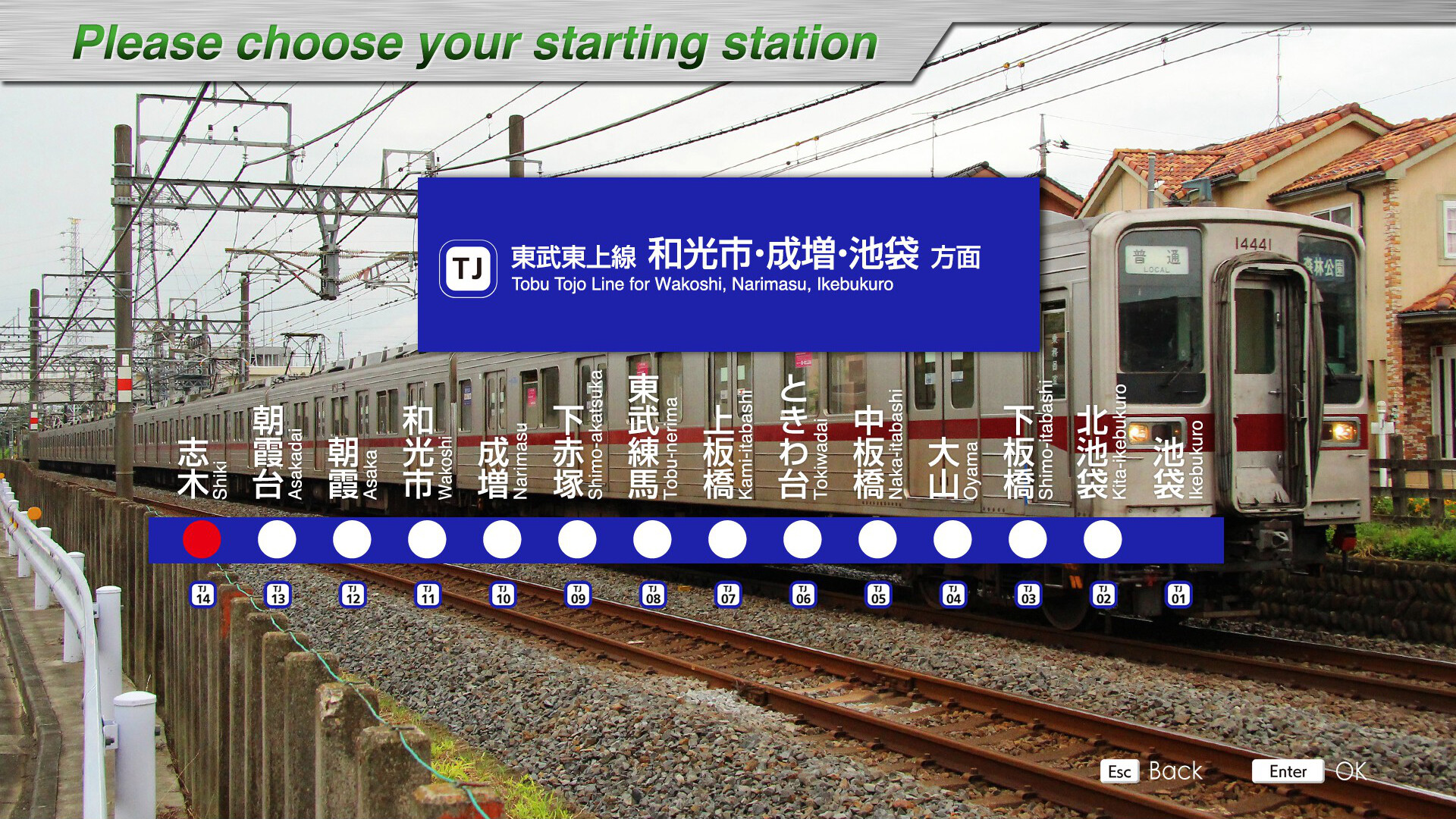
This DLC features the upbound section (toward Ikebukuro) of the Tojo Line, covering the 17.8 km stretch between Shiki Station and Ikebukuro Station. The Tojo Line offers multiple types of train services, and in this DLC, you can choose from four different train types. Enjoy the dynamic change in scenery—from peaceful suburban neighborhoods to the dense urban landscape of central Ikebukuro—as you experience the distinctive character of the Tojo Line.

※This simulation reproduces the 2022 operating timetable. Please note that current  schedules and stopping stations may differ, even for trains of the same category.

Highlights

Shiki Station
This is the starting point of the 5.3 km quadruple-track section on the Tojo Line.
While the TOBU SKYTREE Line refers to its four-track layout as "express/local tracks," the Tojo Line calls them outer and inner tracks—serving the same function but using different terminology.

Shiki Station to Asakadai Station
Immediately after departing Shiki, there is a scissors crossing, allowing trains to switch between the outer and inner tracks.

Asakadai Station
This station provides transfers to the JR Musashino Line, and the two lines cross each other via a grade-separated junction.

Asaka Station to Wakōshi Station
Shortly after leaving Asaka, the train enters a left-hand curve.
After exiting the curve, a track from the Tokyo Metro depot merges from the right, crossing over the down track and leading into Wakoshi Station.
Just before Wakoshi, another scissors crossing allows for direct access from the outer tracks to the Tokyo Metro Yurakucho and Fukutoshin Lines.

Wakoshi Station
A key station on the Tojo Line, served by both the Tokyo Metro Yurakuchō Line and the Fukutoshin Line.

Wakoshi Station to Narimasu Station
After passing over the grade-separated intersection with the Tokyo Metro Yurakuchō Line and Fukutoshin Line, the tracks run almost parallel to them up to around Narimasu Station.
This section features a rare track layout with a turn-back track next to the down line.

Narimasu Station
A station with a unique layout, where the main line runs through the diverging side of the switch point—an unusual configuration in railway design.

Narimasu Station onward
This section runs through a residential area and has a relatively high number of level crossings for a line within Tokyo.

Shimo-akatsuka Station to Tobu-nerima Station
The train passes over National Route 17 via an overpass.

Kami-itabashi Station
As of the timetable revision on March 18, 2023, Kami-itabashi is now a stop for semi-express (“Junkyū”) trains.

Tokiwadai Station
The station features a reconstructed building that replicates its original historical appearance.

Tokiwadai Station to Nakaitabashi Station
This section has the shortest distance between stations on the Tojo Line—only about 700 meters.
It passes over Tokyo’s Loop Route 7 (Kan-nana Dori).

□ Oyama Station
Just before entering the station, to the right of the level crossing, lies the Happy Road Shopping Street, one of the most well-known arcades in Itabashi, stretching for about 500 meters.

□ Oyama Station to Shimo-itabashi Station
The train passes under the Metropolitan Expressway No. 5 (Ikebukuro Route).
On the right-hand side, there are seven storage tracks.
This is also where you will find the zero-kilometer post, marking the starting point of the Tojo Line.

Kita-ikebukuro Station
After a right-hand curve, the train arrives at Kita-ikebukuro.
From here to Ikebukuro Station, the line runs parallel to the JR Saikyō Line.

Kita-ikebukuro Station to Ikebukuro Station
After departing Kita-ikebukuro, JR East’s storage yard can be seen on the left-hand side.

Ikebukuro Station
This is the busiest station on the Tobu Railway network in terms of daily passenger usage.
When a train arrives, one side of the doors opens first for passengers to disembark, and then after a short interval, the opposite side opens.
This dual-side door opening is a rare feature on Tobu lines and is characteristic of trains stopping at Ikebukuro Station.

Route Information

Section: Tobu Tojo Line Inbound Shiki⇒Ikebukuro

Total length:17.8km

Number of Stations: 14

Security equipment: T-DATC(Tobu-type Automatic Train Control)

Train schedules that can be operated

Train Number:300

Type/Destination: Local train to Ikebukuro(weekday)

Section where you can drive: Shiki(05:21)→Ikebukuro(05:48)

Type of train: Series 10030 10 cars

Responsible for real voice train announcements:Tobu Railway Transportation Department

Train Number:3214

Type/Destination: Semi Express to Ikebukuro(weekday)

Section where you can drive: Shiki(07:30)→Ikebukuro(07:55)

Type of train: Series 10030 10 cars

Responsible for real voice train announcements:Tobu Railway Transportation Department

Train Number:54

Type/Destination: Rapid Express to Ikebukuro(weekday)

Section where you can drive: Shiki(10:42)→Ikebukuro(10:59)

Type of train: Series 10030 10 cars

Responsible for real voice train announcements:Tobu Railway Transportation Department

Train Number:1032

Type/Destination: Express to Ikebukuro(weekday)

Section where you can drive: Shiki(12:31)→Ikebukuro(12:51)

Type of train: Series 10030 10 cars

Responsible for real voice train announcements:Tobu Railway Transportation Department

系统需求

    最低配置:
    • 需要 64 位处理器和操作系统
    • 操作系统: 64-bit Windows 11
    • 处理器: Intel Core i5-8500 or AMD Ryzen 5 2600
    • 内存: 16 GB RAM
    • 显卡: NVIDIA GeForce GTX 1060 (VRAM 6GB)
    • DirectX 版本: 12
    • 存储空间: 需要 15 GB 可用空间
    • 附注事项: need resolution 1920×1080@60Hz
    推荐配置:
    • 需要 64 位处理器和操作系统
    • 操作系统: 64-bit Windows 11
    • 处理器: Intel Core i5 12400 or AMD Ryzen 5 5500
    • 内存: 16 GB RAM
    • 显卡: NVIDIA GeForce RTX 3060 (VRAM 8GB)
    • DirectX 版本: 12
    • 存储空间: 需要 15 GB 可用空间
    • 附注事项: Recommended SSD

JR EAST Train Simulator: Tobu Railway (Kita-kasukabe to Kita-senju,Shiki to Ikebukuro) 10030 Series 的顾客评测 关于用户评测 您的偏好

总体评测:
好评 (19 篇评测)


要查看某个日期范围内的评测,请在上方图表中点击并拖动选定的范围或是点击某特定时间柱。


按选择的显示顺序显示评测


了解更多
筛选条件
排除跑题评测活动
游戏时间:
大部分在 Steam Deck 上
Operating System:
CPU:
GPU:
Device Type:
加载评测中…